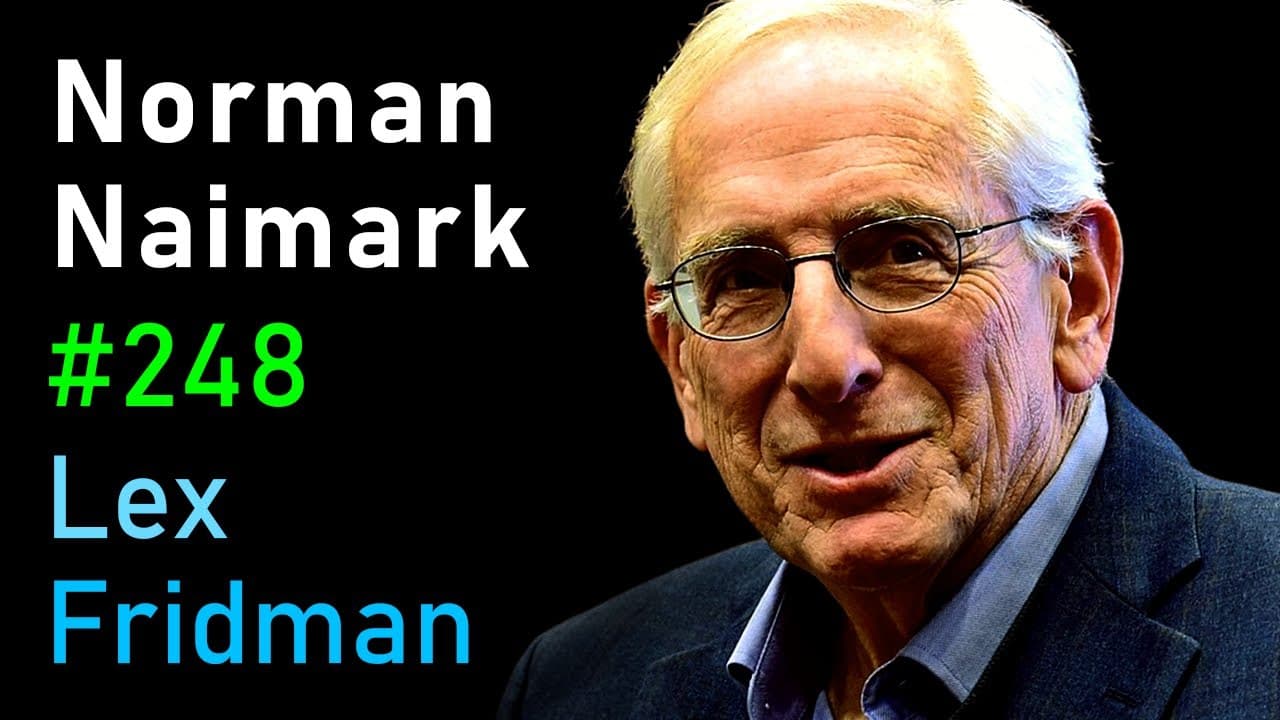
Norman Naimark on Stalin and Absolute Power
TL;DR
Stalin combined ideological conviction, extreme political competence, and a paranoid delusional system with nearly unchecked power. Norman Naimark argues that mass killing was not clearly inevitable from Stalin's youth or early career, but emerged through political contingencies, his consolidation of power, destructive policies, personal crises, and a Soviet system whose institutions and officials enabled terror.
Transcript
The following is a conversation with Norman Naimark, a historian at Stanford specializing in genocide, war, and empire. This is the Lex Fridman Podcast. To support it, please check out our sponsors in the description. And now, here's my conversation with Norman Naimark. Did Stalin believe that communism is good, not just for him, but for the people... Read More
Key Insights
- Stalin was a committed Leninist who believed socialism represented humanity's future. He thought it served both the Soviet Union and the wider world, and he expected an international socialist revolution eventually to occur.
- Stalin was morally culpable because he ordered unnecessary eliminations, authorized torture, and remained indifferent to the suffering of millions. Naimark therefore considers the term evil appropriate, despite historians' general reluctance to use language associated with moral philosophy.
- Stalin's paranoia operated as a delusional system rather than ordinary personal suspicion. He imagined extensive groups and coordinated plots seeking to weaken his authority, remove him from office, or undermine the Soviet Union, then destroyed entire groups on that basis.
- Stalin was highly competent in administration and politics. Research from his archive portrays him as intelligent, enormously hardworking, rhetorically skilled, politically acute, and intensely involved in details, although he still made mistakes during the 1920s, 1930s, and the war.
- Stalin's rise was shaped by political contingency rather than obvious destiny. He was not Lenin's most likely successor, but he successfully used bureaucratic and political maneuvering during the 1920s to defeat rivals and accumulate control.
- Absolute power enabled Stalin's murderous development by removing checks and balances. After achieving complete power in the early 1930s, he could translate ideological goals, suspicions, and political reversals into destructive state action supported by officials in the NKVD and elsewhere.
- Stalin's manipulation relied partly on language and social pressure. Transcripts of early 1930s Politburo meetings show him using humor, sarcasm, and verbal attacks to undermine colleagues, control their conduct, and strengthen the system of terror forming around him.
- Stalin's descent into large-scale killing accelerated when several developments converged in 1932 and 1933. Naimark identifies collectivization, the five-year plan, reversed nationality policies, the Ukrainian famine, Kirov's murder, and Stalin's wife's suicide as parts of an increasingly dangerous situation.
Install to Summarize YouTube Videos and Get Transcripts
Explore YouTube Video Summarizer or Get YouTube Transcript Extractor
Questions & Answers
Q: Did Stalin genuinely believe communism was beneficial?
Stalin genuinely believed socialism was the highest form of human social organization and served the interests of both the Soviet Union and the world. Norman Naimark describes him as a true Leninist who expected the world eventually to become socialist through international revolution. That conviction did not exclude other motives, beliefs, or actions, including his pursuit of personal power and use of mass violence.
Q: Was Stalin evil, delusional, or incompetent?
Norman Naimark characterizes Stalin as evil and delusional, but not incompetent. Stalin eliminated people unnecessarily, had people tortured, and showed complete indifference to the suffering of millions. He also constructed elaborate imagined plots against himself and the Soviet Union. At the same time, archival evidence presents him as intelligent, hardworking, politically perceptive, rhetorically effective, and highly capable of administering and manipulating a political system.
Q: What was Stalin's paranoid delusional system?
Stalin's paranoid delusional system was more extensive than ordinary fear that an individual opponent might attack him. He constructed whole networks and plots involving groups supposedly trying to diminish his power, remove him from leadership, or undermine the Soviet Union. These imagined conspiracies had enormous consequences because Stalin used them to justify state actions that destroyed entire groups of people.
Q: How did Stalin use political manipulation to control others?
Stalin controlled colleagues through sophisticated political and verbal manipulation. Transcripts of Politburo meetings from the early 1930s show him using humor, sarcasm, and other rhetorical methods to undermine people and direct their behavior. He paired those interpersonal skills with bureaucratic maneuvering, hard work, detailed oversight, and a sharp understanding of politics, helping him dominate the Politburo and construct a broader system of terror.
Q: Did absolute power corrupt Stalin or reveal his nature?
Naimark argues that Stalin's mass killing cannot simply be treated as an inborn quality waiting to emerge. Without his political position and power, he could not have murdered individuals and groups on such a scale. His development within the Soviet system, his attainment of complete power, the absence of checks and balances, and support from officials all helped turn existing dictatorial characteristics into systematic terror.
Q: Was Stalin destined to become a mass murderer?
Stalin was not clearly destined to become a mass murderer. Naimark says that someone observing him in 1925 would not necessarily have predicted his later crimes, and Stalin himself probably would not have done so. Although research on the Civil War reveals earlier murderous and dictatorial traits, those characteristics were not a necessary stage leading inevitably to genocide. Political contingencies and institutional power remained crucial.
Q: When did Stalin's progression toward mass killing accelerate?
Naimark places the decisive acceleration in the early 1930s, after Stalin had gained complete power and control over the Politburo. The five-year plan, collectivization, and the reversal of policies allowing nationalities to develop their cultures and internal politics changed the political environment. The Ukrainian famine in 1932 and 1933, Kirov's murder, and Stalin's wife's suicide also contributed to an increasingly dangerous situation.
Q: Why does Naimark consider Stalin highly competent?
Archival research depicts Stalin as enormously hardworking, intelligent, politically acute, and skilled in agitational rhetoric and editing. He worked from morning until night, micromanaged many areas, and believed he should understand everything. One archival folder even shows him reviewing Georgian wine production, specifying quantities and judging grapes. His competence was broad, although he still made mistakes during the 1920s, 1930s, and the war.
Summary & Key Takeaways
-
Norman Naimark describes Stalin as a committed Leninist who believed socialism served the Soviet Union and humanity. That ideological conviction coexisted with cruelty, indifference to mass suffering, and delusions about organized enemies. Stalin's beliefs therefore cannot be separated from the coercive methods he used to protect power and transform society.
-
Naimark rejects the idea that Stalin was incompetent. Archival research depicts an intelligent, hardworking micromanager with sharp political instincts, rhetorical ability, and editorial skill. He mastered bureaucratic maneuvering and interpersonal manipulation, using humor and sarcasm to weaken colleagues and control behavior within the Politburo and the wider Soviet political system.
-
Stalin's progression toward mass killing was not predetermined by an unusually brutal childhood or an obvious murderous destiny. Naimark places the decisive transformation in the early 1930s, after Stalin secured complete power, imposed collectivization and the five-year plan, reversed nationality policies, and faced the Ukrainian famine, Kirov's murder, and his wife's suicide.
Read in Other Languages (beta)
Share This Summary 📚
Summarize YouTube Videos and Get Video Transcripts with 1-Click
Try YouTube Summary with ChatGPT & Claude or YouTube Transcript Generator
Explore More Summaries from Lex Fridman 📚

Summarize YouTube Videos and Get Video Transcripts with 1-Click
Try YouTube Summary with ChatGPT & Claude or YouTube Transcript Generator