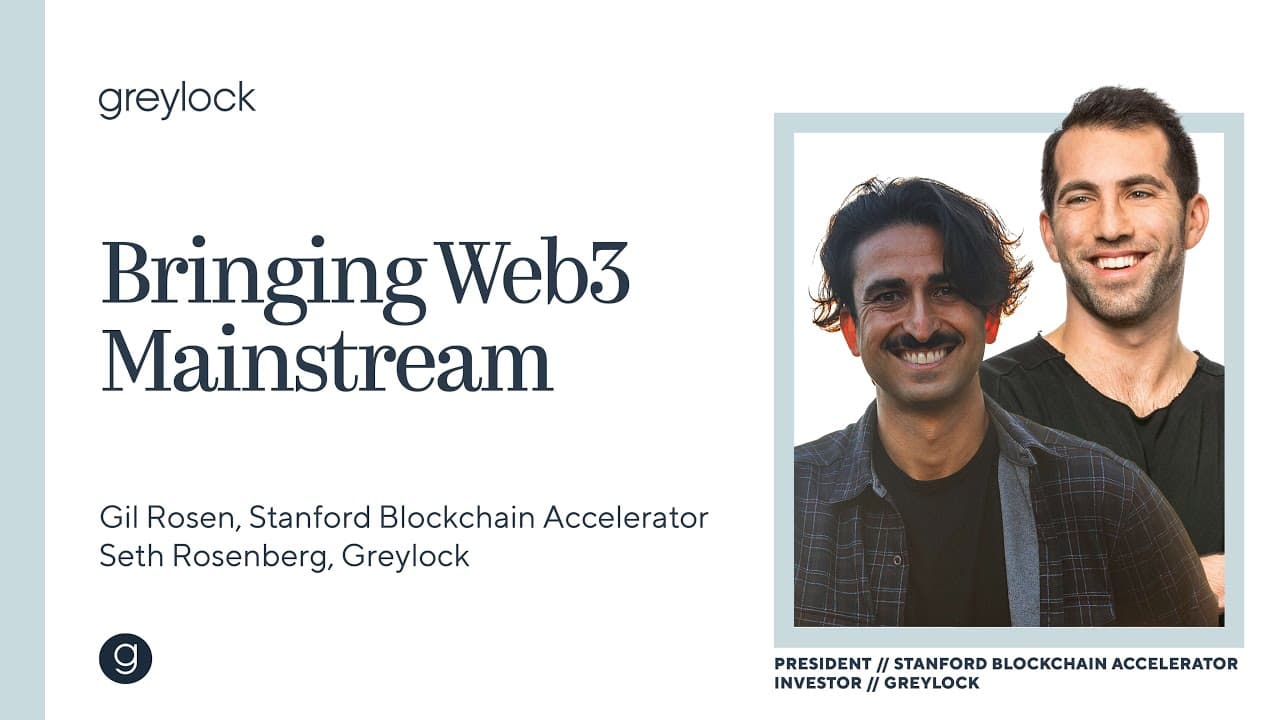
Seth Rosenberg and Stanford's Gil Rosen | Bringing Web3 Mainstream
TL;DR
DeFi has the potential to mainstream Web3 by enabling real-time asset verification and control, making lending more efficient and accessible. Key opportunities lie in tokenizing public equities, which can unlock transparency and efficiency in financial markets. Regulatory clarity and the integration of off-chain data are crucial for broader adoption and effective risk assessment.
Transcript
foreign blockchain accelerator um quick two second background on me as uh around a couple companies that in the data and analytics space before switching to investing uh was at GSB and now doing a degree in policy and running the accelerator uh for those of you interested the accelerator incubates uh teams from the Stanford ecosystem either current... Read More
Key Insights
- ♿ Tokenizing public equities can bring transparency, accessibility, and efficiency to the financial markets.
- ⌛ DeFi lending has the potential to revolutionize traditional lending by utilizing real-time asset verification and control.
- 🔒 Privacy is a critical aspect in financial transactions, and blockchain technology can provide solutions for secure and private transactions.
Install to Summarize YouTube Videos and Get Transcripts
Explore YouTube Video Summarizer or Get YouTube Transcript Extractor
Questions & Answers
Q: How can tokenization of public equities benefit the DeFi space?
Tokenizing public equities can enable 24/7 trading, global access, instant settlement, and more accessible margin lending, opening up a range of financial opportunities for individuals.
Q: What are the challenges in bringing real-world assets on-chain?
Tokenizing physical assets like homes or cars is operationally complex with issues such as value assessment and regulatory complications. Tokenizing public equities is simpler as they are digitally custody and have agreed-upon prices.
Q: How can DeFi address the need for privacy in financial transactions?
DeFi provides an opportunity to improve privacy in B2B payments, where real-time asset verification and control allow for more secure and efficient transactions without revealing sensitive financial information.
Q: What are the key infrastructure challenges in the DeFi space?
Infrastructure challenges include scaling solutions, data availability, and privacy. Improving these aspects can enhance performance, reduce costs, and increase reliability, leading to greater adoption of DeFi applications.
Summary
In this video, Seth Rosenberg from Greylock discusses the opportunities for decentralized finance (DeFi) and how to bring it mainstream. He talks about the gaps in the current financial system and the potential of blockchain technology to solve them. He also explores the possibilities of tokenizing different assets, like equities and accounts receivable, and the challenges that need to be addressed in order to make non-collateralized lending and credit-based lending a reality. Finally, he touches on the importance of infrastructure and oracles in achieving mass adoption of DeFi.
Questions & Answers
Q: What is the background of most people participating in the call?
The participants are a mix of early-stage founders, people interested in starting a company, and students from the web three entrepreneurship class at Stanford.
Q: How did Seth Rosenberg get into crypto and web three?
Seth has been at Greylock for about six years, focusing on early-stage crypto and fintech investments. He gradually became more interested in crypto as he saw its potential through his personal experiences as a user, consumer, and investor. Over time, he realized that crypto offered unique value propositions and decided to focus on it as one of his primary investment areas.
Q: What are the challenges in the current financial system that present opportunities for DeFi?
One major challenge in the traditional financial system is the lack of interoperability and inefficiency in moving assets between different databases. This results in slow settlement times and high fees, particularly for international remittance payments. By leveraging blockchain technology, DeFi can enable fast and low-cost value transfers globally, providing greater access and economic opportunity for people outside the US.
Q: Why haven't existing payment platforms like Circle and Revolut been adopted at a mass scale?
While platforms like Circle and Revolut have made strides in solving international payment challenges, there are still limitations. These platforms primarily work within their own closed ecosystems, and their APIs are typically read-only, lacking the ability to execute smart contracts or assign control over assets. Additionally, the integration of real-time price feeds and regulatory clarity are still needed to achieve wider adoption of these platforms.
Q: What other gaps in the traditional financial system can DeFi solve?
Another major gap that DeFi can address is lending. Traditional lending is often collateralized or based on the borrower's financial statements. DeFi lending, on the other hand, offers the ability to verify assets in real-time using software and assign control over those assets using smart contracts. This can make lending more efficient, reduce fraud, lower operational costs, and enable new forms of lending such as margin lending for lower cost personal loans.
Q: How can more off-chain assets be brought on-chain to make DeFi more accessible?
Tokenizing assets is a potential solution, but there are challenges to consider. Tokenizing physical assets like homes and cars introduces operational and regulatory complications. Instead, tokenizing public equities is a simpler starting point since their value is already digitally custodied and can be represented on-chain through APIs and oracles. Tokenizing equities can enable 24/7 trading, global access, instant settlement, and more accessible margin lending, making personal finance more programmable and offering new opportunities to diversify risk.
Q: Why hasn't tokenizing equities been widely adopted yet?
There are still regulatory challenges and a lack of utility in the early stages. Regulatory clarity is needed to ensure compliance and consumer protection. Some also consider the benefits of tokenizing equities to be only incremental. However, decentralizing finance and making it more accessible and programmable has transformative potential, similar to stablecoins, which have become a major use case in DeFi.
Q: What are some potential use cases for tokenized equities?
Tokenizing equities can enable 24/7 trading, global access, instant settlement, and margin lending. It can open up new possibilities for individuals to diversify their risk, such as taking out margin loans, using cashless callers, or participating in index swaps. This programmable nature of finance can bring financial innovations to a broader audience that were previously only accessible to the wealthy.
Q: How can credit-based lending be facilitated in a DeFi space?
Non-collateralized or credit-based lending in DeFi requires connecting real-world assets, income, and identity to a wallet address, as well as establishing identity permanence. The ability to verify a borrower's creditworthiness using oracles and zero-knowledge proofs can eliminate the need for traditional credit bureaus. While credit bureaus may still play a role in the near term, there are opportunities to build on-chain credit scores and incentive systems that reward borrowers for opting into identity verification with lower loan rates.
Q: Who is doing interesting work in the space of on-chain credit scores and identity verification?
Some companies mentioned include Spectral Finance, which focuses on on-chain credit scores based on wallet data, and Merlin, which provides block explorer analytics for understanding wallet activity. Additionally, projects like Polygon ID and Seelion are working on zero-knowledge proof concepts for privacy and identity solutions. Although it is still early, there is potential for more entrepreneurs to contribute to this space.
Q: What are the infrastructure challenges in achieving mass adoption of DeFi?
One major infrastructure challenge is bringing off-chain data onto the blockchain. Secure and reliable oracles are needed to provide real-time information, such as income, bank statements, and credit scores, to enable lending and credit-based services. Additionally, scalability and transaction throughput need to be addressed for DeFi applications to handle increased user demand. Further research is necessary to optimize infrastructure for the seamless integration of traditional finance and DeFi.
Takeaways
The opportunities for DeFi lie in solving the gaps in the existing financial system, such as inefficient cross-border payments and limited access to lending. Tokenizing assets like equities can bring 24/7 trading and increased liquidity. Non-collateralized lending and credit-based lending require on-chain identity verification and credit scoring systems. Infrastructure challenges include secure oracles and scalable blockchain networks. While regulatory clarity and utility need to be addressed, the programmable nature of DeFi has the potential to revolutionize mainstream finance.
Summary & Key Takeaways
-
Seth Rosenberg, an investor at Greylock, shares his background and journey into crypto and discusses the potential of DeFi.
-
He emphasizes the need to bring more assets on-chain, particularly tokenizing public equities, to unlock the benefits of DeFi.
-
Rosenberg sees opportunities in lending, highlighting the advantages of real-time asset verification and control using software, which can make lending more efficient and accessible.
-
He also discusses the importance of privacy in financial transactions and the potential of blockchain technology to improve international B2B payments.
Read in Other Languages (beta)
Share This Summary 📚
Summarize YouTube Videos and Get Video Transcripts with 1-Click
Try YouTube Summary with ChatGPT & Claude or YouTube Transcript Generator
Explore More Summaries from Greylock 📚





Summarize YouTube Videos and Get Video Transcripts with 1-Click
Try YouTube Summary with ChatGPT & Claude or YouTube Transcript Generator