How Humans Choose and Maintain Romantic Partners
TL;DR
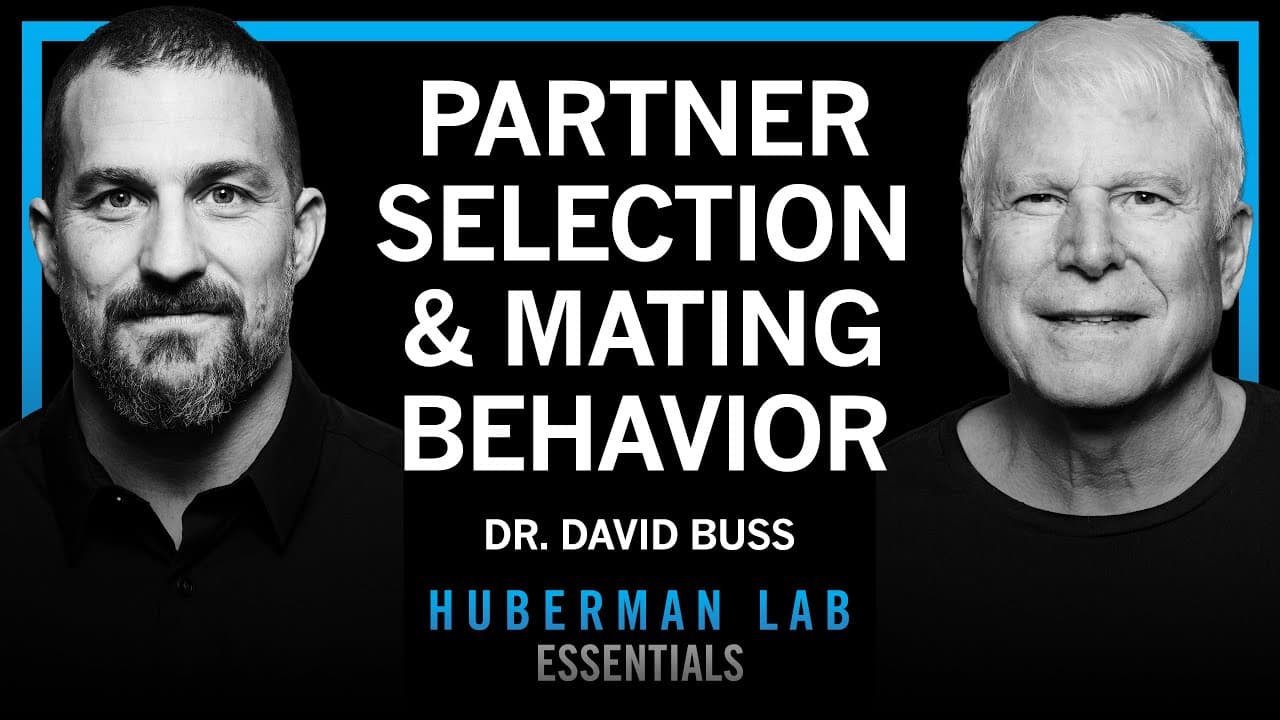
Humans select mates based on a combination of universal traits and sex-specific preferences. Long-term relationships often prioritize intelligence, kindness, and emotional stability, while short-term selections may focus on physical attractiveness and risk-taking traits. Evolutionary psychology explains these behaviors through concepts like sexual selection, mate value, and jealousy, revealing both adaptive strategies and potential conflicts in human mating dynamics.
Transcript
Welcome to Huberman Lab Essentials, where we revisit past episodes for the most potent and actionable science-based tools for mental health, physical health, and performance. I'm Andrew Huberman and I'm a professor of neurobiology and opthalmology at Stanford School of Medicine. And now my conversation with Dr. David Bus. Well, David, delighted to ... Read More
Key Insights
- Mate selection is influenced by universal traits such as intelligence, kindness, and emotional stability, desired by both sexes in long-term partners.
- Sexual selection theory explains that traits providing mating advantages, not just survival benefits, are favored in evolution.
- Women tend to value resource acquisition, ambition, and older age in long-term partners, reflecting evolutionary pressures related to reproduction.
- Men prioritize physical attractiveness in partners, which signals health and fertility, though often subconsciously.
- Deception in mate selection is common, with individuals exaggerating traits that align with the preferences of potential partners.
- Jealousy functions as a mate-guarding mechanism, activated by perceived threats like infidelity or mate value discrepancies.
- The dark triad traits in individuals can lead to manipulation and deception in mating contexts, often correlating with short-term mating strategies.
- Stalking often arises from a perceived mate value discrepancy and can sometimes deter new partners or even result in reconciliation.
Install to Summarize YouTube Videos and Get Transcripts
Explore YouTube Video Summarizer or Get YouTube Transcript Extractor
Questions & Answers
Q: How do humans select mates for long-term relationships?
In long-term relationships, humans tend to select mates based on universal traits such as intelligence, kindness, and emotional stability. Both men and women value these qualities, although women may place additional emphasis on resource acquisition and ambition due to evolutionary pressures related to reproduction. Men often prioritize physical attractiveness, which signals health and fertility.
Q: What is the role of sexual selection in mate choice?
Sexual selection theory explains that certain traits are favored in evolution because they provide mating advantages, not just survival benefits. This includes intra-sexual competition, where traits that help individuals compete with the same sex are favored, and preferential mate choice, where traits desired by the opposite sex increase mating success. These processes shape human mate selection behaviors.
Q: Why is deception common in mate selection?
Deception is common in mate selection because individuals often attempt to embody traits that align with the preferences of potential partners. This may involve exaggerating qualities such as resource acquisition ability or physical attractiveness. Online dating amplifies this tendency, with individuals presenting idealized versions of themselves to attract mates, leading to mismatches between expectations and reality.
Q: How does jealousy function in relationships?
Jealousy functions as an evolved emotion that serves to protect and preserve investment in long-term mateships. It acts as a mate-guarding mechanism, activated by perceived threats such as infidelity or mate poachers. Jealousy motivates individuals to be vigilant and protective of their relationships, helping to maintain pair bonds and deter potential rivals, although it can also lead to conflict.
Q: What are the dark triad traits and their impact on mating?
The dark triad consists of narcissism, Machiavellianism, and psychopathy, traits that can lead to manipulative and deceitful behaviors in mating contexts. Individuals high in these traits often pursue short-term mating strategies, using charm and deception to attract partners. They are more likely to engage in sexual harassment and coercion, making them particularly problematic in romantic relationships.
Q: Why does stalking occur, and what are its outcomes?
Stalking often occurs due to a perceived mate value discrepancy, where the stalker believes they cannot replace their former partner with someone of equivalent value. It serves as a desperate attempt to maintain or regain a relationship. Stalking can deter new partners and may sometimes result in reconciliation, although it is more often a source of distress and conflict for the victim.
Q: How does mate value influence relationship dynamics?
Mate value influences relationship dynamics by affecting individuals' self-esteem and perceptions of their partners. People assess mate value based on traits like status, attractiveness, and compatibility. Discrepancies in mate value can lead to jealousy and relationship instability. Individuals with higher mate value have more options in the mating market, which can impact their commitment and behavior in relationships.
Q: What is the connection between evolutionary psychology and neuroscience?
Evolutionary psychology and neuroscience are increasingly intersecting fields, with evolutionary psychology providing insights into the adaptive functions of behaviors and neuroscience exploring the underlying mechanisms. Together, they offer a comprehensive understanding of human behavior, including mating strategies, by examining both the evolutionary pressures that shaped these behaviors and the brain processes that implement them.
Summary & Key Takeaways
-
Mate selection involves both universal desires and sex-specific preferences. Intelligence, kindness, and emotional stability are universally valued in long-term partners. Women often prioritize resource acquisition, ambition, and slightly older age, while men focus on physical attractiveness, signaling health and fertility.
-
Sexual selection theory highlights traits that provide mating advantages, not just survival benefits. Deception is common in mate selection, with individuals often exaggerating traits to align with potential partners' preferences. Jealousy serves as a mate-guarding mechanism, activated by threats like infidelity.
-
The dark triad traits can lead to manipulation in mating contexts, often correlating with short-term strategies. Stalking, often resulting from perceived mate value discrepancies, can deter new partners or lead to reconciliation. Understanding these dynamics offers insight into human mating behavior.
Read in Other Languages (beta)
Share This Summary 📚
Summarize YouTube Videos and Get Video Transcripts with 1-Click
Try YouTube Summary with ChatGPT & Claude or YouTube Transcript Generator
Explore More Summaries from Andrew Huberman 📚




Summarize YouTube Videos and Get Video Transcripts with 1-Click
Try YouTube Summary with ChatGPT & Claude or YouTube Transcript Generator