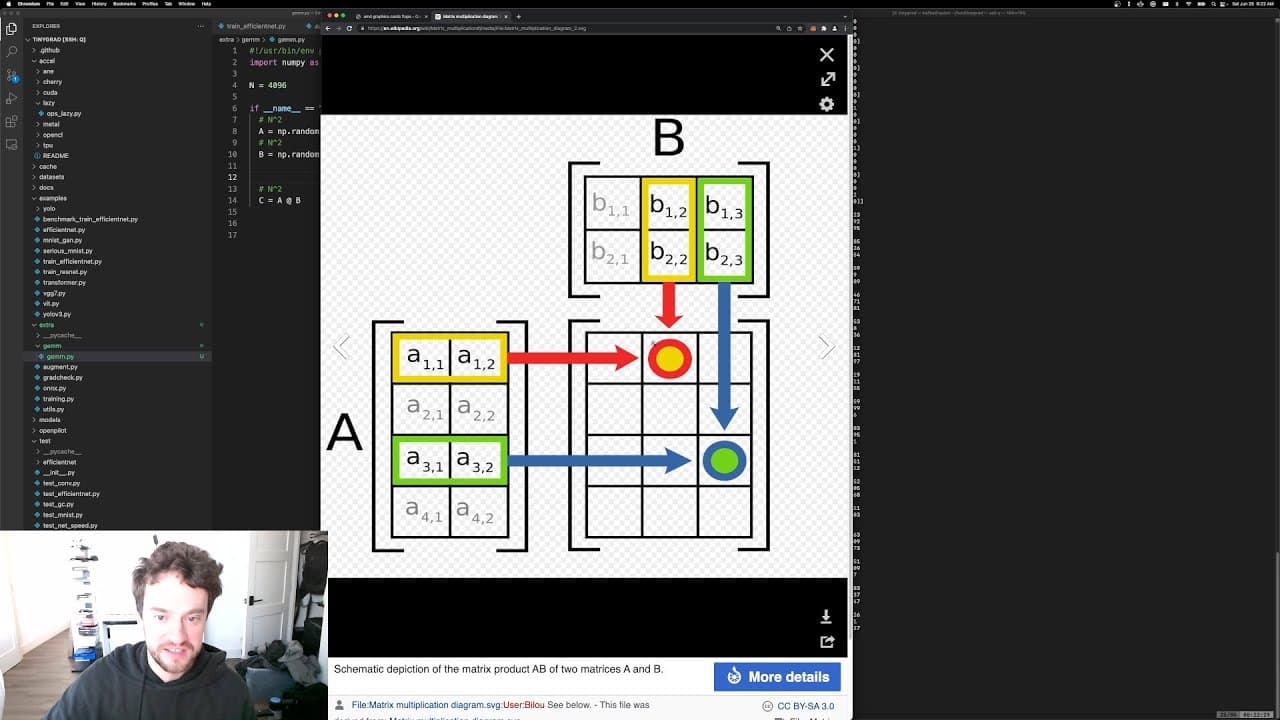
George Hotz | Programming | can you multiply a matrix? (noob lesson) | geohot/tinygrad/tree/gemm
TL;DR
Achieved a performance of 1.2 TFLOPS in CPU matrix multiplication benchmark.
Transcript
alex_fener: Sa Türk var mı? washedpat: yo Koduck007: real american leesin1729: How's it going George? 0xhsn: as var var alex_fener: yes, I know 0mni_1: afternoon Kultiviert: hello georgie my fren trippychivas: Morning twitchdopest: What’s popping l0rtk: hi from georgia 🇬🇪 wpnbos: good afternoon 我幫你素: Yo bijen_: muricccccccccccccccccccccca mntndew... Read More
Key Insights
- ✋ Achieving high TFLOPS in matrix operations requires addressing challenges like thermal throttling and power limitations.
- 🧵 Thread synchronization can introduce overheads in parallel execution, impacting performance.
- ©️ Strategies like copying matrices and reconfiguring layouts are suggested for further optimization.
Install to Summarize YouTube Videos and Get Transcripts
Explore YouTube Video Summarizer or Get YouTube Transcript Extractor
Questions & Answers
Q: What was the peak performance achieved in CPU matrix multiplication?
The peak performance achieved was 1.2 TFLOPS, demonstrating significant computational power.
Q: What were the observed challenges in optimizing matrix multiplication code?
Throttling due to power limits, issues with thermal management, and complexities in thread synchronization were key challenges faced during optimization.
Q: How did thread synchronization impact the overall performance gains?
Thread synchronization, especially in the context of matrix multiplication, can introduce overheads that hinder overall performance, highlighting the importance of efficient implementation.
Q: What strategies were suggested for further optimization in matrix multiplication?
Recommendations included copying matrices, reconfiguring the matrix layout to enhance cache efficiency, and exploring advanced optimization techniques to maximize performance.
Summary & Key Takeaways
-
GeorgeHotz achieved a throughput of 1.2 TFLOPS (Tera Floating Point Operations Per Second) in CPU matrix multiplication.
-
Initial attempts with 16 threads running the same matrix multiplication job led to unexpected performance drops, which were later attributed to thermal throttling.
-
Strategies discussed included optimizing code, thread synchronization, and adjusting power settings to fully utilize hardware potential.
Read in Other Languages (beta)
Share This Summary 📚
Summarize YouTube Videos and Get Video Transcripts with 1-Click
Try YouTube Summary with ChatGPT & Claude or YouTube Transcript Generator
Explore More Summaries from george hotz archive 📚


Summarize YouTube Videos and Get Video Transcripts with 1-Click
Try YouTube Summary with ChatGPT & Claude or YouTube Transcript Generator