How Did Japan React to 33-Minute US War Declaration?
TL;DR
Japan's leadership was shocked by the rapid American declaration of war following the Pearl Harbor attack, which took only 33 minutes. This swift response shattered Japanese assumptions of American political division and hesitation, revealing a unified and determined adversary. The Japanese strategy, based on misconceptions about American democracy and industrial capacity, was fundamentally flawed, leading to strategic miscalculations and a realization of the daunting industrial power they now faced.
Transcript
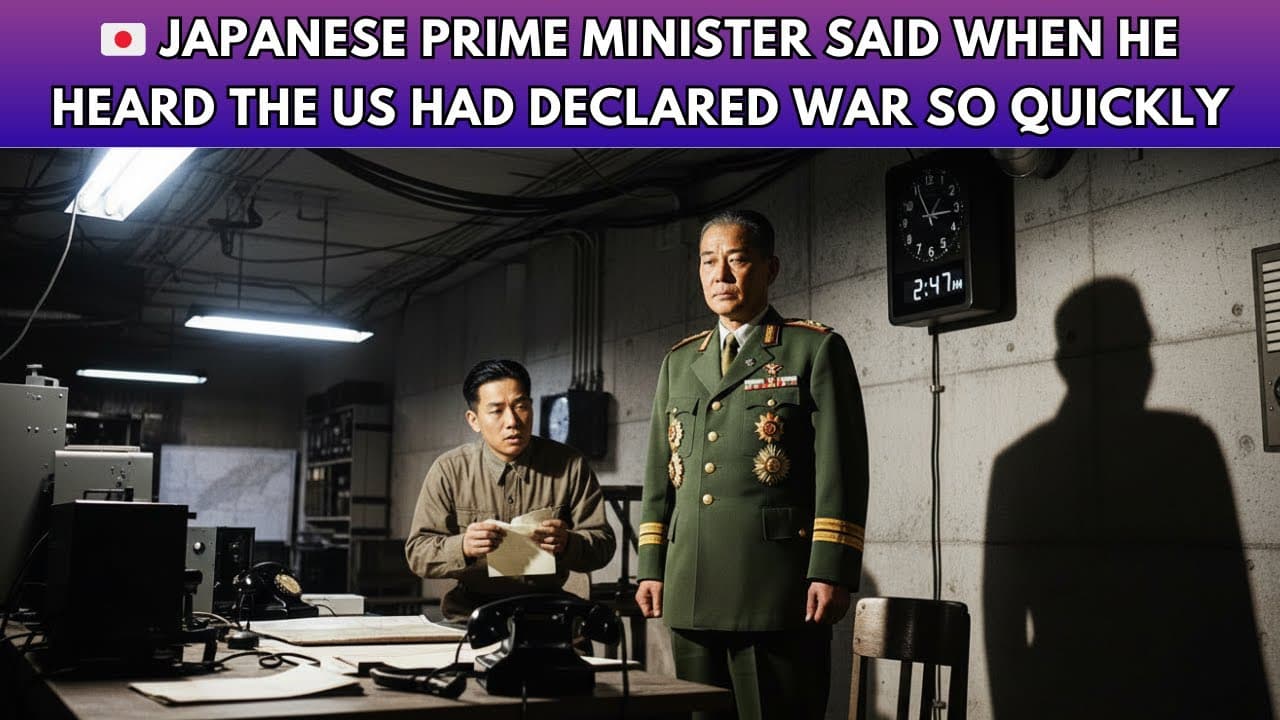
The message that arrived at 2:47 a.m. on December 8th, 1941 contained just 11 words. But those 11 words would shatter every assumption Japan had built its war strategy upon. Prime Minister Hideki Tojo stood in the underground communication center, staring at the decoded transmission as though it were written in a language he couldn't comprehend. 33... Read More
Key Insights
- The US Congress declared war on Japan just 33 minutes after President Roosevelt's address, defying Japanese expectations of a delayed response.
- Japanese intelligence had predicted American political paralysis, but instead found immediate and unified support for the war effort.
- Prime Minister Tojo realized that the attack on Pearl Harbor had unified, rather than divided, the United States.
- American industrial conversion to war production began spontaneously and rapidly, exceeding Japanese estimates.
- Japan's strategic assumptions about American weakness were based on flawed intelligence and wishful thinking.
- The Axis alliance provided no material support to Japan, leaving it isolated against American industrial might.
- Japanese leadership underestimated the resolve and unity of democratic nations once committed to war.
- Japan's territorial gains became liabilities as the US prepared for a long and resource-intensive conflict.
Install to Summarize YouTube Videos and Get Transcripts
Explore YouTube Video Summarizer or Get YouTube Transcript Extractor
Questions & Answers
Q: How did Japan react to the US declaring war in 33 minutes?
Japan's leadership was shocked by the rapid US declaration of war, which took only 33 minutes. This swift response shattered Japanese assumptions of American political division and hesitation, revealing a unified and determined adversary. The Japanese strategy, based on misconceptions about American democracy and industrial capacity, was fundamentally flawed, leading to strategic miscalculations and a realization of the daunting industrial power they now faced.
Q: What assumptions did Japanese intelligence make about the US?
Japanese intelligence assumed that the United States was politically divided and would be slow to respond to the Pearl Harbor attack. They expected weeks or months of debate before any decisive action, believing that American democracy implied weakness and hesitation. These assumptions were proven wrong when the US declared war in just 33 minutes, demonstrating immediate unity and resolve.
Q: What was the impact of the Pearl Harbor attack on US industrial mobilization?
The Pearl Harbor attack resulted in a rapid and spontaneous mobilization of US industry for war production. American factories began converting to military production within days, far exceeding Japanese expectations. This swift industrial response highlighted the US's existing infrastructure and capacity, which had been underestimated by Japanese planners, and marked the beginning of a formidable and sustained war effort.
Q: How did Japan's strategic assumptions about the US prove flawed?
Japan's strategic assumptions about the US were flawed in that they underestimated American unity and industrial capacity. Japanese planners believed that American democracy would lead to division and hesitation, but found the opposite. The US's rapid declaration of war and subsequent mobilization revealed a unified nation with vast industrial resources, challenging Japan's strategy and exposing its vulnerabilities.
Q: What role did the Axis alliance play in Japan's strategy?
The Axis alliance, comprising Japan, Germany, and Italy, was expected to provide diplomatic and strategic support to Japan. However, in reality, the alliance offered no material support in the Pacific theater. Germany and Italy were focused on European conflicts, leaving Japan isolated against the United States. This lack of support contributed to Japan's strategic disadvantage as it faced a unified and industrially powerful adversary alone.
Q: How did the US public respond to the Pearl Harbor attack?
The US public responded to the Pearl Harbor attack with overwhelming unity and resolve. Recruitment stations were overwhelmed with volunteers, and war bond drives exceeded targets. American society quickly unified, with political opposition to the war effectively ceasing. This response demonstrated the depth of American commitment and the capacity for total mobilization, challenging Japanese assumptions about American political division.
Q: What were the consequences of Japan's misjudgment of American democracy?
Japan's misjudgment of American democracy led to a strategic miscalculation that underestimated the unity and resolve of the United States. The rapid US declaration of war and subsequent industrial mobilization revealed the strength of democratic nations once committed to conflict. This miscalculation left Japan facing a formidable adversary with vast industrial resources, challenging its war strategy and exposing its vulnerabilities.
Q: How did Japan's territorial gains become liabilities after Pearl Harbor?
Japan's territorial gains, achieved at great cost, became liabilities after the Pearl Harbor attack as the US began its rapid mobilization. The extensive territory Japan occupied required significant resources to defend, stretching its military capabilities. As American industrial production ramped up, these territories became strategic overextensions, vulnerable to the growing industrial and military power of the United States.
Summary & Key Takeaways
-
Japan's leadership miscalculated the American response to Pearl Harbor, expecting political division and delay. Instead, the US declared war in just 33 minutes, revealing a unified and determined opponent. This rapid mobilization shattered Japanese assumptions, exposing their strategic errors and highlighting the industrial power they now faced.
-
The Japanese believed American democracy would lead to hesitation and division, but found the opposite. The attack on Pearl Harbor unified the US, leading to swift industrial mobilization and national resolve. Japan's strategy, based on flawed intelligence, underestimated the capacity and unity of its new adversary.
-
The Axis alliance offered Japan no material support, leaving it isolated against a rapidly mobilizing US. Japan's territorial gains, achieved at great cost, became strategic overextensions as American industrial capacity began to outpace Japanese production. The swift US response marked a turning point, challenging Japan's war strategy.
Read in Other Languages (beta)
Share This Summary 📚
Summarize YouTube Videos and Get Video Transcripts with 1-Click
Try YouTube Summary with ChatGPT & Claude or YouTube Transcript Generator
Explore More Summaries from Untold WW2 Stories 📚
Summarize YouTube Videos and Get Video Transcripts with 1-Click
Try YouTube Summary with ChatGPT & Claude or YouTube Transcript Generator