How Could Computation Produce Physical Laws?
TL;DR
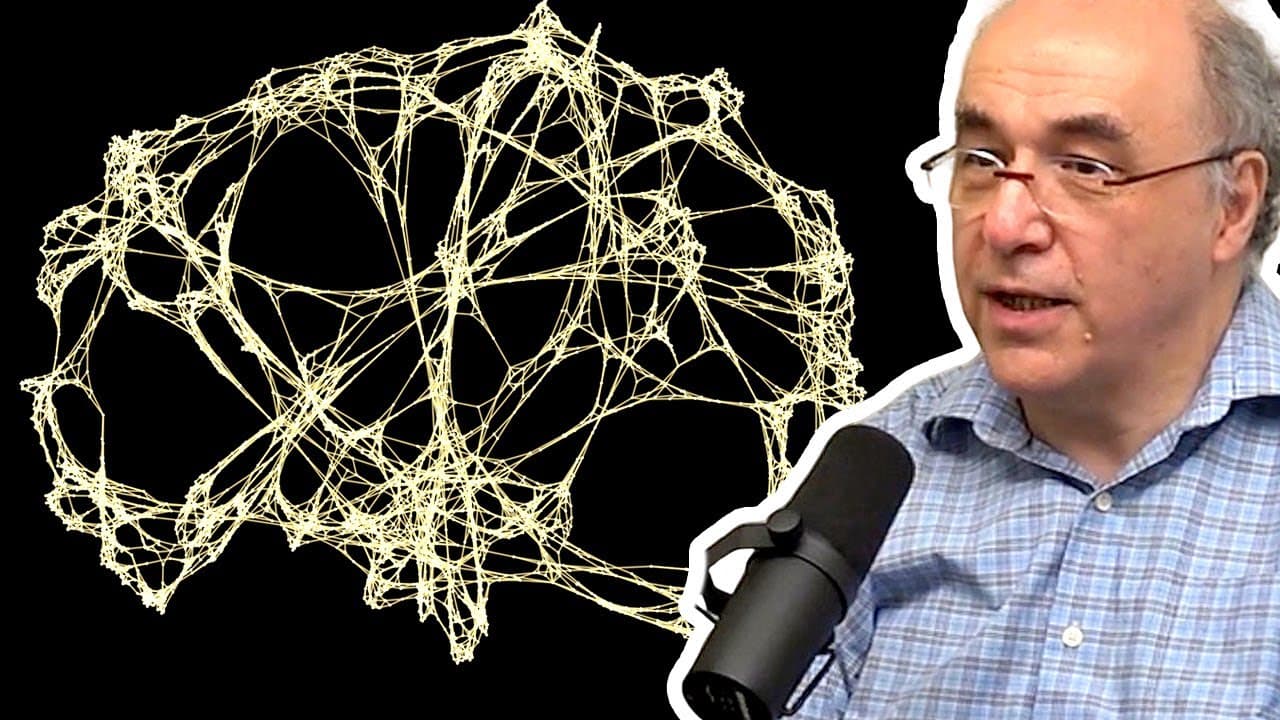
Physical laws may emerge from simple computations on highly structureless networks, with continuous space arising as the aggregate behavior of discrete underlying elements. Finding such a model requires the right computational language, while understanding it requires conceptual waypoints that let humans build explanations across otherwise overwhelming layers of emergence and computational complexity.
Transcript
What kind of computation do you think the fundamental laws of physics might emerge from? So just to clarify, so there's -- you've, you've done a lot of fascinating work with kind of discrete kinds of computation that, uh, you know, th- because cellular automata, and we'll talk about it, have this very clean structure. It's, it's such a nice way to ... Read More
Key Insights
- Universal computation is sufficient for simulation in principle, because one universal computational system can simulate another. However, a simulation may be so unnatural or cumbersome that it does not provide a practical basis for discovering a compact program corresponding to the physical universe.
- The right computational language is essential for finding fundamental physical laws. A search across all possible programs becomes feasible only if the chosen representation makes the universe's underlying rules appear small and simple rather than burying them inside an unnecessarily complicated encoding.
- Cellular automata are rigid computational structures built from cells on a grid that update synchronously with each clock tick. Their ability to generate immense complexity from simple rules is informative, but their predefined geometry and timing may make them too structured to describe what lies beneath space and time.
- Physical space may be an emergent continuum produced by discrete underlying elements. Air and water appear continuous at ordinary scales even though they consist of discrete molecules, suggesting that apparently continuous space could likewise arise from a more fundamental structure that is not itself continuous.
- Graphs and networks are candidates for a structureless computational foundation because they do not require the fixed spatial grid used by cellular automata. Wolfram's interest centers on whether such minimally structured relationships could generate the space, time, and physical entities observed at higher levels.
- Infinity is useful for conceptual and theoretical questions but is not actualizable, according to Wolfram's view. A competing possibility remains that physics fundamentally requires continuous quantities, exact real numbers, and partial differential equations defined at arbitrarily close points, which would undermine a discrete computational approach.
- A simple model of the universe cannot contain separate instructions for every dimension, electron, muon, quark, or other observed feature. These distinct physical properties and entities must instead emerge from deeper rules if the foundational model is genuinely compact and simple.
- Human understanding depends on cognitive waypoints that compress complex ideas into usable concepts. Words, mathematical tools, and scientific theories provide anchors for building higher levels of explanation, making an abstract computational foundation potentially understandable through a sequence of intermediate abstractions.
- More videos with Stephen Wolfram:
Install to Summarize YouTube Videos and Get Transcripts
Explore YouTube Video Summarizer or Get YouTube Transcript Extractor
Questions & Answers
Q: What kind of computation could produce physical laws?
Physical laws could emerge from a computational system built on highly structureless elements, such as graphs or networks, rather than from a rigid grid with synchronized updates. The underlying rules would need to be simple, while familiar features such as space, time, dimensions, and particle types would have to arise collectively from those rules instead of being explicitly programmed.
Q: Are cellular automata sufficient to model the universe?
Cellular automata can demonstrate that simple rules produce immense complexity, and universal computation means they can simulate other computations in principle. However, their cells occupy a predefined grid and update together at clock ticks, making them highly specific structures. A fundamental physical model may require a more structureless foundation that does not assume space or synchronized time in advance.
Q: Why does the choice of computational language matter?
The choice of computational language determines whether a candidate universe can be expressed naturally as a small, simple program. Universal systems can simulate one another, but those simulations may be awkward and obscure. To find the physical universe by searching possible programs, researchers need a basis in which its underlying rules are compact enough to recognize and investigate.
Q: Could physical space be discrete rather than continuous?
Physical space could be discrete underneath even though it appears continuous at observable scales. Air and water provide the analogy: they can be poured and modeled as continuous fluids, yet they consist of discrete molecules moving around. Space might similarly emerge as a continuum from discrete relationships, although existing physical frameworks have not made that idea work successfully.
Q: What role could graphs or networks play in fundamental physics?
Graphs or networks could represent a minimally structured layer beneath physical space and time. Unlike cellular automata, they do not inherently require cells arranged on a fixed spatial grid. Their relationships might evolve computationally and collectively generate apparent space, dimensionality, time, and physical objects, allowing observed structure to emerge from something more arbitrary and unstructured underneath.
Q: Does infinity belong in the foundations of physics?
Wolfram considers infinity useful for conceptualizing theoretical questions but not something that can be actualized. He therefore doubts that infinity is part of the underlying mechanism of space and time. Still, he acknowledges that physics might fundamentally depend on continua, exact real numbers, and partial differential equations evaluated at arbitrarily close points, which would challenge his computational proposal.
Q: Why must particles and dimensions emerge from deeper rules?
A truly simple model of the universe cannot include a separate line of code for every observed feature, such as the number of spatial dimensions or each variety of particle. Those features must arise from the behavior of a more basic structure. This requirement makes the foundation abstract, since its primitive components cannot simply resemble everything they eventually produce.
Q: Can humans understand a fundamental computational theory?
Humans may understand such a theory by constructing conceptual waypoints between its primitive rules and familiar physical phenomena. Science and language already work this way: named concepts and mathematical methods become cognitive anchors that support more advanced explanations. Understanding would be far harder if reasoning had to jump directly from raw underlying elements to complex outcomes without intermediate abstractions.
Summary & Key Takeaways
-
Universal computation can simulate any process in principle, but this fact does not make every computational representation equally useful. A successful search for the universe's underlying program requires a natural language or basis in which the relevant rules are sufficiently small, simple, and discoverable within the space of possible programs.
-
Cellular automata demonstrate how simple rules generate complexity, yet their fixed grids and synchronized updates may impose too much structure. Wolfram instead considers graphs or networks as more structureless foundations from which physical space, time, dimensionality, and particle varieties might emerge without being individually encoded in separate rules.
-
Human understanding develops through conceptual waypoints such as named ideas, mathematical methods, and shared vocabulary. These cognitive anchors allow increasingly abstract explanations to be constructed in manageable stages. A fundamental theory may therefore become understandable if science can identify intermediate concepts connecting its primitive computations to familiar physical phenomena.
Read in Other Languages (beta)
Share This Summary 📚
Summarize YouTube Videos and Get Video Transcripts with 1-Click
Try YouTube Summary with ChatGPT & Claude or YouTube Transcript Generator
Explore More Summaries from Lex Fridman 📚
Summarize YouTube Videos and Get Video Transcripts with 1-Click
Try YouTube Summary with ChatGPT & Claude or YouTube Transcript Generator