How to Build No-Code AI Skills Employers Want
TL;DR
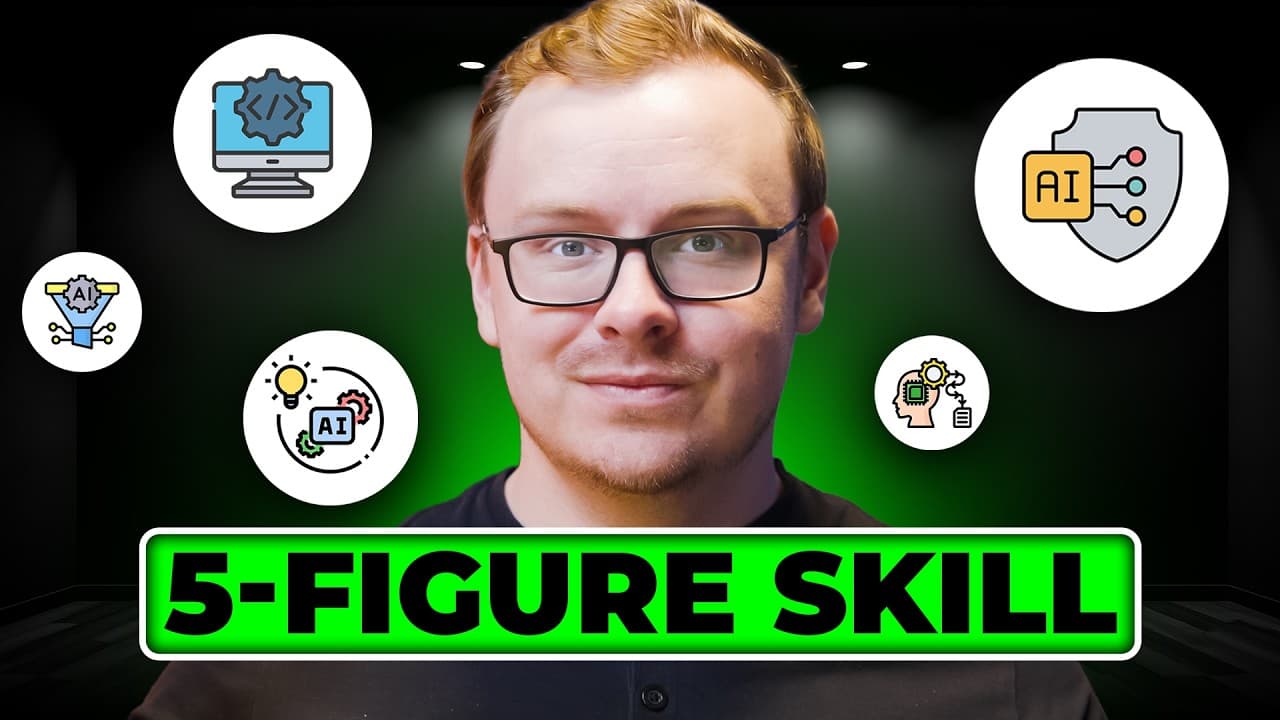
Focus on practical AI use rather than model development: write precise prompts, connect tools into useful workflows, and use AI to interpret business data. Employers value people who can apply existing tools to real problems, improve weak outputs, and turn information into decisions without requiring a coding background or traditional technical credentials.
Transcript
So, two months ago, I had a conversation with my buddy who runs a tech recruiting firm, and he was pulling his hair out trying to find people with basic AI skills. And you know what he told me? Shane, I've got companies offering 150K plus for people who can just use these AI tools properly. And I still can't find anyone. And that's when it hit me. ... Read More
Key Insights
- AI literacy is becoming a practical workplace skill because companies increasingly need employees who can use existing AI tools effectively. The source distinguishes this ability from programming, machine learning, and model development, making the opportunity accessible to people without technical degrees or coding backgrounds.
- AI builders create and train models, while AI users apply those models to business problems. The source argues that companies need far more users than builders because AI must be incorporated across departments, workflows, and job functions rather than remaining solely within engineering teams.
- Prompt engineering is the ability to communicate goals and requirements clearly enough for an AI tool to produce useful results. Effective prompts specify the audience, context, desired outcome, relevant objections, tone, limits, and other constraints instead of relying on vague instructions.
- A detailed marketing prompt is more useful when it identifies the customer, product, problem, offer, objection, tone, and required length. The source uses this contrast to show why generic prompts often produce weak material and why structured instructions can improve output quality substantially.
- AI tool integration is the practice of combining specialized tools into a coordinated workflow. The source describes analyzing data with one tool, turning the analysis into actionable insights with another, and using an additional tool to create an infographic that communicates the findings clearly.
- AI-enhanced data analysis allows nontechnical workers to interpret business information without becoming traditional data scientists. The source describes using AI to identify customer types and acquisition sources, helping a business understand its audience without relying entirely on a dedicated analyst.
- Business context is essential for useful AI output because tools need relevant source material to recognize patterns. The source describes analyzing sales calls to uncover common objections, recurring problems, and desired outcomes, then applying those findings to sales and content decisions.
- Demonstrated AI ability can strengthen employment prospects because it shows that a candidate can improve workflows and solve practical problems. The source also suggests that certificates may signal initiative, although the central value comes from showing how AI skills can produce useful business outcomes.
Install to Summarize YouTube Videos and Get Transcripts
Explore YouTube Video Summarizer or Get YouTube Transcript Extractor
Questions & Answers
Q: What no-code AI skills do employers want?
The source identifies prompt engineering, AI tool integration, and AI-enhanced data analysis as practical skills employers want. Its description also names content optimization and problem-solving. These abilities focus on using existing AI products effectively, combining tools into workflows, interpreting information, and applying outputs to real business needs rather than programming or developing AI models.
Q: What is prompt engineering for business tasks?
Prompt engineering is the practice of giving an AI tool clear, detailed instructions so its response fits a business objective. A strong prompt can define the intended audience, customer problem, product details, objections, offer, tone, length, and desired result. The source contrasts this structure with vague requests that tend to generate generic, less useful material.
Q: How can someone write a better AI prompt?
A better AI prompt should explain the task, relevant context, intended audience, desired outcome, and important constraints. For marketing work, the source recommends including the product, customer characteristics, customer difficulty, featured offer, likely price objection, promotional details, tone, and length. Specific instructions give the tool more information for producing a relevant response.
Q: What is AI tool integration without coding?
AI tool integration means connecting multiple existing products so each performs the part of a workflow it handles best. The source gives an example in which one tool analyzes data, another develops actionable insights, and another creates an infographic for people who are not data savvy. A platform such as make.com can connect these steps without conventional programming.
Q: How can AI help nontechnical workers analyze data?
AI can help nontechnical workers interpret business data by identifying patterns and translating information into understandable findings. The source describes using it to determine what types of customers join a content program and where those customers originate. This approach lets workers answer practical business questions without becoming traditional data scientists or performing the entire analysis manually.
Q: What is the difference between AI builders and AI users?
AI builders are engineers and computer scientists who create and train AI models, and their work generally requires coding. AI users work with existing tools to solve business problems. The source presents AI users as the broader employment opportunity because organizations need practical adoption across many departments, not only specialists who construct the underlying technology.
Q: How can AI sales-call analysis improve business decisions?
AI can process sales-call material to identify repeated customer objections, common problems, and the outcomes prospects most want. According to the source, these findings can support sales performance by clarifying what prevents customers from buying. The same information can also improve prompts and content because messaging can address concerns and goals found in actual conversations.
Q: How should job seekers demonstrate practical AI literacy?
Job seekers should demonstrate that they can use AI to produce useful business results, not merely list familiarity with a chatbot. Relevant examples include writing structured prompts, connecting tools into a workflow, analyzing customer information, extracting actionable insights, and communicating findings clearly. The source also says an AI certificate can show initiative and possible workflow value.
Summary & Key Takeaways
-
Employers described in the source are seeking AI users who can apply existing tools to everyday business problems. The opportunity does not require building models or writing code. Instead, workers can distinguish themselves by producing useful outputs, improving business processes, and demonstrating practical AI literacy across roles such as marketing, sales, content, and analysis.
-
Prompt engineering means giving AI detailed context, goals, constraints, audience information, objections, tone, and output requirements. A vague request tends to produce generic material, while a specific request can generate a more relevant result. The skill also includes using business information, such as customer objections and desired outcomes, to guide AI-generated work.
-
AI tool integration and AI-enhanced data analysis extend beyond using a single chatbot. Workers can connect specialized tools into workflows that analyze information, extract actionable insights, and present findings clearly. The source argues that this practical combination of tools is valuable because companies need outcomes, not merely familiarity with individual AI products.
Read in Other Languages (beta)
Share This Summary 📚
Summarize YouTube Videos and Get Video Transcripts with 1-Click
Try YouTube Summary with ChatGPT & Claude or YouTube Transcript Generator
Explore More Summaries from Shane Hummus 📚


Summarize YouTube Videos and Get Video Transcripts with 1-Click
Try YouTube Summary with ChatGPT & Claude or YouTube Transcript Generator