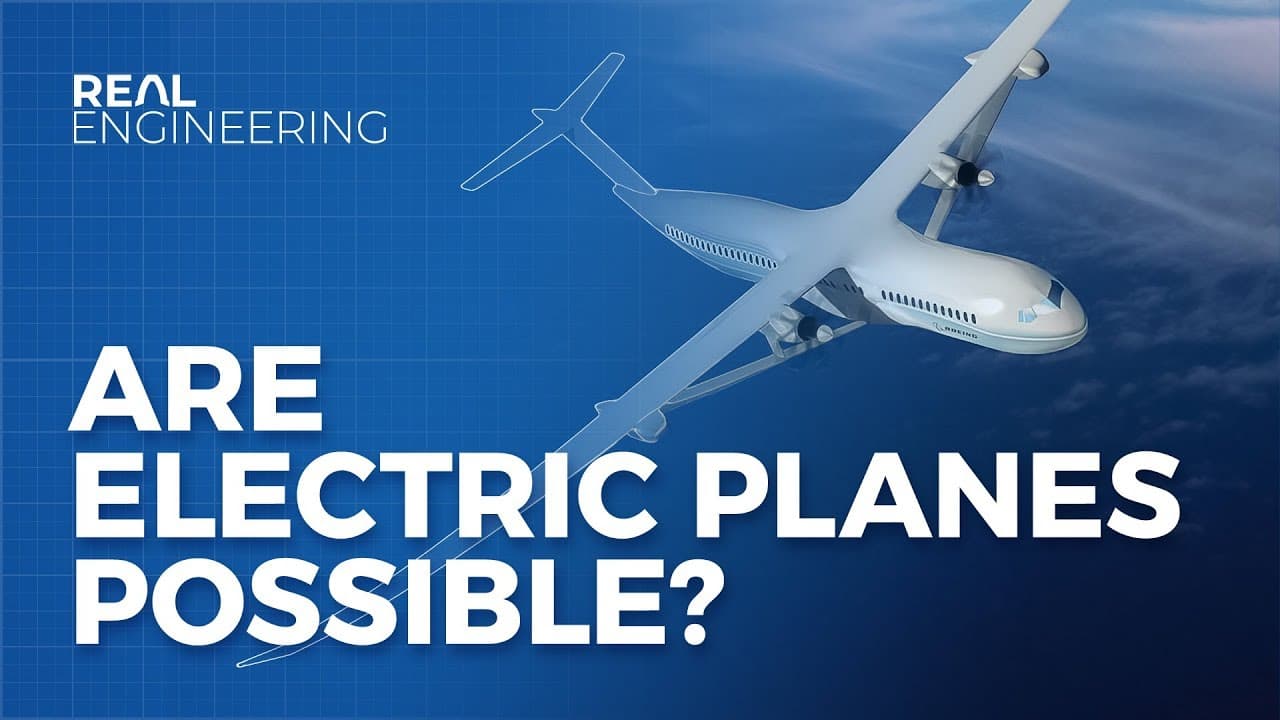
Are Electric Planes Possible?
TL;DR
Electric planes face significant challenges due to energy density issues.
Transcript
This episode of Real Engineering is brought to you by Brilliant, a problem solving website that teaches you think like an engineer. Over the past decade we have seen multiple industries looking to transition to renewable fuel sources, and while we have been making huge strides in the production of renewable energy, the technology required to allow ... Read More
Key Insights
- The aviation industry's shift to renewable energy is hindered by current energy storage technologies, which are not yet efficient enough to replace fossil fuels.
- Energy density is a critical factor in aviation; current batteries are significantly heavier than traditional jet fuel, impacting flight efficiency.
- The weight of batteries required for electric planes drastically increases power needs, creating a cycle of increased weight and energy demand.
- Calculations show that converting large aircraft like the Airbus A320 to electric power is currently impractical due to excessive battery weight requirements.
- Small aircraft, such as the Cessna, are more feasible for electric conversion, with current battery technology allowing for reasonable flight durations.
- Electric aircraft development is promising for short-range flights and small planes, but not yet viable for long-haul commercial flights.
- Innovations in battery technology or alternative energy storage methods are necessary for electric planes to become mainstream.
- The video hints at hydrogen as a potential future solution for energy storage in aviation, to be explored in a subsequent video.
Install to Summarize YouTube Videos and Get Transcripts
Explore YouTube Video Summarizer or Get YouTube Transcript Extractor
Questions & Answers
Q: What is the main challenge for electric planes in the aviation industry?
The main challenge for electric planes is the energy density of current battery technology. Batteries are much heavier than traditional jet fuel, meaning that the power required to lift and maintain flight increases significantly with the added weight, making it difficult to achieve efficient and practical electric flight.
Q: How does energy density affect electric planes?
Energy density affects electric planes by determining how much energy can be stored per kilogram of battery weight. Current batteries have much lower energy density compared to jet fuel, resulting in heavier planes that require more power to achieve lift. This creates a cycle where more batteries are needed, further increasing weight and power requirements.
Q: Why is converting large aircraft to electric power currently impractical?
Converting large aircraft to electric power is impractical due to the excessive weight of batteries needed to match the range of traditional fuel. For example, an Airbus A320 would require batteries weighing four times the empty weight of the plane, severely limiting flight duration and rendering long-haul flights infeasible with current technology.
Q: What are the prospects for small electric aircraft?
Small electric aircraft, like the Cessna, have better prospects due to their lower power requirements and shorter flight durations. Current battery technology can support reasonable flight times for these planes, making them more viable for short-range flights. Innovations in design and efficiency are further enhancing their potential.
Q: What is the significance of the power equation derived in the video?
The power equation derived in the video highlights the relationship between lift, weight, and power requirements for flight. It shows how increasing the mass of a plane, such as with heavier batteries, exponentially increases the power needed, underscoring the challenges of achieving efficient electric flight with current technology.
Q: How does the video suggest overcoming the current limitations of electric planes?
The video suggests that overcoming the limitations of electric planes requires advancements in energy storage technology. It hints at hydrogen as a potential solution, which may offer higher energy density and lighter weight compared to current batteries, making it a promising avenue for future research and development in aviation.
Q: What role does drag play in the power requirements for electric planes?
Drag plays a significant role in the power requirements for electric planes, as it increases the total power needed to maintain flight. The video explains that the optimal power requirement occurs when the forces of lift and drag are balanced, which is a critical consideration when designing efficient electric aircraft.
Q: What advancements are needed for electric planes to become mainstream?
For electric planes to become mainstream, significant advancements in energy storage are needed. This includes developing batteries or alternative technologies with higher energy density and lighter weight. Additionally, improvements in aircraft design, such as more efficient engines and aerodynamics, are necessary to optimize energy use and extend flight range.
Summary & Key Takeaways
-
The video explores the challenges of transitioning the aviation industry to renewable energy, focusing on the limitations of current battery technology. It explains how energy density impacts aircraft design and performance, using calculations to illustrate the impracticality of converting large planes to electric power.
-
While electric conversion is feasible for small aircraft, the weight of batteries required for larger planes like the Airbus A320 makes it unviable. The video emphasizes the need for advancements in energy storage technology to overcome these challenges, hinting at hydrogen as a potential solution.
-
The video's detailed analysis highlights the complexity of achieving electric aviation, explaining key concepts such as energy density and power requirements. It concludes that significant technological breakthroughs are needed before electric planes can replace traditional fuel-powered aircraft for long-haul flights.
Read in Other Languages (beta)
Share This Summary 📚
Summarize YouTube Videos and Get Video Transcripts with 1-Click
Try YouTube Summary with ChatGPT & Claude or YouTube Transcript Generator
Explore More Summaries from Real Engineering 📚




Summarize YouTube Videos and Get Video Transcripts with 1-Click
Try YouTube Summary with ChatGPT & Claude or YouTube Transcript Generator