Why Did the Fed Cast Doubt on a December Cut?
TL;DR
The Federal Reserve cut its policy rate by a quarter percentage point, but Chair Powell said another reduction in December was far from certain because officials held sharply differing views. Markets also weighed a new U.S.-China trade framework, heavy artificial intelligence spending by major technology companies, and signs that lower-income consumers were reducing spending as prices and tariffs increased pressure.
Transcript
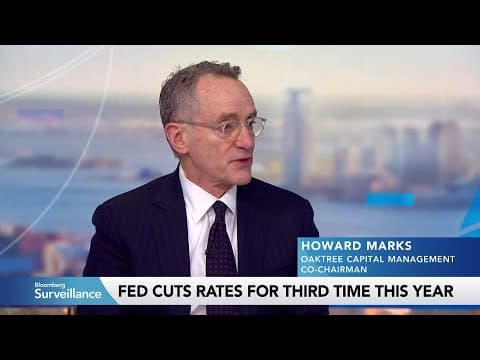
THE FEDERAL OPEN MARKET COMMITTEE DECIDED TO LOWER POLICY INTEREST RATE BY A QUARTER PERCENTAGE POINT. A FURTHER REDUCTION OF DECEMBER MEETINGS. >> WHICH MAKES IT DIFFICULT FOR THEM TO BE CUTTING AGAIN IN DECEMBER. >> WE CAN SEE A REPRICING OF MARKET PRICING TO DECEMBER. >> WE HAVE A PRETTY DIVIDED COMMITTEE IN TERMS OF THE CASE FOR PREEMPTIVE C... Read More
Key Insights
- The Federal Reserve cut its policy interest rate by a quarter percentage point, but Powell emphasized that another reduction at the December meeting was not assured. Strongly differing committee views made the decision less predictable than market pricing had suggested before the meeting.
- The December policy decision depends partly on whether officials receive enough economic information. A government shutdown could leave policymakers in what the discussion called a data desert, forcing them to assess inflation, labor conditions, bond-market behavior, and economic leadership without normal data visibility.
- The bond market is signaling demand for additional monetary easing, according to Christopher Verrone. He argued that failing to cut while the economy is cooling could create more meaningful downside, even if an eventual market rally occurred for reasons associated with economic weakness.
- The equity market remains broadly constructive despite isolated disappointments. Verrone noted broad new highs and a new high for Nvidia, while Meta occupied a more tenuous position because investors reacted negatively to its spending plans rather than to weak reported earnings.
- The U.S.-China agreement reduced immediate escalation concerns by including a cut to fentanyl-related tariffs and renewed Chinese soybean purchases. However, uncertainty remained around energy purchases, shipping issues, and whether China would receive access to advanced Blackwell semiconductor technology.
- The offshore Chinese yuan serves as a barometer of broader China-related macroeconomic risk in Verrone's framework. He said meaningful weakening in the currency would signal rising macro concern, while stable high-yield credit would suggest that a domestic credit problem had not yet emerged.
- Consumer weakness is appearing across income groups, with particular stress among households earning below $100,000. Chipotle reported a broad pullback in visit frequency, while higher prices and tariffs were also described as pressures on consumers and the company's bottom line.
- Treasury yield thresholds remained important to the market's constructive trend. Verrone said the trend looked acceptable while the 10-year yield stayed below 4.25% and the 30-year yield remained below 4.90%, reflecting continued sensitivity to long-term borrowing costs.
Install to Summarize YouTube Videos and Get Transcripts
Explore YouTube Video Summarizer or Get YouTube Transcript Extractor
Questions & Answers
Q: Why was another Federal Reserve rate cut in December uncertain?
Another December rate cut was uncertain because Powell said Federal Open Market Committee members held strongly differing views about the appropriate next step. The committee faced two-sided risks and a divided assessment of preemptive easing. A government shutdown could also restrict access to economic data, making it harder to judge labor-market weakness and inflation before the December meeting.
Q: How did markets respond to the Federal Reserve's rate decision?
Markets treated the quarter-point reduction as a hawkish rate cut because Powell would not confirm another move in December. The 10-year Treasury yield had risen by about 10 basis points around the meeting before taking a break, while stocks showed slight softness and the dollar weakened modestly after its earlier strength. December cut expectations were repriced lower.
Q: What did the bond market signal about future interest-rate cuts?
Christopher Verrone argued that the bond market continued to want more monetary easing. Market rates were trading roughly 75 basis points below the policy rate, which he viewed as evidence that investors expected additional cuts in December and beyond. He also warned that withholding a cut while the economy cooled could create a more meaningful downside risk.
Q: What warning signs suggested that the U.S. economy was cooling?
The discussion identified weakness in regional banks, consumer discretionary shares, and spending behavior as possible cooling signals. Chipotle reported lower visit frequency across income groups, with ongoing stress among consumers earning below $100,000. Higher prices and tariff costs added pressure, while the bond market and parts of equity-market leadership also suggested that investors expected policymakers to provide more support.
Q: What was included in the U.S.-China trade agreement?
The announced framework included an immediate reduction in fentanyl-related tariffs on China and a Chinese commitment to resume purchases of U.S. soybeans. Trump described the meeting with Xi Jinping as highly successful. Investors still lacked clarity about potential Chinese purchases of U.S. energy, shipping-related measures, and access to advanced Blackwell chips, which were not discussed at the meeting.
Q: How were technology earnings affecting the stock market?
Major technology earnings were generally strong, but investors distinguished between current results and future spending. Meta shares were set to fall because of its spending plan rather than poor earnings, while Alphabet reported third-quarter sales above Wall Street estimates and said it was investing record amounts to advance artificial intelligence. Nvidia and the broader market had reached new highs.
Q: Which indicators did Christopher Verrone use to monitor market risk?
Verrone used the offshore Chinese yuan as a gauge of China-related macroeconomic risk and high-yield credit as a measure of domestic credit stress. He said meaningful yuan weakness would reveal broader macro trouble, while deterioration in high-yield credit would indicate a developing domestic problem. Neither indicator had yet delivered the risk signal he was watching for.
Q: What Treasury yield levels were considered important for stocks?
The discussion identified several yield levels as important boundaries for a constructive equity trend. One market view held that stocks could tolerate rate uncertainty while the 10-year Treasury yield remained below roughly 4.20%. Verrone separately said the trend looked fine with the 10-year below 4.25% and the 30-year Treasury yield below 4.90%.
Summary & Key Takeaways
-
The Federal Reserve lowered its policy interest rate by a quarter percentage point, while Powell rejected the assumption that another December cut was guaranteed. Strongly differing committee views, two-sided economic risks, and a possible shortage of government data created uncertainty about whether policymakers would continue easing at the next meeting.
-
Markets stabilized after initially reacting to Powell's cautious message with higher Treasury yields and reduced confidence in a December cut. Christopher Verrone remained bullish but watched bond-market signals, regional banks, consumer discretionary shares, high-yield credit, and the offshore Chinese yuan for evidence that economic or financial risks were worsening.
-
Trump described his meeting with Xi Jinping as exceptionally successful, citing lower fentanyl-related tariffs and renewed Chinese soybean purchases. Investors still wanted clarity about possible U.S. energy purchases, shipping measures, and access to advanced Blackwell chips. Technology earnings remained strong, although Meta's spending plans and consumer weakness complicated the market outlook.
Read in Other Languages (beta)
Share This Summary 📚
Summarize YouTube Videos and Get Video Transcripts with 1-Click
Try YouTube Summary with ChatGPT & Claude or YouTube Transcript Generator
Explore More Summaries from Bloomberg Television 📚
Summarize YouTube Videos and Get Video Transcripts with 1-Click
Try YouTube Summary with ChatGPT & Claude or YouTube Transcript Generator