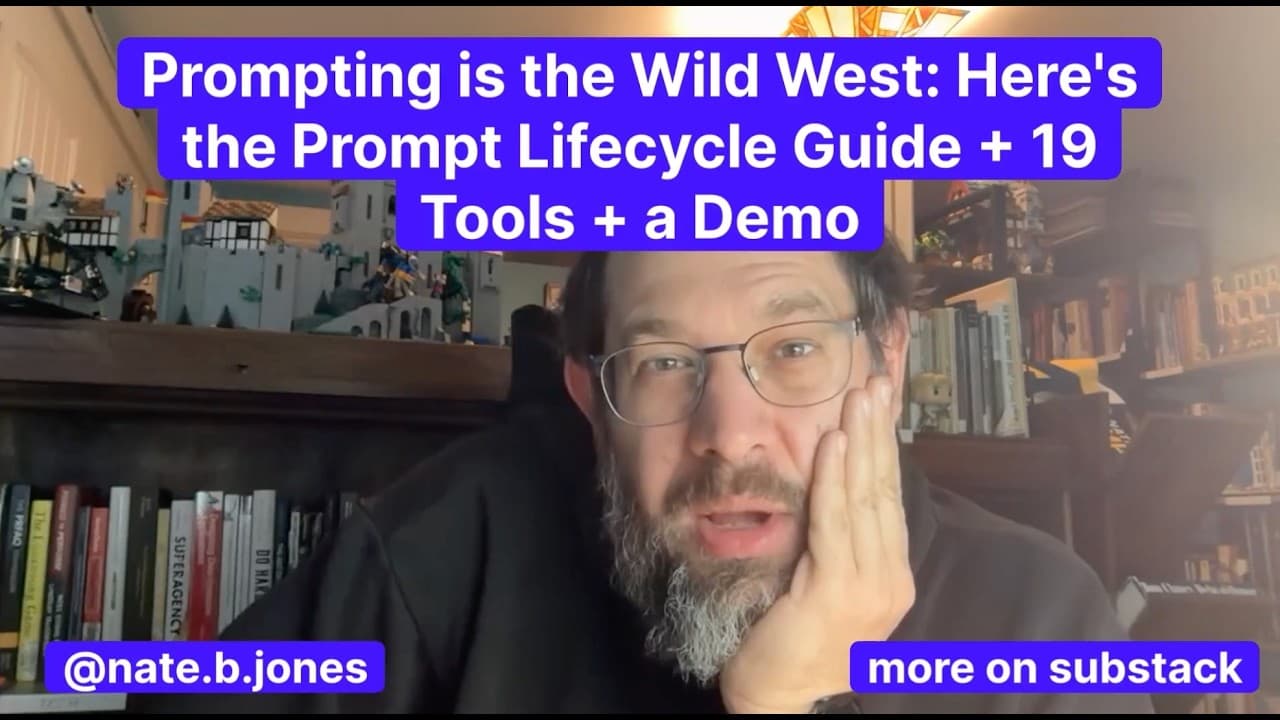
Prompting Is the Wild West: How Do You Manage the Full Prompt Lifecycle with 19 Tools and a Demo?
TL;DR
A prompt should move through intent formation, authoring, versioning, evaluation, workflow construction, and deployment. Intent formation comes first because it turns a fuzzy goal into a structured objective with constraints, steps, and output requirements; production teams may later validate each revision with 50 or 100 automated tests. Read on to see what each stage requires and where tools such as HeyPresto fit.
Transcript
Prompting is really weird because it's the most wild west software space I've ever seen, but it's also a highly leveraged critical part of AI workflows. There are dozens and dozens of prompt tools. And as far as I can tell, very few people have laid out or thought through the overall life cycle of a prompt and how we think about prompting systemati... Read More
Key Insights
- Intent formation is the missing first stage of the prompt lifecycle. A fuzzy goal such as summarizing information, drafting a plan, or analyzing sentiment must first become a structured, unambiguous prompt with a clarified objective, constraints, steps, and intended output.
- Authoring and drafting are focused on hands-on experimentation with prompt wording. People commonly use Claude, ChatGPT, Prompt Perfect, or Cursor to organize messy thoughts, rewrite instructions, and make the written prompt better match their mental model of an effective prompt.
- Prompt versioning makes frequently reused prompts persistent and auditable artifacts. Individuals and teams can assign version numbers, describe differences, compare revisions, preserve a single record, and coordinate changes through PromptLayer, Prometheus, Git-based approaches, Lang tools, or similar systems.
- Production prompt evaluation requires systematic comparisons across prompt versions and outputs. Relevant measures can include accuracy, cost, and hallucinations, while tools such as Hegel, Prompt Tools, Prompt Flow evaluation components, Prometheus, and custom frameworks can support repeatable testing.
- Team evaluation is more rigorous than typical individual testing. A production team may create automated suites containing 50 or 100 tests for every new prompt version, while an organized individual might maintain only 10 or 15 queries and otherwise rely on ad hoc checks.
- Workflow construction turns prompts into steps within larger automated systems. An agent may combine its central prompt with tools, memory, and conditional logic, making the prompt the core mechanism that guides behavior predictably across a multi-step process.
- Prompt deployment requires production-level reliability and oversight. Once prompts are embedded in real applications, organizations must track them, keep them available, ensure correct execution, and address robustness, safety, traceability, and governance through platforms or direct model APIs.
- HeyPresto is designed for ideation and intent formation before prompt authoring. It expands rough notes into editable, detailed prompts, supports formats such as JSON, email, tables, numbered lists, step-by-step instructions, and structured sections, and can regenerate instructions when requirements change.
Install to Summarize YouTube Videos and Get Transcripts
Explore YouTube Video Summarizer or Get YouTube Transcript Extractor
Questions & Answers
Q: What are the stages of the full prompt lifecycle?
The lifecycle begins with intent formation and discovery, followed by authoring and drafting, versioning, evaluation and testing, workflow construction or automation, and deployment. It progresses from defining the objective to refining the prompt, tracking revisions, validating performance, integrating it into larger systems, and maintaining it in production.
Q: Why should intent formation happen before prompt authoring?
People often start with a fuzzy goal, such as summarizing information, drafting a plan, or analyzing sentiment. Intent formation converts that goal into a structured objective with explicit constraints, steps, and output requirements before the wording is refined.
Q: How are prompts authored and refined?
Authoring involves writing, rewriting, testing prompt text, and experimenting with its wording. Claude, ChatGPT, Prompt Perfect, and Cursor can help organize messy thoughts and make the written prompt better match the creator's mental model.
Q: Why should frequently reused prompts be versioned?
Frequently reused prompts become persistent business artifacts that need a reliable record. Teams can label versions such as v1 and v1.1, describe and compare changes, preserve auditability, and coordinate revisions through PromptLayer, Prometheus, Git-based approaches, or Lang tools.
Q: How should production-grade prompts be evaluated?
Production prompts should be tested by comparing prompt versions and evaluating outputs for accuracy, cost, hallucinations, and other relevant measures. Teams can use Hegel, Prompt Tools, Prompt Flow evaluation components, Prometheus, or custom evaluation frameworks suited to their production setup.
Q: How does team prompt testing differ from individual testing?
A production team may run suites of 50 or 100 automated tests against every new prompt version. An organized individual might maintain only 10 or 15 test queries, while many individuals rely on ad hoc checks.
Q: How do prompts work inside AI agents and automated workflows?
A prompt acts as the central guide for an agent that may also use tools, memory, and conditional logic. It becomes one step within a multi-step automation while serving as the mechanism that predictably directs the agent's behavior.
Q: What does HeyPresto do in the prompt lifecycle?
HeyPresto supports ideation and intent formation by expanding rough notes into detailed, editable prompts. It can tailor prompts to selected technologies and formats such as JSON, email, tables, numbered lists, step-by-step instructions, and structured sections, then regenerate the instructions when requirements change.
Summary & Key Takeaways
-
The prompt lifecycle begins with intent formation and discovery, where a fuzzy request is converted into a structured objective with explicit constraints, steps, and output requirements. Authoring follows, using tools such as ChatGPT, Claude, Prompt Perfect, or Cursor to organize ideas, refine wording, and align the written prompt with a mental model.
-
Frequently reused prompts should be versioned as persistent business artifacts. Teams can name versions, record differences, compare revisions, and coordinate changes through systems such as PromptLayer, Prometheus, Git-based approaches, or Lang tools. Production prompts then require regular evaluation for accuracy, cost, hallucinations, and other relevant measures before they enter operational workflows.
-
Prompts can become central instructions inside agents and automated workflows that also use tools, memory, and conditional logic. Deployment adds requirements for uptime, correct execution, robustness, safety, traceability, and governance. HeyPresto addresses the earlier intent stage by expanding rough notes into editable prompts tailored to selected technologies and output formats.
Read in Other Languages (beta)
Share This Summary 📚
Summarize YouTube Videos and Get Video Transcripts with 1-Click
Try YouTube Summary with ChatGPT & Claude or YouTube Transcript Generator
Explore More Summaries from AI News & Strategy Daily | Nate B Jones 📚






Summarize YouTube Videos and Get Video Transcripts with 1-Click
Try YouTube Summary with ChatGPT & Claude or YouTube Transcript Generator