How Will Post-Labor Economics Change Jobs?
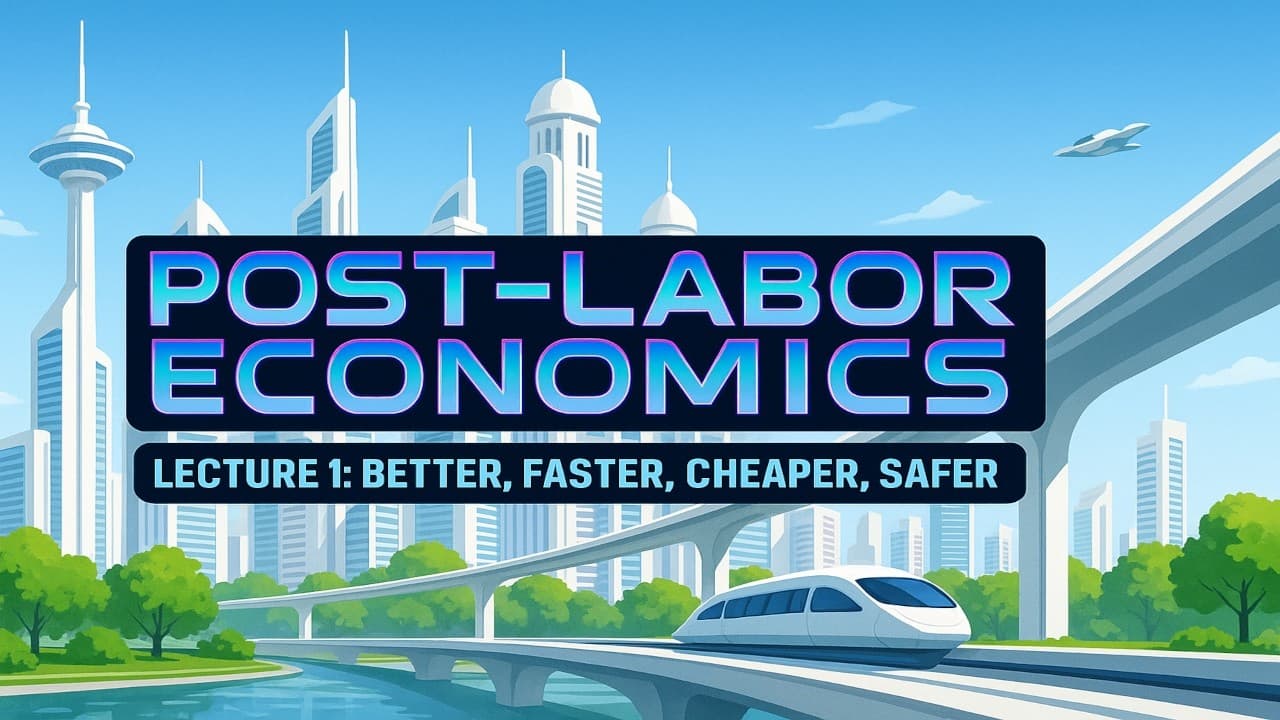
TL;DR
Post-labor economics describes a future where automation replaces human labor, leading to economic decoupling and a weaker link between GDP growth and employment. It outlines four criteria—better, faster, cheaper, safer—that drive labor substitution, and discusses social contract shifts and aggregate demand challenges in a highly automated economy.
Transcript
Welcome to my lecture series on post-labor economics. This will be a four-part series in which I will uncover and uh explain post-labor economic theory as it stands today 2025. It will be updated in the future, but this is basically the culmination of the past 2 or 3 years worth of work. So with all that being said, let's get into it. Uh lecture nu... Read More
Key Insights
- Automation displacement replaces many knowledge and blue-collar jobs as machines improve
- Economic decoupling means GDP grows while human labor input remains limited
- Social contract breakdown occurs when the notion of the right to work loses value
- Aggregate demand can falter if unemployment rises and spending falls
- Better, faster, cheaper, safer are the four drivers of labor substitution
- Automation must deliver superior outputs in accuracy, speed, cost, and safety to be adopted
- Labor attributes on the supply side show strength and dexterity being automated first
- Cognition and empathy remain critical but face growing automation over time
Install to Summarize YouTube Videos and Get Transcripts
Explore YouTube Video Summarizer or Get YouTube Transcript Extractor
Questions & Answers
Q: A real search query question about the video (e.g. 'How to...', 'What is...', 'Why does...', 'When should...'). Question 1
Post-labor economics describes a future economic paradigm where the exchange of wages for labor is no longer the primary driver of growth. It discusses automation displacement as the process that replaces human workers with machines, leading to a potential decoupling of GDP growth from human labor. The framework also introduces social contract changes and the challenge of sustaining aggregate demand when unemployment rises.
Q: Question 2
The concept of labor substitution means replacing human labor with automation. When automation consistently delivers better, faster, cheaper, and safer outputs, it becomes economically irrational to employ humans for those tasks. This shift can drive creative destruction by replacing entire industries that rely on human labor with automated systems and AI.
Q: Question 3
What is economic decoupling in post-labor theory? It is the idea that economic growth and productivity can continue to rise even as the demand for human labor declines. This occurs as automation and AI reduce the need for human input while machines increase efficiency and output across industries.
Q: Question 4
Why is the social contract around the right to work at risk in a highly automated economy? Because if robots and AI are cheaper, safer, and more capable, companies will prefer hiring machines over humans, diminishing the practical ability of individuals to find work even if they have the legal right to be employed.
Q: Question 5
How do the four criteria better, faster, cheaper, and safer drive automation adoption? When a machine can perform a task with higher quality, in less time, for lower cost, and with fewer safety or liability concerns, businesses see automation as the rational choice, accelerating labor substitution.
Q: Question 6
What role does aggregate demand play in post-labor scenarios? If unemployment increases and consumer purchasing power declines, aggregate demand may shrink, threatening the ability of an economy to sustain production and growth even when automation raises productivity and output.
Q: Question 7
Which human labor attributes are most affected by automation, according to the talk? Strength and dexterity have largely shifted toward machines; cognition underpins knowledge work and remains a key area, while empathy and interpersonal skills are increasingly tested by advanced automation and AI in professional settings.
Q: Question 8
What is meant by creative destruction in the context of post-labor economics? It refers to the process by which new technologies render existing industries obsolete, such as automation displacing traditional labor-intensive sectors, while creating opportunities in new automated and AI-driven domains.
Summary & Key Takeaways
-
Post-labor economics envisions a world where wage labor is no longer the primary growth driver due to rapid automation replacing human work. It explains how economic output can rise even as human labor shrinks, creating a decoupled relationship between productivity and employment. The framework also highlights social and demand side challenges that arise in such a shift.
-
The lecture defines automation as a broad category including robots and AI, and emphasizes four criteria—better, faster, cheaper, and safer—that make automation economically rational. It also contrasts labor substitution with creative destruction and underlines the need to rethink labor rights and consumer demand.
-
Finally, the talk outlines how different job attributes are affected, arguing that strength and dexterity have been increasingly replaced by machines while cognition and empathy remain key areas of human value, albeit under intensifying competitive pressure from automation.
Read in Other Languages (beta)
Share This Summary 📚
Summarize YouTube Videos and Get Video Transcripts with 1-Click
Try YouTube Summary with ChatGPT & Claude or YouTube Transcript Generator
Explore More Summaries from David Shapiro 📚

![Claude 3 Review - LLMs are finally good at fiction and prose! [Cyberpunk Fanfic] thumbnail](/_next/image?url=https%3A%2F%2Fi.ytimg.com%2Fvi%2F3anercD5sLA%2Fhqdefault.jpg&w=750&q=75)




Summarize YouTube Videos and Get Video Transcripts with 1-Click
Try YouTube Summary with ChatGPT & Claude or YouTube Transcript Generator