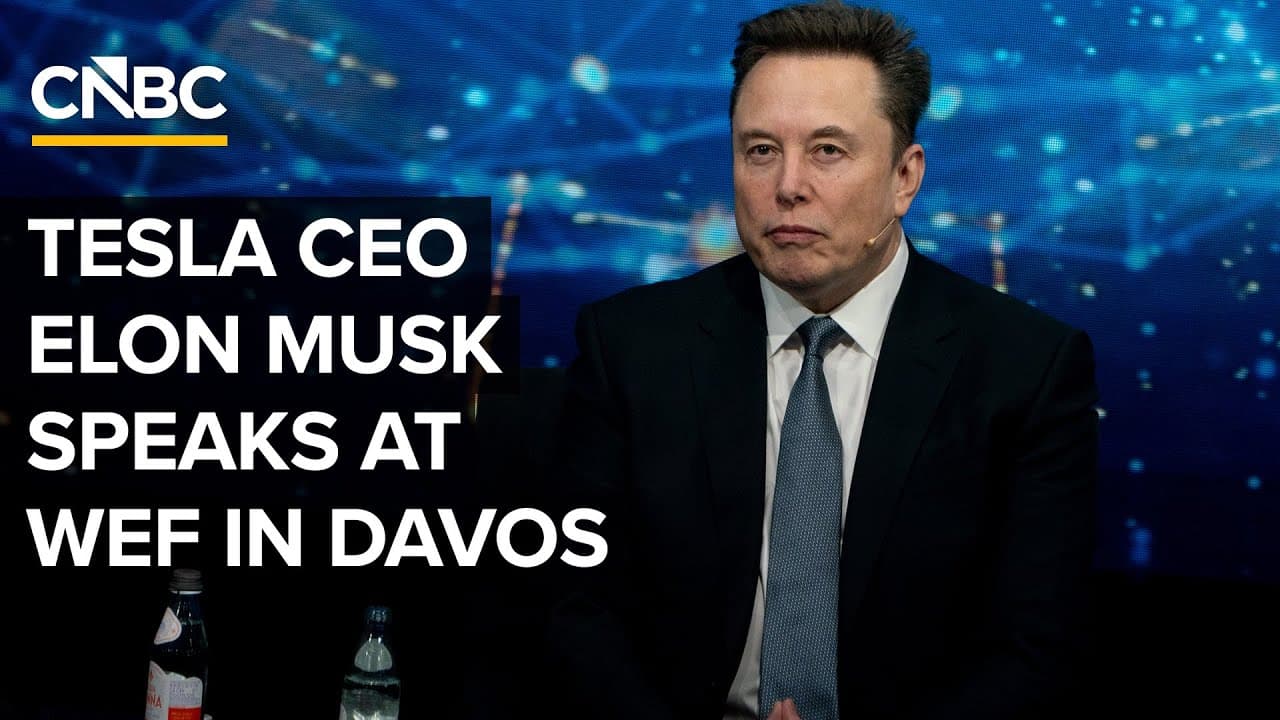
Elon Musk on AI, Robots, Energy, and Space
TL;DR
AI and robotics could create broad abundance by multiplying economic output and making goods, services, and personal assistance widely available, according to Elon Musk. He identifies electrical power as the fundamental constraint on AI deployment, while arguing that reusable space technology, sustainable systems, and careful AI safety are essential to civilization’s long-term future.
Transcript
[applause] [applause] That was not a That was not a large applause. Start again. [applause and cheering] >> That's better. Thank you. >> Yeah, we're going to make this interesting. >> [laughter] >> How many how many quotes are you going to want that are going to be after this session? >> Uh I don't know. I mean five. >> Okay. [laughter] So uh good ... Read More
Key Insights
- Musk’s stated corporate objective is to maximize the probability that civilization has a positive future. His projects address this objective through space exploration, sustainable technology, artificial intelligence, robotics, energy, and the engineering work required to deploy those technologies at scale.
- SpaceX is intended to extend life and consciousness beyond Earth. Musk argues that life may be exceptionally rare and vulnerable, so settlements on the Moon, Mars, and eventually other star systems could preserve consciousness after a natural or human-caused disaster on Earth.
- Tesla’s expanded mission includes sustainable abundance through AI and robotics. Musk argues that providing everyone with a very high standard of living requires machines capable of producing goods and services at a scale that human labor alone cannot achieve.
- Economic output from humanoid robots can be understood as average productivity per robot multiplied by the number of robots. Musk predicts that robots could eventually outnumber people and satisfy so many needs that consumers would struggle to identify additional tasks for them.
- Humanoid robots could provide practical care for children, pets, and elderly parents if they are safe. Musk highlights elderly care because it is expensive and there are not enough younger people available to care for older populations.
- AI and robotics require careful safety controls because abundance does not eliminate technological risk. Musk invokes the dangerous machine scenarios portrayed in the Terminator films as outcomes society should avoid while developing ubiquitous intelligent systems and robots.
- Aging appears solvable to Musk because the body’s cells generally age at similar rates. He infers that a synchronizing clock may operate across the body’s 35 trillion cells, while also warning that extremely long lives could make society rigid and less vibrant.
- Electrical power is the fundamental limiting factor for AI deployment, according to Musk. AI chip production is increasing exponentially, while electricity generation is being added at only about 3% to 4% annually, creating a mismatch between available computing hardware and the energy needed to operate it.
Install to Summarize YouTube Videos and Get Transcripts
Explore YouTube Video Summarizer or Get YouTube Transcript Extractor
Questions & Answers
Q: What is Elon Musk’s goal for Tesla and SpaceX?
Elon Musk says the overall goal of his companies is to maximize the probability that civilization has a positive future. SpaceX advances rocket technology so life and consciousness can expand beyond Earth. Tesla focuses on sustainable technology and has added sustainable abundance to its mission, using artificial intelligence and robotics to pursue wider access to goods, services, and a high standard of living.
Q: Why does Elon Musk want humanity to become multiplanetary?
Musk argues that life and consciousness should be treated as rare, delicate, and vulnerable because there is no confirmed life elsewhere in the discussion. He describes consciousness as a tiny candle in a vast darkness. A multiplanetary civilization could ensure that consciousness continues if a natural disaster or a human-caused disaster severely damages life on Earth.
Q: How could AI and robotics create economic abundance?
AI and robotics could create abundance by greatly increasing the capacity to produce goods and services. Musk describes economic output as average productivity per robot multiplied by the number of robots. If billions of humanoid robots existed, they could perform necessary work at enormous scale, potentially satisfying human needs and expanding the global economy beyond historical precedent.
Q: What jobs could humanoid robots perform in homes?
Humanoid robots could watch children, care for pets, and assist or protect elderly parents, provided that the machines are safe. Musk emphasizes elderly care because it can be expensive and difficult for families, while the number of younger caregivers is insufficient. A dependable household robot could therefore address both practical labor shortages and important personal care needs.
Q: Will robots outnumber humans according to Elon Musk?
Musk predicts that there will eventually be more robots than people and that everyone on Earth may want one. In his benign scenario, billions of humanoid robots would help saturate demand for goods and services. He suggests abundance could become so extensive that people might struggle to think of additional things they want a robot to provide or accomplish.
Q: What is the biggest bottleneck for AI deployment?
Electrical power is the fundamental limiting factor for AI deployment, according to Musk. He says production of AI chips is increasing exponentially, but the rate at which new electricity supply comes online is much slower, at about 3% to 4% annually. This mismatch means energy availability can constrain how much computing hardware is actually operated.
Q: Why could access to AI become broadly available?
Musk expects AI access to broaden because AI companies will seek as many customers as possible. He says the cost of AI is already low and falling rapidly, with meaningful changes occurring from month to month. Open models are also widely available, although he estimates that they trail private or closed models by roughly one year.
Q: Does Elon Musk think aging can be reversed?
Musk considers aging a highly solvable problem and believes methods for extending life or reversing aging are highly likely to emerge. His reasoning is that cells throughout the body generally age at similar rates, suggesting a shared synchronizing clock across 35 trillion cells. He also cautions that extremely long lifespans could lock society in place and reduce its vibrancy.
Summary & Key Takeaways
-
Musk says his companies share a goal of improving civilization’s prospects. SpaceX seeks to extend life and consciousness beyond Earth, while Tesla pursues sustainable technology and sustainable abundance. He presents life as potentially rare and fragile, making a multiplanetary civilization a safeguard against natural or human-caused disasters on Earth.
-
AI and humanoid robots could expand economic output through the combined productivity of billions of machines, Musk predicts. Robots might eventually satisfy human demand for goods and services while helping with childcare, pets, and elderly care. He acknowledges unresolved questions about safety, employment, human purpose, and avoiding dangerous outcomes.
-
Electrical power is the fundamental bottleneck for deploying AI at scale, according to Musk. AI chip production is growing exponentially, but new electricity supply is increasing much more slowly. He nevertheless expects AI access to broaden because companies want more customers, costs are falling rapidly, and open models trail closed models by roughly a year.
Read in Other Languages (beta)
Share This Summary 📚
Summarize YouTube Videos and Get Video Transcripts with 1-Click
Try YouTube Summary with ChatGPT & Claude or YouTube Transcript Generator
Explore More Summaries from CNBC Television 📚

Summarize YouTube Videos and Get Video Transcripts with 1-Click
Try YouTube Summary with ChatGPT & Claude or YouTube Transcript Generator