How to start a profitable trash business with little cash
TL;DR
Presell the service before buying equipment to fund the venture. Use a low-cost, side loader setup to reduce staffing and licensing needs, then finance the truck and scale through neighborhood signups and city contracts. The result: a recurring revenue model with high margins and minimal churn.
Transcript
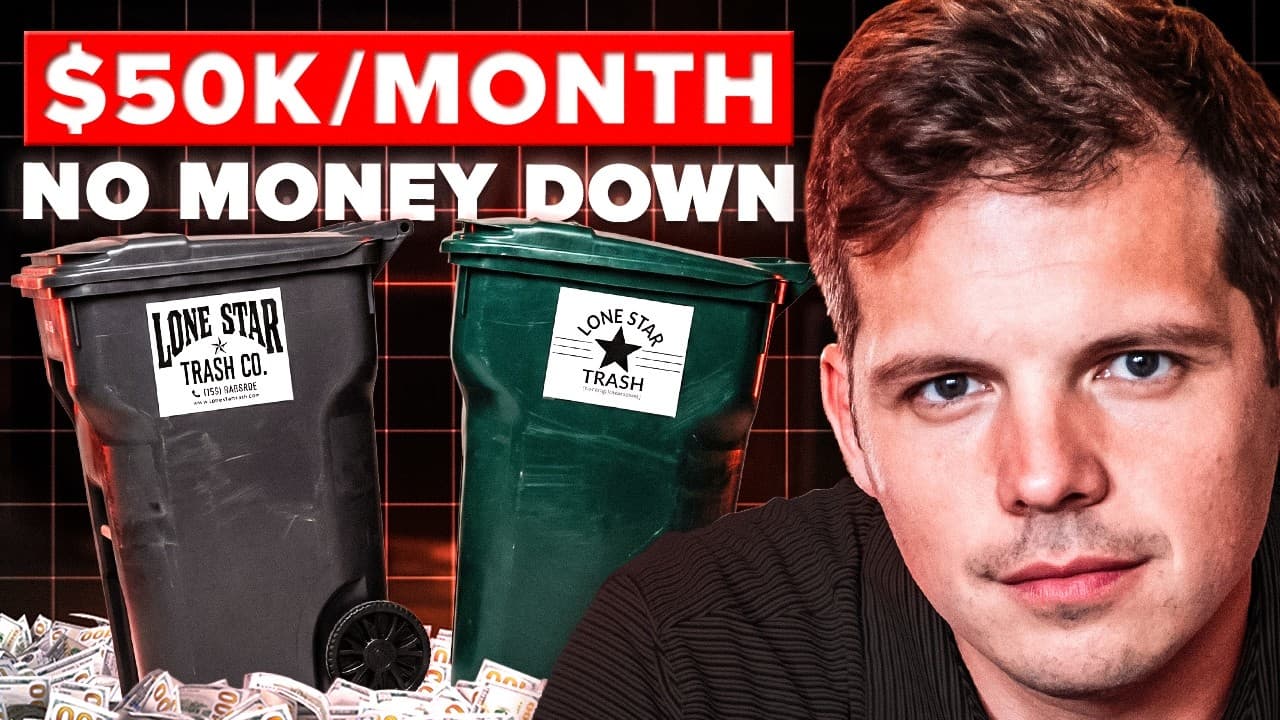
What if I told you there was treasure in this trash? Well, as luck would have it, my friend Spencer started a trash business with almost no money that does $50,000 a month. And so, I bought the truck, started making payments on it, never took a dollar out of my pocket. How much revenue does this one truck generate? 9* 800 would be your number. I st... Read More
Key Insights
- Presales fund equipment and reduce financial risk by pre-booking customers before ownership.
- A side loader truck enables faster service and lower labor needs, boosting daily house coverage.
- Financing the truck 100 percent removes initial cash barriers and accelerates growth.
- Transparency and risk-free offers help attract customers without prior industry experience.
- Route density, not just fleet size, determines profitability and scalability.
- Public sentiment about existing providers can be leveraged to win new customers through clear value propositions.
- Marketplace research and community groups can uncover cost-effective truck acquisition channels.
- Recurring revenue with upfront prepayments creates cash flow predictability and easier budgeting.
- More videos from this channel:
- More from this channel: Chris Koerner on The Koerner Office Podcast
Install to Summarize YouTube Videos and Get Transcripts
Explore YouTube Video Summarizer or Get YouTube Transcript Extractor
Questions & Answers
Q: How did Spencer fund the initial truck without upfront cash?
Spencer funded the initial truck almost entirely through pre sales and a personal loan route. He used a pre sale to gather 15,000 dollars from about 200 people with a 105 dollar upfront commitment, while keeping an escrow window to protect refunds. He later financed the truck using a personal loan secured through his AMX account, enabling him to purchase the truck and ship it with minimal immediate outlay. This approach demonstrated that almost all capital could be generated before ownership, validating demand and reducing risk.
Q: What is the role of pre sales in starting the trash business?
Pre sales served as the core mechanism to validate demand and fund equipment. The strategy offered a no-risk guarantee: if the goal wasn’t met, everyone would be refunded. It created a cash runway of about 15,000 dollars before the truck was owned and showed the viability of a subscription-like model in a traditionally cash-intensive industry. It also helped quantify customer interest and set expectations.
Q: How does a side loader truck contribute to efficiency?
A side loader truck contributes to efficiency by delivering fast and automated bin handling, allowing the team to service more homes per day. The dialogue notes that 15 seconds per house is achievable with a side loader, versus potentially a minute per house with a rear loader. This speed difference significantly impacts route density and scalability, enabling broader coverage with the same staffing.
Q: What financing method was used to acquire the truck?
The truck was financed 100 percent using a personal loan obtained through a bank-like lender associated with a major card company. The loan terms were seven percent and not tied to the equipment, meaning the liability was personal but the equipment could be used independently. This financing choice lowered upfront costs and allowed rapid acquisition while maintaining cash flow flexibility.
Q: How did Spencer discover where to buy a suitable trash truck?
Spencer searched on Facebook Marketplace and then joined the mom and pop trash group to consult operators. He learned that the holy grail truck was a side loader that could operate with minimal staff under CDL. This discovery came from conversations with operators in the group who shared recommendations about auctions and direct seller networks, guiding him to a suitable purchase.
Q: What numbers illustrate the pre sales and initial revenue in the story?
The pre sales generated about 15,000 dollars from roughly 200 customers paying 105 dollars each. In addition, the offering promised a 100% refund if goals were not met, and the plan was to use proceeds to buy the truck. These numbers show a strong early cash flow and a concrete plan to scale once ownership was secured.
Q: How did the team handle risk and refunds during the pre-sale period?
Risk was mitigated by extending the escrow for as long as possible before funds were transferred to the operator, with the option for refunds clearly outlined. The approach balanced customers’ protection with the seller’s ability to deploy the funds toward early investments. If the goals were achieved, refunds would not occur; otherwise, refunds would be issued, preserving trust with early adopters.
Q: What was the motivation for using a software mindset in a trash business?
The motivation was to apply software-like thinking to a physical service model, treating the customer base as subscribers and the service as a recurring delivery. The founder compared trash collection to software subscriptions and sought predictable monthly revenue, scalability, and low churn by delivering consistent value and providing transparent offerings to customers.
Summary & Key Takeaways
-
The plan begins with a presale to fund the truck and service setup, reducing upfront risk. By offering a near risk-free option, the founders secure 15,000 dollars in pre-sales and build a customer base before ownership. This approach creates a reliable early cash flow and validates demand.
-
Next, the strategy centers on acquiring a discount truck and financing it entirely, enabling rapid fleet expansion with minimal out-of-pocket expense. A side loader and CDL flexibility lower labor requirements and compliance barriers, accelerating route growth and scalability.
-
Finally, the model emphasizes scalable customer acquisition and retention through transparent terms and strong service guarantees. This reduces churn, supports expansion to multiple neighborhoods, and sustains a roughly 40 percent gross margin as operations mature.
Read in Other Languages (beta)
Share This Summary 📚
Summarize YouTube Videos and Get Video Transcripts with 1-Click
Try YouTube Summary with ChatGPT & Claude or YouTube Transcript Generator
Explore More Summaries from Chris Koerner on The Koerner Office Podcast 📚





Summarize YouTube Videos and Get Video Transcripts with 1-Click
Try YouTube Summary with ChatGPT & Claude or YouTube Transcript Generator