Column Chromatography Principle And Technique - Basic Principles and Techniques in Organic Chemistry
TL;DR
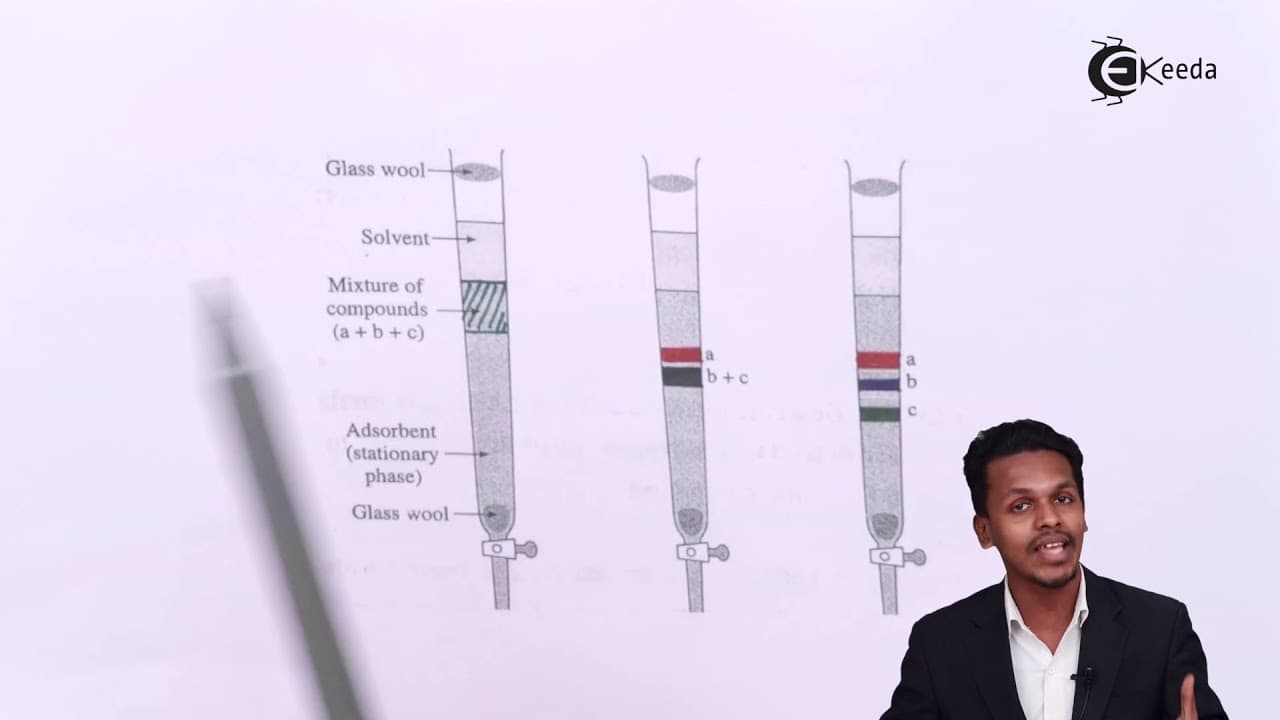
Column chromatography is a technique used for separating organic mixtures based on the principle of differential adsorption on a stationary phase.
Transcript
click the bell icon to get latest videos from Ikeda reference in the previous lecture we have understood that is what is a chromatograph yes less what are the type sauce formula carefully I along with that of the principle and now we are going to talk about the first type that is the column chromatography that comes under the type that is adsorptio... Read More
Key Insights
- ⚾ Column chromatography is a technique used to separate organic mixtures based on differential adsorption.
- ❓ The principle behind column chromatography is that different components of a mixture have varying tendencies to adsorb onto the stationary phase.
- ☠️ The technique involves passing a solvent through a column packed with a stationary phase, with components eluting at different rates.
- ❓ Column chromatography is widely used in industries for separating and purifying organic compounds.
- 🚗 The choice of stationary phase and mobile phase in column chromatography is crucial for achieving optimal separation.
- 👻 The technique allows for the separation of complex mixtures into individual components.
- ✋ Column chromatography can be time-consuming but provides high resolution separation.
Install to Summarize YouTube Videos and Get Transcripts
Explore YouTube Video Summarizer or Get YouTube Transcript Extractor
Questions & Answers
Q: What is column chromatography and how does it work?
Column chromatography is a technique used to separate mixtures of organic compounds. It works based on differential adsorption, where the components of the mixture adsorb to varying degrees on a stationary phase packed in a column. By passing a solvent through the column, the components elute at different rates, allowing for separation.
Q: What is the principle behind column chromatography?
The principle behind column chromatography is differential adsorption. Different components of a mixture have varying tendencies to adsorb onto the stationary phase. By exploiting these differences, it is possible to separate the components based on their adsorption characteristics.
Q: What is the stationary phase in column chromatography?
The stationary phase in column chromatography is a material packed inside the column, typically silica or aluminum gel. It provides a surface for the components of the mixture to adsorb onto during the separation process.
Q: How is column chromatography used to purify organic compounds?
Column chromatography can be used to purify organic compounds by separating them from impurities in a mixture. By carefully selecting the mobile phase and controlling the elution conditions, it is possible to obtain pure compounds in separate fractions.
Summary & Key Takeaways
-
Column chromatography is a type of adsorption chromatography used to separate mixtures of organic compounds.
-
The principle behind column chromatography is differential adsorption, where different components of a mixture are adsorbed to varying degrees on the stationary phase.
-
The technique involves passing a solvent through a column filled with a stationary phase, with different components of the mixture eluting at different rates.
Read in Other Languages (beta)
Share This Summary 📚
Summarize YouTube Videos and Get Video Transcripts with 1-Click
Try YouTube Summary with ChatGPT & Claude or YouTube Transcript Generator
Explore More Summaries from Ekeeda 📚



Summarize YouTube Videos and Get Video Transcripts with 1-Click
Try YouTube Summary with ChatGPT & Claude or YouTube Transcript Generator