What Are the Key Engineering Features of the Space Shuttle?
TL;DR
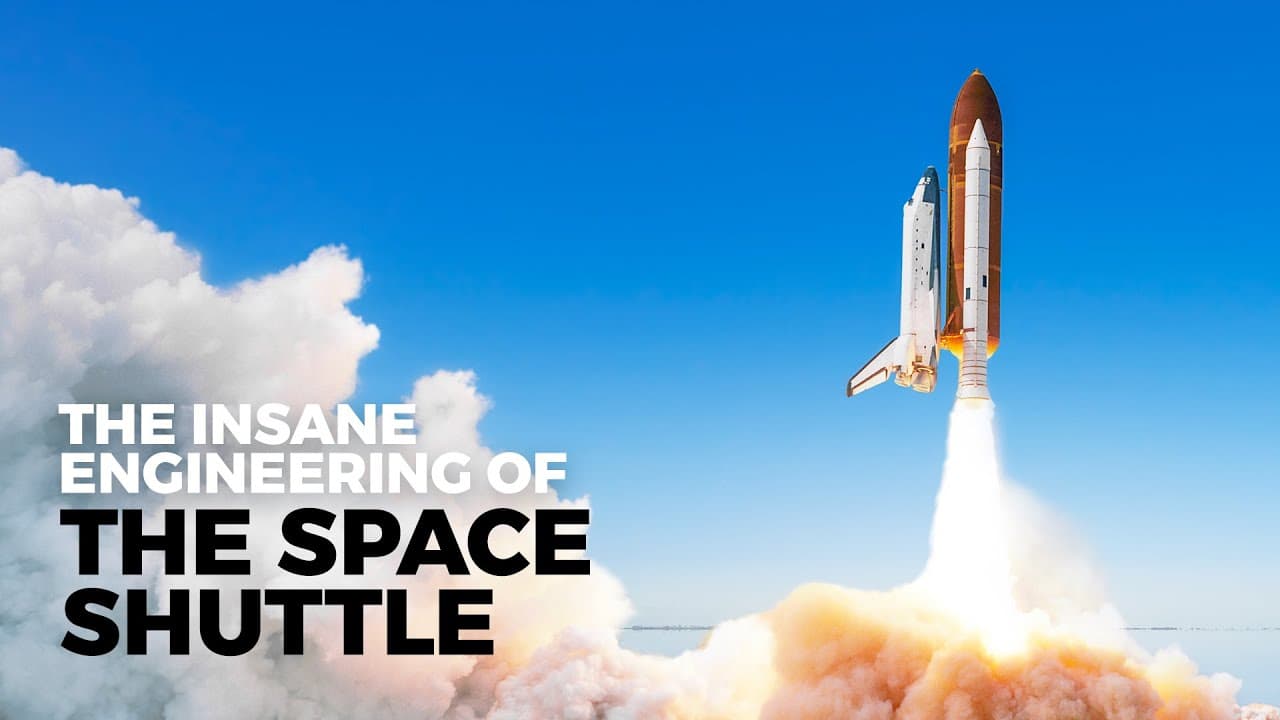
The Space Shuttle's launch system comprises three liquid fuel engines and two solid rocket boosters that provide immense thrust. Solid rocket boosters present control challenges due to their inability to be shut down once ignited, while the external tank acts as the structural backbone of the Shuttle, housing liquid hydrogen and oxygen. Its design innovations ensure stability and successful ascent into orbit.
Transcript
This video is brought to you by Nebula. Watch episode 2 right now by signing up With the link the description. Late on a spring evening, 1992, the Endeavor Space Shuttle, on its maiden flight, stood on its launch pad in Cape Canaveral Florida. The crew sitting aboard ready to take on a daring mission. A rendezvous between two spacecraft in orbit. A... Read More
Key Insights
- The Space Shuttle's launch involves a complex sequence of events, including the ignition of three liquid fuel rocket engines and two massive solid rocket boosters.
- Solid rocket boosters provide immense thrust but pose control challenges, as they cannot be turned off once ignited.
- The Shuttle's design includes unique engineering solutions like the offset main engines and hold down posts to prevent tipping during launch.
- The external tank is a critical component, acting as the structural backbone and housing both liquid hydrogen and oxygen.
- Thrust vectoring and aerodynamic control surfaces are crucial for maintaining the Shuttle's trajectory and reducing stress during ascent.
- Separation of the solid rocket boosters is a carefully timed process involving explosive bolts and separation motors.
- The Shuttle's ascent involves a roll maneuver to align with its orbital path, dictated by the constraints of the launch pad design.
- The external tank is designed to disintegrate upon reentry, with its remnants falling into the ocean, marking a significant design compromise.
Install to Summarize YouTube Videos and Get Transcripts
Explore YouTube Video Summarizer or Get YouTube Transcript Extractor
Questions & Answers
Q: What challenges did the crew face during the satellite rescue mission?
The crew faced the challenge of rescuing a satellite that was not designed to be handled by humans. It was stuck in a low orbit due to a failed second stage rocket. The mission involved manually attaching a new second stage to the satellite, requiring precise maneuvers and coordination.
Q: How do the solid rocket boosters contribute to the Shuttle's launch?
The solid rocket boosters provide the majority of the thrust needed to lift the Space Shuttle off the ground. They are the largest solid rockets ever used in human space flight, each providing 13,000 kilonewtons of thrust. Once ignited, they burn continuously until all the propellant is expended, requiring careful engineering to control the launch.
Q: Why is the Shuttle's main engine offset from the fuel tanks?
The Shuttle's main engines are attached to the reusable orbiter rather than the expendable external tank. This design choice allows the engines to be reused on multiple missions. However, it also creates a moment that tilts the Shuttle during ignition, a phenomenon known as 'twang,' which is countered by hold down posts.
Q: What is the purpose of the external tank in the Shuttle's design?
The external tank serves as the structural backbone of the Space Shuttle system, housing the liquid hydrogen and oxygen needed for the main engines. It must withstand enormous loads during launch and is designed to disintegrate upon reentry, marking a significant compromise in the Shuttle's intended reusability.
Q: How is thrust vectoring used during the Shuttle's ascent?
Thrust vectoring involves adjusting the direction of the rocket nozzles to control the Shuttle's trajectory. It is crucial for maintaining stability and executing maneuvers like the roll program, which aligns the Shuttle with its orbital path and reduces aerodynamic stress on the wings.
Q: What design considerations are made for the solid rocket boosters?
The solid rocket boosters are designed with a specific thrust profile to manage dynamic pressure and control during ascent. They feature an 11-point star cavity to increase initial thrust and gradually decrease it, preventing structural stress on the Shuttle. They are also filled in pairs to ensure balanced thrust.
Q: How does the Shuttle's ascent affect the astronauts' experience?
During ascent, astronauts experience significant G-forces and noise from the engines, which diminishes as the Shuttle reaches supersonic speeds. The transition from the first to the second stage involves a loud separation event, followed by a smoother ride under the main engines' power, with increasing G-forces until engine cutoff.
Q: What happens to the external tank after separation?
After separation, the external tank tumbles back to Earth, where it disintegrates upon reentry. The tank's remnants fall into the ocean, making it the only non-reusable component of the Shuttle system. Astronauts are tasked with photographing the tank after separation to identify any potential issues for future missions.
Summary & Key Takeaways
-
The video dissects the intricate engineering behind the Space Shuttle's launch, highlighting the sequence of events from ignition to booster separation. It delves into the challenges and innovations involved in using solid rocket boosters and the design of the external tank.
-
The launch sequence is a finely tuned choreography involving the Shuttle's main engines and solid rocket boosters, which provide the necessary thrust to escape Earth's atmosphere. The video explains the technical details of these components and their roles in the launch.
-
The Space Shuttle's design features, such as its external tank and thrust vectoring capabilities, are explored in depth. The video also covers the unique challenges posed by the Shuttle's offset engines and the solutions engineered to ensure a successful launch.
Read in Other Languages (beta)
Share This Summary 📚
Summarize YouTube Videos and Get Video Transcripts with 1-Click
Try YouTube Summary with ChatGPT & Claude or YouTube Transcript Generator
Explore More Summaries from Real Engineering 📚

Summarize YouTube Videos and Get Video Transcripts with 1-Click
Try YouTube Summary with ChatGPT & Claude or YouTube Transcript Generator