Do Large Contexts Replace RAG in LLMs?
TL;DR
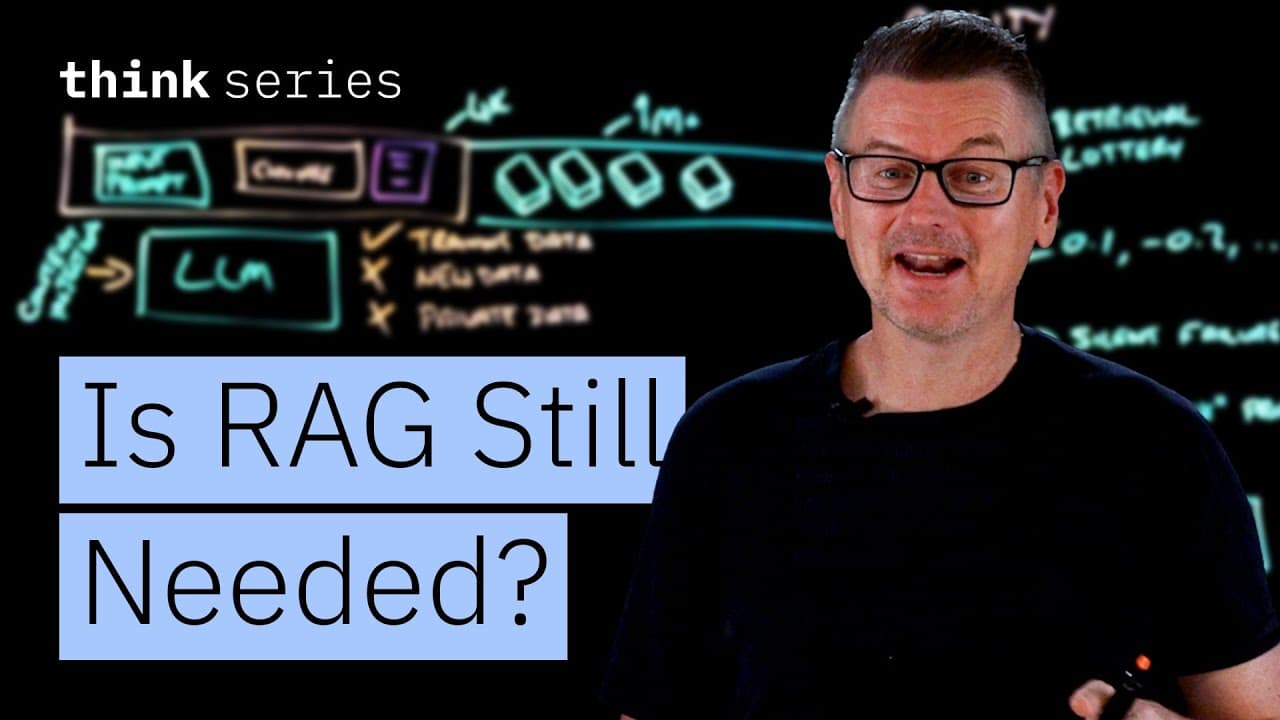
Large contexts do not replace RAG in LLMs; long context works well for bounded datasets, while RAG remains necessary for vast or effectively infinite enterprise data. A context window can reach a million tokens, roughly 700,000 words, but repeatedly processing a 250,000-token manual creates heavy compute costs. Read on to compare retrieval risk, reasoning quality, infrastructure, and the best use cases for each approach.
Transcript
There's a fundamental truth about LLMs, large know everything about our world up until nothing about what happened 5 minutes ago. Nor your internal wikis, your proprietary codebase. And well, we have to solve the problem of context model at the right time? And there have been two is really what we can think of as the engineering So here we've got a... Read More
Key Insights
- LLMs have limitations in accessing up-to-date or proprietary information, requiring solutions like RAG.
- RAG uses embedding models to convert documents into vectors for efficient retrieval.
- Long context windows allow direct input of large data sets into the model for analysis.
- RAG is advantageous for large, unbounded datasets with its efficient retrieval mechanism.
- Long contexts are suitable for bounded datasets where all information can fit into the context window.
- RAG reduces computational load by focusing on relevant data chunks, avoiding unnecessary processing.
- Long context windows require significant computational resources for large data inputs.
- Combining RAG and long context approaches can optimize performance based on specific use cases.
Install to Summarize YouTube Videos and Get Transcripts
Explore YouTube Video Summarizer or Get YouTube Transcript Extractor
Questions & Answers
Q: Do large context windows replace RAG in LLMs?
No. Long context is compelling when the relevant dataset is bounded and fits within the model’s context window, but RAG remains useful for enterprise data measured in terabytes or more. The best choice depends on the dataset and the task.
Q: How does RAG work in LLMs?
RAG chunks documents such as PDFs, code files, or books and passes the chunks through an embedding model that turns them into vectors. When a user asks a question, semantic search retrieves matching chunks and injects them into the LLM’s context window.
Q: What is the main advantage of using long context instead of RAG?
Long context removes much of the retrieval infrastructure: embeddings, retrieval logic, vector data stores, and reranking. The data is placed directly into the context window, allowing the model to find the answer and reason across the full material.
Q: What is the retrieval lottery in RAG?
RAG relies on probabilistic vector search to find the closest chunks to a query. Relevant information may exist in the data but never reach the LLM because retrieval returned the wrong results. Long context avoids this retrieval step by giving the model the full bounded dataset.
Q: Why can long context be better for comparing complete documents?
RAG is designed to retrieve snippets that match a query, so it may miss relationships defined by what differs or is absent across documents. For example, retrieving snippets from requirements documents may not reveal omitted security requirements. Long context can provide both documents in full so the model sees the complete picture.
Q: What computational drawback does long context have?
The model must process all supplied material for each prompt, which creates a substantial compute cost. A 500-page manual may contain about 250,000 tokens, and frequently changing content limits how much caching can offset repeated processing.
Q: How does RAG address the needle-in-the-haystack problem?
Models can struggle to locate one relevant paragraph inside a context containing around 500,000 tokens. RAG removes much of that haystack by supplying fewer, relevant chunks. This focuses the model on the signal rather than the entire dataset.
Q: When should you choose RAG versus long context?
Choose long context for bounded material such as a specific legal contract or a book when the full dataset fits and cross-document reasoning matters. Choose RAG for vast enterprise knowledge that cannot fit into a context window and when narrowing the model’s attention to relevant chunks is valuable. The two approaches can also be combined according to the application’s needs.
Summary & Key Takeaways
-
Retrieval Augmented Generation (RAG) remains essential for large language models (LLMs) when dealing with vast, unbounded datasets. It efficiently retrieves relevant data chunks, minimizing computational load. Conversely, long context windows are ideal for bounded datasets, allowing direct input of large data into the model's context window.
-
RAG employs embedding models to convert documents into vectors, enabling efficient semantic search and retrieval. This approach excels in scenarios where precise, relevant information retrieval is crucial, such as in enterprise knowledge bases or dynamic datasets.
-
Long context windows, while resource-intensive, provide comprehensive data analysis by allowing large datasets to be directly processed. The choice between RAG and long context depends on dataset size and application needs, with both methods offering distinct advantages.
Read in Other Languages (beta)
Share This Summary 📚
Summarize YouTube Videos and Get Video Transcripts with 1-Click
Try YouTube Summary with ChatGPT & Claude or YouTube Transcript Generator
Explore More Summaries from IBM Technology 📚




Summarize YouTube Videos and Get Video Transcripts with 1-Click
Try YouTube Summary with ChatGPT & Claude or YouTube Transcript Generator