How to Build a Language Model with Python
TL;DR
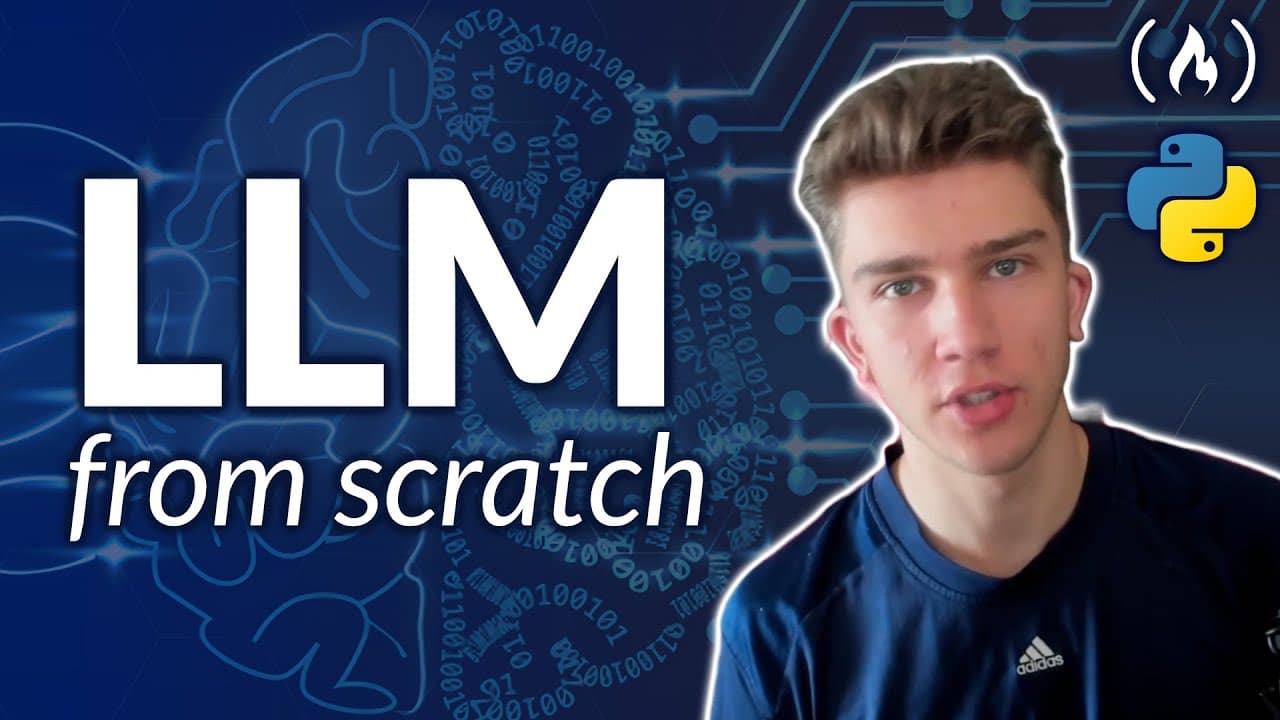
Learn to create a large language model from scratch using Python, focusing on data handling, math, and transformers. The course is beginner-friendly, requiring minimal math background, and uses local computation without cloud services. You will gain insights into tokenization, tensors, and PyTorch functions to develop a functional language model.
Transcript
Learn how to build your own large language model from scratch. This course goes into the data handling, math, and transformers behind large language models. Elia Arleds created this course. He will help you gain a deep understanding of how LLMs work and how they can be used in various applications. So let's get started. Welcome to Intro to Language... Read More
Key Insights
- Large language models (LLMs) can be built from scratch using Python, focusing on data handling, math, and transformers.
- The course is designed for beginners, requiring only basic Python knowledge and no advanced math prerequisites.
- Tokenization is crucial for language models, with character-level tokenizers being used to convert text into integers.
- PyTorch is used for handling tensors and performing complex calculations efficiently, especially when utilizing GPUs.
- Batch size and block size are key hyperparameters that affect the training efficiency and performance of the model.
- The course emphasizes using local computation, avoiding the need for paid datasets or cloud computing resources.
- Embedding vectors play a vital role in representing the sentiment of characters in the model.
- Gradient descent and optimizers like AdamW are used to minimize loss and improve the model's accuracy over time.
Install to Summarize YouTube Videos and Get Transcripts
Explore YouTube Video Summarizer or Get YouTube Transcript Extractor
Questions & Answers
Q: How to build a large language model from scratch?
To build a large language model from scratch, start by understanding the data handling, math, and transformer architecture. Use Python and libraries like PyTorch to manage tensors and perform calculations. Tokenize your data, set hyperparameters like batch and block size, and use gradient descent with optimizers like AdamW to minimize loss and improve accuracy over iterations.
Q: What prerequisites are needed for this course?
The course is beginner-friendly and requires only basic Python knowledge, with no advanced math prerequisites. It assumes familiarity with Python syntax and a willingness to learn about data handling, math, and transformers used in building large language models.
Q: Why is tokenization important in language models?
Tokenization is crucial in language models because it converts text into integers, allowing the model to process and understand the data. Character-level tokenizers, used in this course, break down the text into individual characters, which are then encoded as integers for further processing using tensors and PyTorch functions.
Q: How does PyTorch help in building language models?
PyTorch aids in building language models by efficiently handling tensors, which are used for storing and manipulating data. It provides functions for matrix operations, gradient descent, and optimizers, allowing for efficient training and computation, especially when utilizing GPUs for parallel processing.
Q: What are batch size and block size in language models?
Batch size and block size are hyperparameters that affect the training efficiency and performance of language models. Batch size determines how many sequences are processed in parallel, while block size defines the length of each sequence. Adjusting these parameters can optimize the model's learning process and computational efficiency.
Q: Why use local computation instead of cloud services?
Local computation is emphasized in this course to avoid the costs and complexities associated with cloud services. By using local resources, learners can focus on understanding the fundamental concepts of language models without the need for paid datasets or cloud computing, making the learning process more accessible and cost-effective.
Q: What role do embedding vectors play in language models?
Embedding vectors represent the sentiment and meaning of characters in a language model. They are learnable parameters that help the model understand the context and relationships between different tokens, improving the model's ability to generate coherent and contextually relevant text.
Q: How is gradient descent used in training language models?
Gradient descent is used to minimize the loss function by adjusting the model's parameters in the direction of the steepest descent. By iteratively updating the weights and biases, the model learns to make more accurate predictions. Optimizers like AdamW enhance this process by adapting the learning rate and applying weight decay for better generalization.
Summary & Key Takeaways
-
The course teaches how to build a large language model from scratch using Python, focusing on data handling, math, and transformers. It's designed for beginners, requiring minimal math background and basic Python knowledge.
-
Tokenization, particularly character-level tokenizers, is essential for converting text into integers, which are then processed using PyTorch's tensor operations.
-
Key concepts like batch size, block size, embedding vectors, and gradient descent are covered, with an emphasis on local computation to avoid cloud services.
Read in Other Languages (beta)
Share This Summary 📚
Summarize YouTube Videos and Get Video Transcripts with 1-Click
Try YouTube Summary with ChatGPT & Claude or YouTube Transcript Generator
Explore More Summaries from freeCodeCamp.org 📚




Summarize YouTube Videos and Get Video Transcripts with 1-Click
Try YouTube Summary with ChatGPT & Claude or YouTube Transcript Generator