How to Get More Done in Less Time With Leverage
TL;DR
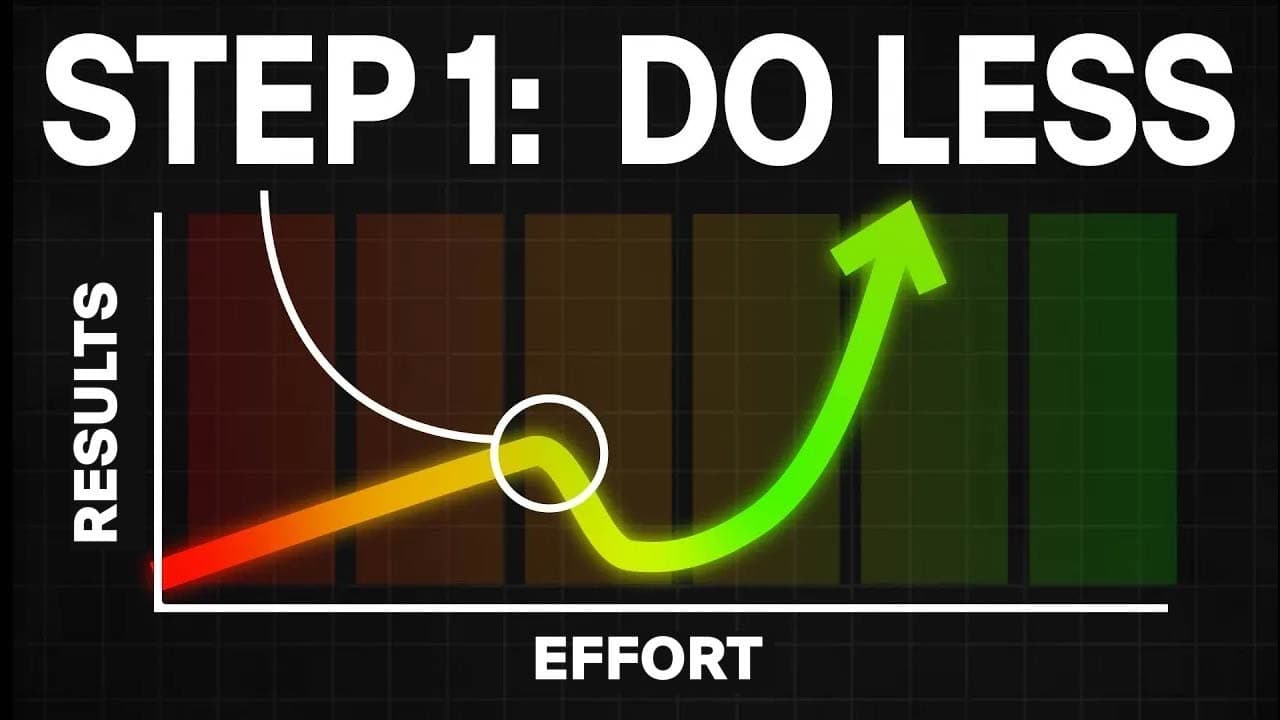
Productivity is the ratio of input to output, not raw effort, so the fastest way to get more done is to gain leverage: producing more output per unit of input. Push through the temporary 'output dip' when building systems, and focus leverage on three areas: proficiency, process, and people.
Transcript
Imagine accomplishing 30 hours worth of work in a single hour with consistency. Well, it's not a fantasy. It's a reality for those who understand the deep science of productivity and how to untether the number of hours you work from the amount you achieve. Now, I'm Randar, founder and CEO of flowstate.com. We've trained everyone from Audi, Assentur... Read More
Key Insights
- Productivity is defined as input cost relative to output value, not the amount of effort spent. A factory is not more productive because workers sweat more; it is more productive if it produces more units per hour.
- Leverage lets you increase output without increasing input, or achieve the same output with less input. Like a physical lever lifting a heavy object with minimal force, it multiplies results while effort stays constant or drops.
- The 'output dip' is the temporary slowdown when building leverage. Automating a system takes setup time and hiring someone requires training, so momentum drops at first, which makes the brain panic and revert to familiar linear effort.
- People stay stuck in effort loops because their brain is wired to avoid what leverage requires. They try to build leverage, hit the output dip, interpret the slowdown as lost productivity, and revert to tasks that feel productive but aren't.
- The 'leverage lens' is a way of seeing work where every action is evaluated by the question: does this create future leverage that increases output per unit of input? One editor with this lens went from $4,000/month to $250,000/year.
- Proficiency leverage means learning the right skill, not all the skills. Identify the biggest constraint blocking your results, then run a 'five for four': 5 hours of skill building per week for 4 weeks to reach 20 hours of real proficiency.
- Process leverage turns one-off tasks into repeatable systems. Any task done at least twice will be done again, signaling it needs a standard operating procedure. A writer's email template dropped response time from 45 minutes to five forever.
- People leverage means multiplying yourself through others. A low-leverage entrepreneur does 2 hours of admin daily, wasting over 500 hours a year, while a high-leverage one automates sequences, onboarding, and invoicing to free that time.
Install to Summarize YouTube Videos and Get Transcripts
Explore YouTube Video Summarizer or Get YouTube Transcript Extractor
Questions & Answers
Q: What is the real definition of productivity?
Productivity is technically defined as input cost relative to output value, meaning the ratio between what you put in and what you get out. It is not about doing more or working harder. One of the simplest ways to boost productivity is to get the same or better results while putting in fewer hours, less energy, or less attention. A factory is not considered more productive because workers sweat more, but because it produces more units per hour.
Q: What is leverage in productivity?
Leverage allows you to increase output without increasing input, or achieve the same output with less input. Just as a physical lever lets you lift a heavy object with minimal force, leverage in productivity lets you multiply results while holding effort constant or even reducing it. For example, a dentist gains leverage by hiring an assistant to fix more teeth per hour, and a writer gains leverage by learning to type faster to produce more words in the same time.
Q: What is the output dip and why does it stop people?
The output dip is the temporary pause and slowdown you experience when building leverage. Automating a system takes time to set up, and hiring someone requires training, so at first you lose momentum. This makes your brain panic because it only cares that nothing got finished today, not that you will save hundreds of hours long term. It pulls you back into familiar linear effort that feels productive, which is why so many people stay stuck in effort loops.
Q: What is a leverage lens and how do you develop one?
A leverage lens is a way of seeing work where every action is evaluated through the question: does this create future leverage that increases my output for every unit of input? An editor named Johnny used it by constantly asking how each task could be done faster or better next time, building systems and learning to recruit and manage others. Over two years he went from $4,000 a month to $250,000 a year, while a second editor with the same skills but no leverage lens saw zero change.
Q: What is the leverage trifecta?
The leverage trifecta is the three places a knowledge worker, entrepreneur, or executive needs to gain leverage: proficiency, process, and people, known as the three Ps. It gives you a consistent way to view, diagnose, and fix productivity gaps anytime you feel stuck or stalled. Proficiency leverage means learning the right skill; process leverage means turning one-off tasks into repeatable systems; and people leverage means multiplying yourself through others.
Q: How do you build proficiency leverage?
Proficiency leverage means learning the right skill, not all the skills. First, identify your biggest constraint by looking at the results you want but do not yet have, since a skill gap is blocking you. An entrepreneur struggling to get clients might master sales, while a creator might master distribution. Then run the five-for-four protocol: 5 hours of skill building per week for 4 weeks straight, reaching 20 hours, enough to gain real working proficiency in a single high-lever skill.
Q: How do you create process leverage?
Process leverage turns one-off tasks into repeatable systems. To spot deficiencies, look at any task you have done at least twice, because if you have done it twice you will do it again, which signals it needs a system. Build a standard operating procedure by defining the purpose and goal and detailing every step with instructions clear enough for anyone to follow. An artist wasting 24 creative days a year on inventory could reclaim nearly a month with a basic tracking system.
Q: How much time can automating tasks actually save?
A low-leverage entrepreneur does everything manually, spending 2 hours a day on admin work that could be fully automated. That is 10 hours a week and over 500 hours a year wasted on tasks that create no leverage. A high-leverage entrepreneur builds systems instead, with pre-written email sequences that send automatically, onboarding processes, and invoicing handled by software. That frees up 500 hours per year to focus on more high-leverage work that continues compounding per-hour output.
Summary & Key Takeaways
-
Productivity is the ratio between input and output, not effort. Getting the same or better results with fewer hours, less energy, or less attention is what makes you more productive. Leverage, like a physical lever, multiplies output while holding effort constant or reducing it.
-
Building leverage triggers an 'output dip,' a temporary slowdown while systems are set up or people are trained. The brain panics because nothing gets finished today and steers you back to familiar linear effort. Pushing through this dip and cultivating a 'leverage lens' is essential.
-
The leverage trifecta covers the only three places knowledge workers need leverage: proficiency (learn the right skill via a five-for-four sprint), process (turn repeated tasks into SOPs and automation), and people (multiply yourself through others). Mastering these three flips tiny inputs into massive outputs.
Read in Other Languages (beta)
Share This Summary 📚
Summarize YouTube Videos and Get Video Transcripts with 1-Click
Try YouTube Summary with ChatGPT & Claude or YouTube Transcript Generator
Explore More Summaries from Rian Doris 📚





Summarize YouTube Videos and Get Video Transcripts with 1-Click
Try YouTube Summary with ChatGPT & Claude or YouTube Transcript Generator