How to Build Effective Skills for AI Agents
TL;DR
Build effective agent skills by making deliberate choices about invocation, separating procedures from supporting references, steering behavior with precise language, and pruning unnecessary content. User-invoked skills improve control but increase the user’s cognitive load, while model-invoked skills improve flexibility but add context load and unpredictability. Keep the main skill file small by moving branch-specific material into referenced files.
Transcript
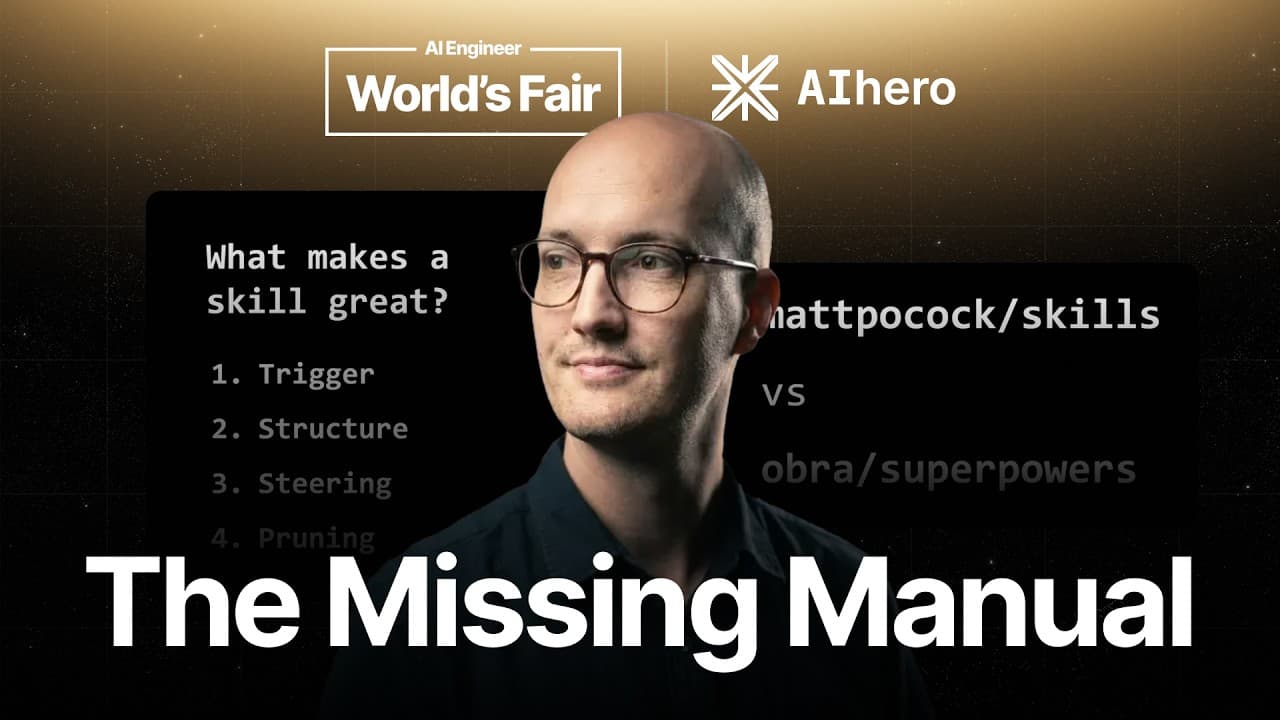
Hello friends. I was dearly hoping to be able to come to the AI engineer World's Fair, but family matters have intruded and I'm not able to make it. However, I will not be leaving you empty-handed. I'm going to give you the talk that I would have given in San Francisco. This talk is called the missing manual. How to write great skills. And I think ... Read More
Key Insights
- A shared checklist is necessary for evaluating agent skills because developers and organizations otherwise lack a consistent way to distinguish effective instructions from ineffective ones, improve existing skills, or translate operating procedures into work an agent can perform.
- A skill trigger is the mechanism that determines how the skill is invoked. Skills can always be invoked through user communication, while model-invoked skills expose a description to the agent so it can decide whether to load the main skill file.
- A model-invoked skill increases context load because its description remains in the agent’s context on every request. Each additional description consumes tokens and introduces another possible action for the agent to consider while deciding how to handle a task.
- A user-invoked skill increases cognitive load on the user because the user must know that the skill exists, understand when it applies, and explicitly request it. This approach offers greater control and removes uncertainty about whether the model will choose to invoke it.
- A model-invoked skill introduces unpredictability because a context pointer does not guarantee that the model will follow it, even when the skill fits the task. Verifying reliable invocation can therefore require evaluations of whether the skill is selected at the appropriate time.
- A skill’s structure usually consists of steps and references. Steps describe the procedure the agent should execute, while references contain supporting information such as definitions and templates that help the agent complete those steps correctly.
- A small main skill file reduces token use, maintenance effort, and auditing complexity. Reference material needed only for a particular branch should be moved outside the main file and reached through a context pointer when that branch becomes relevant.
- A complete skill-improvement process covers trigger design, internal structure, behavioral steering, and pruning. Precise leading words can guide agent behavior, substantial work should be assigned within each step, and irrelevant material, accumulated crud, and no-op instructions should be removed.
Install to Summarize YouTube Videos and Get Transcripts
Explore YouTube Video Summarizer or Get YouTube Transcript Extractor
Questions & Answers
Q: How do you build an effective skill for an AI agent?
Build an effective agent skill by working through four areas: its trigger, internal structure, steering language, and final pruning. Decide who invokes it, organize its content into procedural steps and supporting references, use precise terms that guide behavior, and remove irrelevant or ineffective instructions. Keep the main skill file small, especially by placing branch-specific supporting material behind context pointers.
Q: What is skill hell in AI agent development?
Skill hell is the condition in which many freely available agent skills exist, but users cannot tell which ones are good or understand how their pieces work together. People try several frameworks or skills without receiving the promised results. Organizations face the same problem when they lack a framework for turning operating procedures into reliable tasks that agents can perform.
Q: What is the difference between user-invoked and model-invoked skills?
A user-invoked skill is selected manually through communication with the agent, so the user controls when it runs. A model-invoked skill exposes a description in the agent’s context, allowing the model to decide whether to load the main skill file. The first approach increases user cognitive load, while the second increases agent context load and introduces uncertainty about automatic selection.
Q: When should an agent skill be user-invoked?
A user-invoked design is appropriate when direct control and predictable activation matter more than minimizing the operator’s effort. It removes the possibility that the model will overlook a relevant context pointer, but it requires the user to understand the available skills and remember when to request each one. This tradeoff favors knowledgeable pilots who want to control skill selection explicitly.
Q: Why can model-invoked skills become unpredictable?
Model-invoked skills depend on descriptions that act as context pointers to their main instruction files. The model may choose not to follow a pointer even when the corresponding skill is appropriate for the task. As more automatically available skills are added, more descriptions compete for attention, and creators may need evaluations to confirm that each skill is invoked at the correct time.
Q: How should an agent skill be structured?
An agent skill should generally separate procedural steps from reference material. Steps tell the agent what work to perform and in what sequence. References supply definitions, templates, or other supporting information needed by those steps. Some skills may contain only references or only a short procedure, but treating these as distinct units makes the skill easier to organize and refine.
Q: Why should the main skill file be kept small?
A small main skill file is easier to maintain and audit, gives maintainers fewer words to reason about, and reduces the number of tokens loaded when the skill is used. Material needed only for one path through the procedure should be moved into a separate reference. The agent can follow a context pointer to that material only when the relevant branch is selected.
Q: How can an existing agent skill be improved?
Improve an existing skill by checking its invocation choice, separating steps from references, strengthening its steering language, and pruning accumulated clutter. Confirm that every procedural step assigns useful work and that supporting material appears only where it is needed. Remove irrelevant content, crud, and instructions that have no practical effect, then minimize the main skill file without eliminating necessary guidance.
Summary & Key Takeaways
-
The proposed checklist begins with the skill’s trigger. A creator must decide whether users will invoke the skill manually or whether the model can select it from a description in its context. The choice balances user cognitive load and control against agent context load, flexibility, and invocation unpredictability.
-
A skill’s internal structure can be understood as steps and references. Steps define the procedure the agent should follow, while references provide supporting definitions, templates, or other information. A skill may contain either unit alone, but separating them helps creators organize instructions and move branch-specific material out of the main file.
-
Effective skills use precise steering language, assign meaningful leg work to each procedural step, and undergo deliberate pruning. The main skill file should remain as small as possible because compact instructions are easier to maintain and audit, consume fewer tokens, and avoid accumulating irrelevant material, redundant directions, and instructions that produce no useful effect.
Read in Other Languages (beta)
Share This Summary 📚
Summarize YouTube Videos and Get Video Transcripts with 1-Click
Try YouTube Summary with ChatGPT & Claude or YouTube Transcript Generator
Explore More Summaries from AI Engineer 📚




Summarize YouTube Videos and Get Video Transcripts with 1-Click
Try YouTube Summary with ChatGPT & Claude or YouTube Transcript Generator