How to Optimize Your Exercise Program with Science
TL;DR
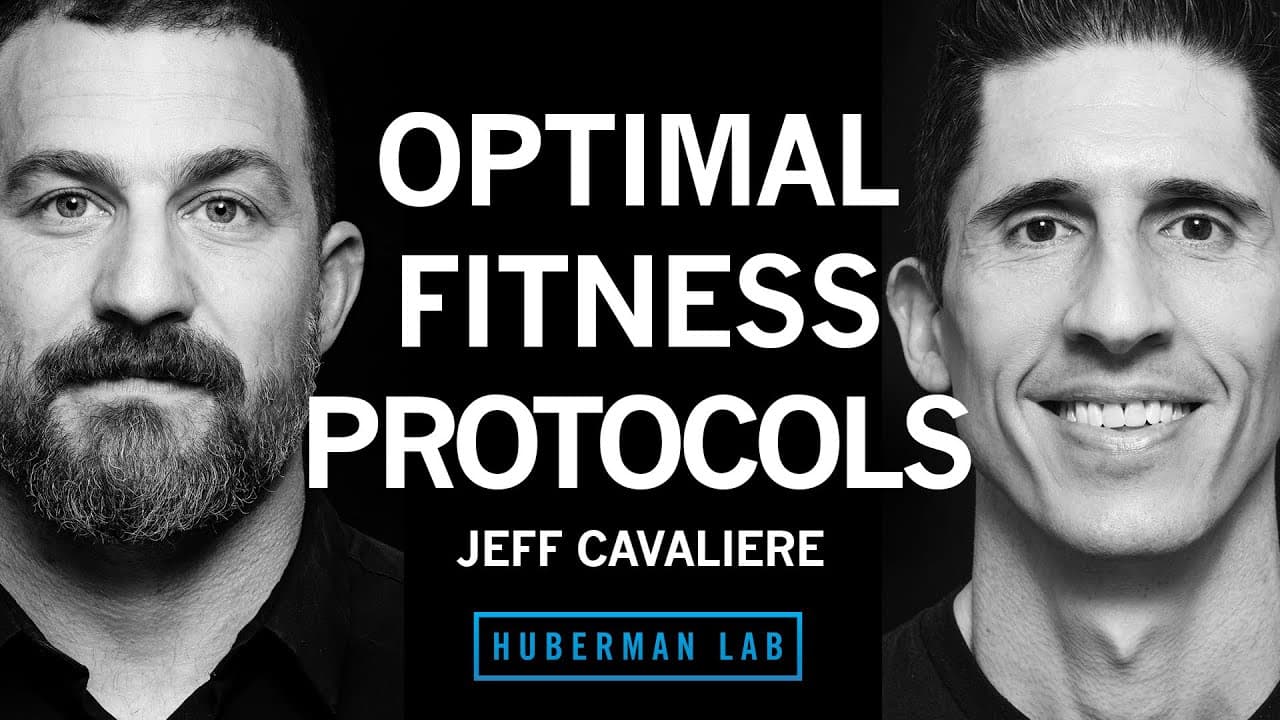
To optimize your exercise program, aim for a 60% strength training and 40% conditioning split in your weekly routine, ideally consisting of three strength days and two conditioning days. Keep workouts under an hour, focus on challenging the muscles rather than just moving weights, and incorporate cardiovascular training at the end of your sessions for the best results.
Transcript
- Welcome to the Huberman Lab Podcast, where we discuss science, and science based tools for everyday life. I'm Andrew Huberman, and I'm a professor of neurobiology and ophthalmology at Stanford School of Medicine. Today, my guest is Jeff Cavaliere. Jeff Cavaliere holds a Master of Science in Physical Therapy and is a certified strength and conditi... Read More
Key Insights
- ☠️ Individual muscles may have different recovery rates, and it is important to listen to your body and adjust training frequency accordingly.
- 💪 Muscle soreness and grip strength can be valuable indicators of recovery.
- 💪 Developing a strong mind-muscle connection and seeking discomfort during workouts can lead to better results in muscle growth and muscularity.
- 🤗 Simple tools like hand grip dynamometers can be used to measure grip strength and assess recovery.
Install to Summarize YouTube Videos and Get Transcripts
Explore YouTube Video Summarizer or Get YouTube Transcript Extractor
Questions & Answers
Q: What is the recommended split for strength training and conditioning?
Jeff Cavaliere recommends a split of 60% strength training and 40% conditioning, with three days dedicated to strength training and two days for conditioning in a weekly schedule.
Q: How long should workouts be?
Cavaliere suggests keeping workouts under an hour to avoid fatigue and ensure optimal recovery.
Q: How can I challenge my muscles effectively during workouts?
Instead of focusing on moving weights, Cavaliere advises concentrating on challenging muscles and seeking discomfort. This can be achieved by improving the mind-muscle connection and aiming for a strong contraction in each repetition.
Q: How do I know if my muscles are fully recovered?
Assessing muscle soreness can give an indication of local recovery, while grip strength can be used to assess systemic recovery. A drop in grip strength of 10% or more may indicate inadequate recovery and suggest skipping the gym for the day.
Key Insights:
- Individual muscles may have different recovery rates, and it is important to listen to your body and adjust training frequency accordingly.
- Muscle soreness and grip strength can be valuable indicators of recovery.
- Developing a strong mind-muscle connection and seeking discomfort during workouts can lead to better results in muscle growth and muscularity.
- Simple tools like hand grip dynamometers can be used to measure grip strength and assess recovery.
- Proper sleep position and posture during sleep can impact muscle health and prevent discomfort or injuries.
Summary & Key Takeaways
-
Jeff Cavaliere is a certified strength and conditioning specialist known for his science-based online content on fitness, nutrition, and injury rehabilitation.
-
He emphasizes the importance of training like an athlete to achieve optimal results and suggests a split of 60% strength training and 40% conditioning in a weekly workout schedule.
-
Cavaliere recommends keeping workouts under an hour, focusing on challenging muscles rather than just moving weights, and incorporating cardiovascular training at the end of workouts.
-
Recovery is crucial, and assessing muscle soreness and grip strength can help determine when a muscle is ready to be trained again.
Read in Other Languages (beta)
Share This Summary 📚
Summarize YouTube Videos and Get Video Transcripts with 1-Click
Try YouTube Summary with ChatGPT & Claude or YouTube Transcript Generator
Explore More Summaries from Andrew Huberman 📚

Summarize YouTube Videos and Get Video Transcripts with 1-Click
Try YouTube Summary with ChatGPT & Claude or YouTube Transcript Generator