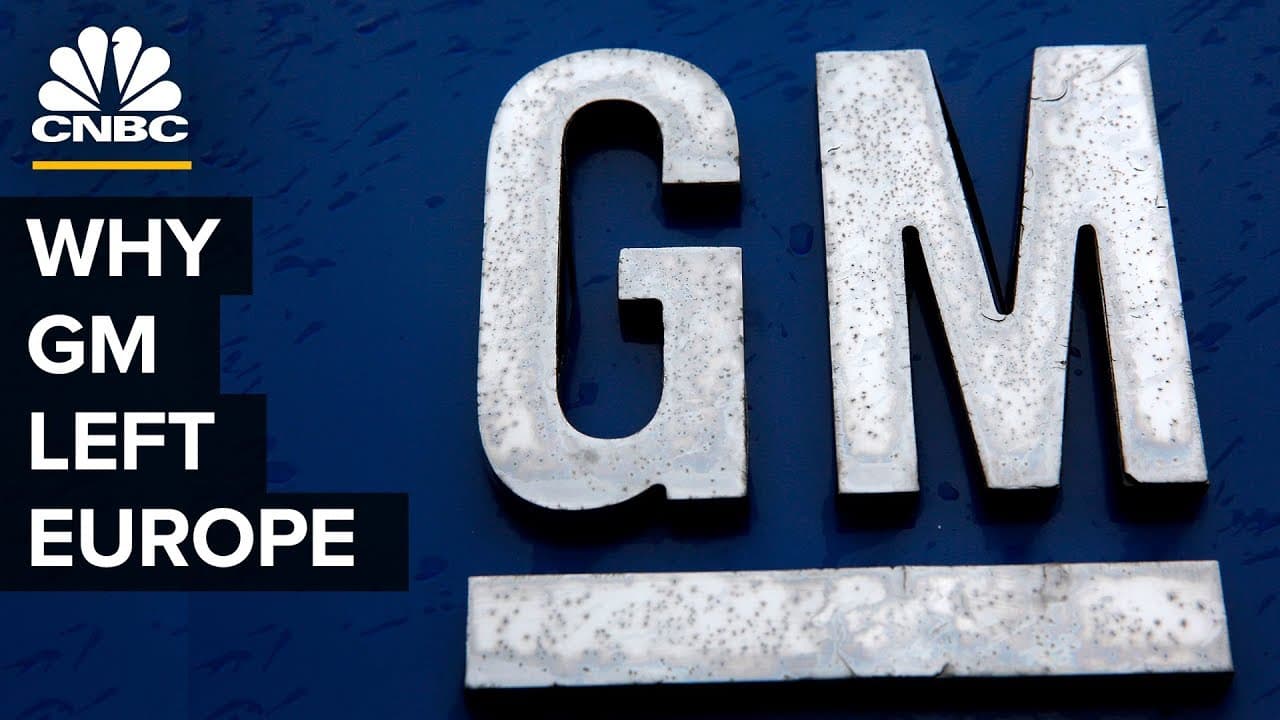
Why Did General Motors Leave Europe After 90 Years?
TL;DR
General Motors sold its European Opel and Vauxhall brands to French automaker PSA in 2017 after bleeding roughly $14 billion in losses over nine years. GM never turned a profit there because it sold mostly low-margin passenger cars, faced high labor and regulatory costs, and only 20 percent of Opel's portfolio shared parts with GM's other markets.
Transcript
In 2017, General Motors, the largest U.S. automaker with brands known around the world made perhaps one of its boldest moves in its history. It sold its European Opel and Vauxhall brands to the French automaker PSA known for brands such as Peugeot and Citroen. It was the end of an era for GM which had first ventured into Europe nearly 90 years befo... Read More
Key Insights
- General Motors sold its European Opel and Vauxhall brands to French automaker PSA (maker of Peugeot and Citroen) in 2017, ending an era that began when GM first ventured into Europe nearly 90 years earlier.
- GM's European business lost money at the EBIT line every single year for about nine years before the sale, totaling roughly $14 billion in losses on $208.4 billion in sales, a weighted loss of 6.9 percent.
- The 2017 sale caused GM to take a $3.9 billion loss that year, driven mostly by $6.2 billion in costs it had to pay to complete the divestiture of the European unit.
- GM struggled in Europe partly because it sold mostly low-margin passenger cars like subcompacts and sedans rather than the higher-margin trucks and SUVs that sold well in the U.S., and it missed the crossover and small SUV boom.
- Only 20 percent of Opel's vehicle portfolio shared parts or platforms with GM's other markets, meaning the brand lacked the economies of scale that automakers rely on to keep costs low across regions.
- GM's European market share fell steadily from 9.3 percent in 2008 to below 7 percent in 2014 and around 6 percent in 2016, while European competitors fared better during the same period.
- After selling its European business, GM's global EBIT jumped to 9.9 percent in 2017 and 8.4 percent in 2018, versus an industry target of roughly 8 percent for a region or the world.
- GM said it would redirect cash from the sale toward its profitable North American truck business and investments in electric vehicles and self-driving cars, aspirations that may take a long time to become profitable.
Install to Summarize YouTube Videos and Get Transcripts
Explore YouTube Video Summarizer or Get YouTube Transcript Extractor
Questions & Answers
Q: Why did General Motors leave Europe in 2017?
GM left Europe after roughly two decades of losses because it could not make its Opel and Vauxhall brands profitable. Over about nine years the European business lost around $14 billion at the EBIT line on $208.4 billion in sales, a 6.9 percent weighted loss. GM said selling the unit to PSA would unload a struggling business, let it focus on its profitable North American market, and free up cash for electric cars and autonomous driving investments.
Q: How much did the sale of GM's European business cost the company?
The sale was expensive. GM took a $3.9 billion loss in 2017, owing mostly to the $6.2 billion in costs it had to pay to complete the transaction. So while the divestiture removed a chronically money-losing unit, it also racked up huge one-time charges. The tradeoff was that after selling the business, GM's global EBIT improved sharply, reaching 9.9 percent in 2017 and 8.4 percent in 2018.
Q: Who did GM sell Opel and Vauxhall to?
GM sold its European Opel and Vauxhall brands to the French automaker PSA, known for brands such as Peugeot and Citroen. PSA had been successful focusing on Europe. Notably, PSA surprised the industry by saying it had restored Opel and Vauxhall to profitability, partly by cutting costs and introducing new, more profitable models. PSA also had plans to return to the U.S. market, showing interest specifically in Fiat Chrysler and its Jeep brand.
Q: Why couldn't GM make money selling cars in Europe?
GM struggled for several reasons. What it sold were primarily low-margin passenger cars like subcompacts and sedans, not the higher-margin trucks and SUVs popular in the U.S., and it missed the crossover and small SUV boom. It also faced high costs from labor, unions, and stringent emissions regulation. Selling high volumes to keep costs low drove down prices, and only about 6 to 7 percent market share meant Europe was never a dominant market for GM.
Q: What role did shared platforms and economies of scale play in GM's European struggles?
A major factor was the lack of shared parts. At the time, CEO Mary Barra said 80 percent of Opel's vehicles did not share parts or platforms with those sold in any of GM's other markets, meaning only 20 percent overlapped with the rest of GM's portfolio. Automakers want flexible platforms usable across many models and markets to keep costs low and achieve economies of scale. Varying regional regulations on fuel economy and emissions make sharing platforms harder and costlier.
Q: What missteps did GM make with Opel and Vauxhall?
Observers say GM made several errors. Opel and Vauxhall were seen as sensible cars without the glamorous reputations of premium brands, and GM sold them in high volumes to keep costs low, which drove down prices and made profits hard. GM also introduced Chevrolet into Europe, which undermined Opel and Vauxhall sales by placing highly similar cars next to them and confusing buyers. The portfolio was also too heavily weighted toward traditional passenger cars.
Q: How did GM's European performance compare to its North American business?
The contrast was stark. Over the same nine-year period, GM's European unit lost about $14 billion on $208.4 billion in sales, a 6.9 percent weighted loss. Meanwhile North America earned a $28 billion profit on $823.7 billion in sales, a 3.4 percent weighted gain. GM's North American sales grew consistently from $56 billion in 2009 to $113 billion in 2018, as U.S. consumers turned toward higher-priced crossovers, SUVs, and pickup trucks.
Q: What does GM's exit from Europe reveal about being a global automaker today?
The decision shows how difficult it is to be a global automaker and how markets increasingly favor local players who tailor products to specific regions. GM may have failed in Europe partly because it simply isn't European, in a market dominated by big German manufacturers and fragmented among many players. Europe is also a mature, slow-growing market. GM redirected cash toward North American trucks and investments in electric and self-driving vehicles, while China became the world's largest car market with 28 million vehicles sold in 2018.
Summary & Key Takeaways
-
In 2017 General Motors, the largest U.S. automaker, sold its European Opel and Vauxhall brands to French automaker PSA, ending nearly two decades of losses and a European presence dating back almost 90 years. GM said the deal would let it focus on North America and fund new technology.
-
GM's European unit lost money every year for about nine years, roughly $14 billion on $208.4 billion in sales, a 6.9 percent weighted loss. By contrast, North America earned $28 billion in profit on $823.7 billion in sales, a 3.4 percent weighted gain over the same period.
-
GM struggled because it sold low-margin passenger cars, faced high labor and emissions costs, had little platform overlap with other markets, and confused buyers by adding Chevrolet next to Opel. Europe is also a mature, fragmented, slow-growing market compared with China and the U.S.
Read in Other Languages (beta)
Share This Summary 📚
Summarize YouTube Videos and Get Video Transcripts with 1-Click
Try YouTube Summary with ChatGPT & Claude or YouTube Transcript Generator
Explore More Summaries from CNBC 📚





Summarize YouTube Videos and Get Video Transcripts with 1-Click
Try YouTube Summary with ChatGPT & Claude or YouTube Transcript Generator