THE BUFFETT PARTNERSHIP LETTERS (BY WARREN BUFFETT)
TL;DR
Warren Buffett's early investment partnership letters reveal valuable insights on portfolio management, value investing, and the importance of measuring relative performance.
Transcript
“The highest rates of return I’ve ever achieved were in the 1950’s. I killed the Dow. You ought to see the numbers. But I was investing peanuts back then. It’s a huge structural advantage not to have a lot of money. I think I could make you 50% a year on $1 million. No, I know I could. I guarantee that.” Perhaps you’ve heard this line before. It’s ... Read More
Key Insights
- 💌 Buffett's partnership letters highlight the importance of measuring relative performance and avoiding overconfidence.
- 🥡 His investment approach involved finding undervalued stocks, taking advantage of arbitrage opportunities, and occasionally taking control of a company.
- 😥 Diversification can be a means of risk mitigation, but it should not be excessive to the point where it hampers returns.
- ❤️🩹 The Go-Go years, characterized by rapid speculation and mergers, eventually ended in failure, reaffirming the merits of Buffett's value investing approach.
- 👨🔬 Calculating intrinsic value and conducting thorough research are crucial to successful investing.
- 🤩 Buffett's long-term perspective and patience were key factors in his success.
Install to Summarize YouTube Videos and Get Transcripts
Explore YouTube Video Summarizer or Get YouTube Transcript Extractor
Questions & Answers
Q: Why did Warren Buffett believe that relative performance is more important than absolute performance?
Buffett recognized that market conditions play a significant role in investment returns. By measuring relative performance against benchmarks like the S&P 500, investors can assess their true skill and avoid overestimating their abilities during bull markets.
Q: What were the three main categories of investments in Buffett's partnership?
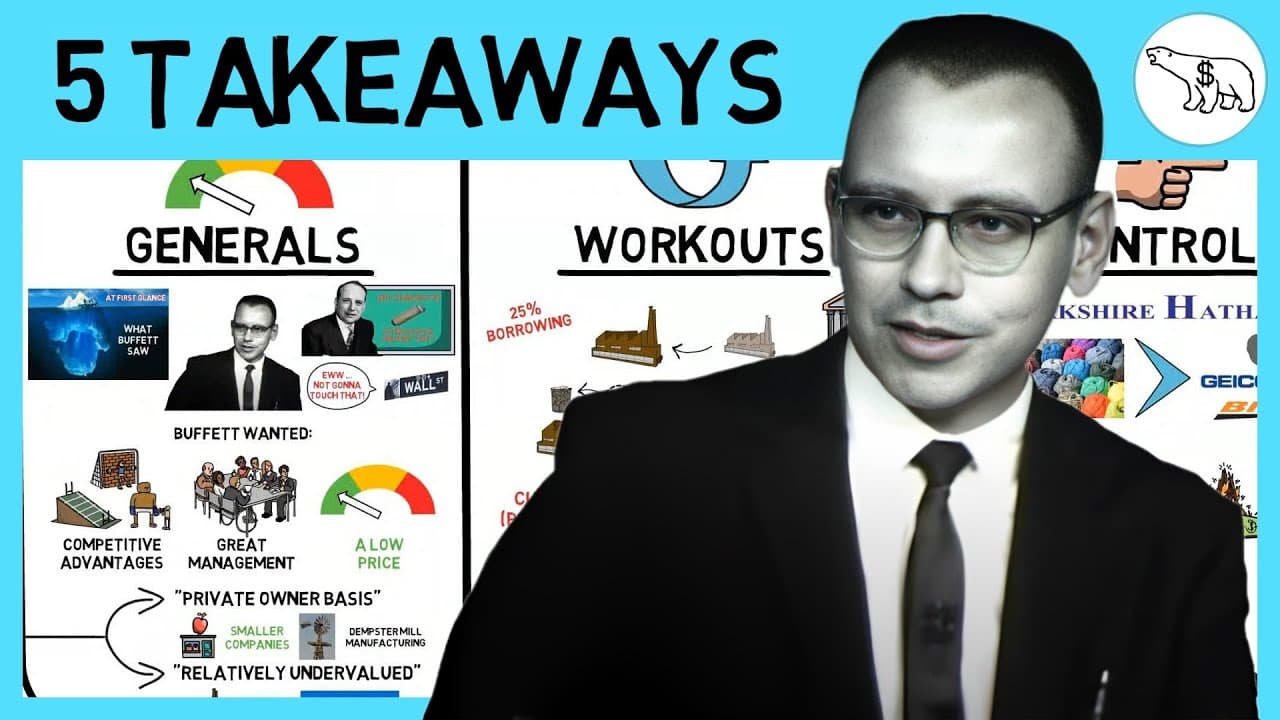
Buffett's main investment categories were Generals (undervalued common stocks), Workouts (special arbitrage situations), and Controls (buying a controlling stake in a company).
Q: Why did Buffett prioritize concentrated positions in his portfolio instead of diversifying widely?
Buffett believed that when opportunities arise, it is more rewarding to focus heavily on your best ideas. Having a concentrated portfolio allows for higher conviction and potentially higher returns, provided that thorough research is conducted.
Q: How did Buffett handle the investment in Commonwealth Trust Co.?
Buffett recognized the value of the investment and was willing to wait for a potential buyout. However, when a more attractive opportunity arose, he sold his stake in Commonwealth Trust Co. to redeploy capital into the new investment.
Summary & Key Takeaways
-
Warren Buffett achieved remarkable returns during his partnership years, consistently outperforming the market.
-
Buffett emphasized the importance of measuring relative performance rather than focusing solely on absolute returns.
-
He used a combination of undervalued stocks, workouts, and control situations to find investment opportunities.
-
Buffett believed that diversification should be used to mitigate risk, but overly diversifying can hinder performance.
Read in Other Languages (beta)
Share This Summary 📚
Summarize YouTube Videos and Get Video Transcripts with 1-Click
Try YouTube Summary with ChatGPT & Claude or YouTube Transcript Generator
Explore More Summaries from The Swedish Investor 📚


Summarize YouTube Videos and Get Video Transcripts with 1-Click
Try YouTube Summary with ChatGPT & Claude or YouTube Transcript Generator