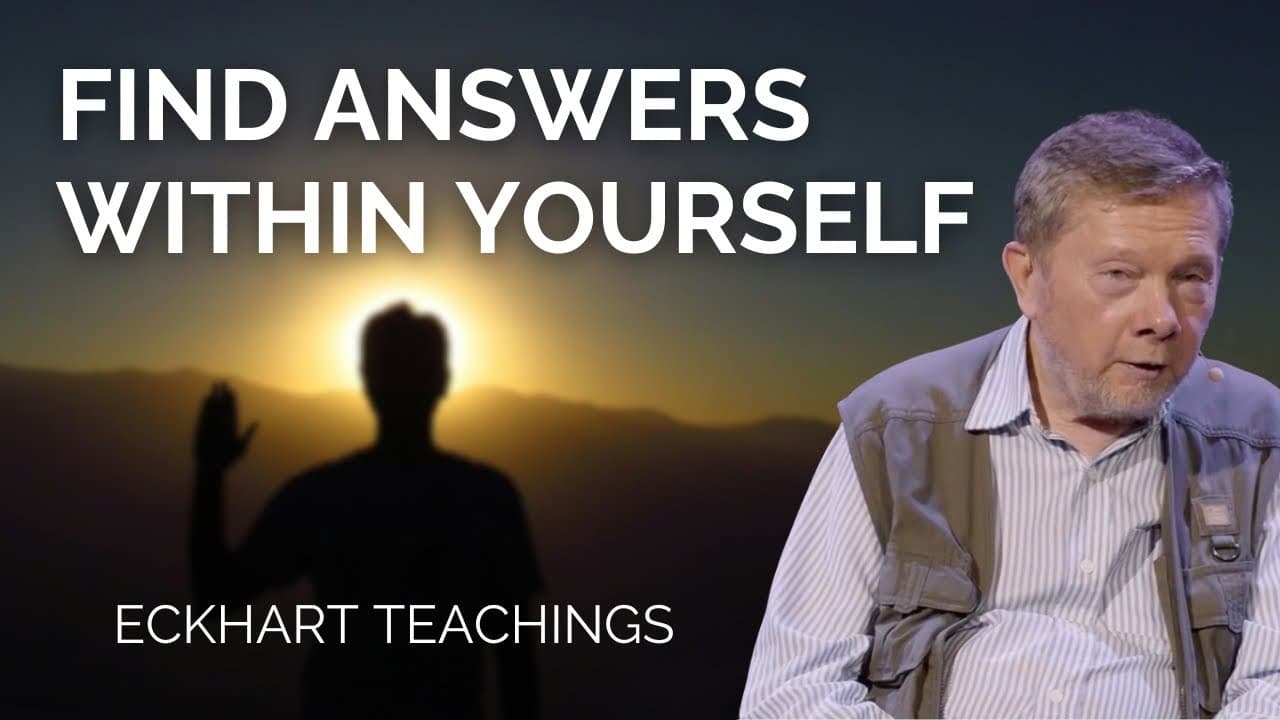
How to Find Spiritual Answers Within Yourself
TL;DR
Divine truth cannot be understood through concepts alone, but it can be approached through a deeper, nonconceptual knowing found within. By looking beneath personality, emotions, personal history, and conditioned beliefs, a person can recognize the "Deep I," the fundamental dimension of being to which the ancient instruction "know thyself" points.
Transcript
There's a word or topic that I have mostly tried to avoid in previous years a word let's say there's a word that I haven't used much it actually for many years tried to avoid It's a threeletter word, God. But it may be helpful to address that, not falling into the belief that you could possibly understand what that word means or what it points to b... Read More
Key Insights
- Conceptual understanding of God is impossible because thought can only create mental explanations of what the word represents. Analogies can offer a limited approach, but spiritual realization depends on a deeper attunement rather than an attempt to capture divine reality within ideas.
- Gnosis is a form of nonconceptual knowing associated with early Christian groups called the Gnostics. In a spiritual context, it refers to direct realization of life's deeper reality and of who or what a person is beneath the identity constructed by thought.
- "Know thyself" points beyond knowledge of personality, according to Tolle's interpretation of the ancient Greek instruction. Psychological investigation can reveal hidden aspects of the personal self, but that useful form of analysis remains different from recognizing the deeper self.
- The "Surface I" is the personality formed through thinking, emotion, personal history, and past conditioning. Every person has a different surface identity because different events happened to them and because they made different choices throughout their personal history.
- The "Deep I" is the deeper dimension of identity beneath the historical person. Knowing oneself deeply means recognizing this level of being, rather than merely collecting more information about one's character, memories, emotional patterns, or personal narrative.
- Past-life investigation remains an exploration of the surface identity, even when someone believes in reincarnation. Trying to recover numerous former lives could become an absorbing narrative that keeps a person occupied without revealing the deeper reality meant by "know thyself."
- Divine reality is approached by going deeply within rather than searching the external world. Looking upward for God reflects a planet-bound way of thinking, since the directions called up and down depend on one's location and disappear as meaningful orientations in outer space.
- External observation cannot settle the deepest spiritual questions because failing to see God in physical space does not address nonconceptual knowing. Tolle uses the story of a Russian astronaut to illustrate the limitation of treating God as an observable object located somewhere above Earth.
Install to Summarize YouTube Videos and Get Transcripts
Explore YouTube Video Summarizer or Get YouTube Transcript Extractor
Questions & Answers
Q: What does nonconceptual knowing mean in spirituality?
Nonconceptual knowing is a deeper form of realization that does not depend on mental definitions, explanations, or conditioned beliefs. Tolle associates it with the Greek word "gnosis." In spiritual use, it means becoming attuned to the deeper reality of life and to who or what one is beneath thought, emotion, personality, and personal history.
Q: Why can the thinking mind not fully understand God?
The thinking mind works through concepts, so any idea it forms about God remains a mental construction rather than the reality to which the word points. Tolle therefore considers complete conceptual comprehension impossible. A person may use analogies to approach the subject, but deeper understanding requires nonconceptual knowing and inward attunement rather than intellectual explanation alone.
Q: What does "know thyself" mean according to Eckhart Tolle?
"Know thyself" means recognizing who or what one is in the depths of being. It does not primarily mean understanding personality traits, emotional patterns, hidden psychological material, or personal history. Those subjects may still be interesting and useful, but Tolle says the ancient instruction points beyond the surface person toward direct knowledge of the deeper self.
Q: What is the difference between the Surface I and the Deep I?
The "Surface I" is the person with a history, personality, thought patterns, emotions, memories, and conditioning from the past. The "Deep I" is the deeper reality beneath that historical identity. Tolle argues that true self-knowledge involves recognizing the Deep I, not simply gaining more detailed information about the changing characteristics and experiences of the surface self.
Q: How does personal history shape the surface identity?
Personal history shapes the surface identity through what has happened to a person and what that person has done. These past experiences condition personality, thought, and emotion, creating a historical person. Because individuals experience different events and make different choices, each develops a distinct personal identity. Tolle treats this conditioned identity as real at the surface level, but not as the deepest self.
Q: Does exploring past lives lead to true self-knowledge?
Exploring supposed past lives does not necessarily produce the deeper self-knowledge described by "know thyself." Even if someone believes in reincarnation, earlier incarnations would still belong to the historical, conditioned Surface I. Tolle warns that regression and similar investigations could become an extensive personal narrative that absorbs attention while leaving the deeper reality of being unrecognized.
Q: How can someone seek spiritual answers within themselves?
A person can seek spiritual answers by directing attention beneath thought, emotion, personality, and historical conditioning. The aim is not to construct a better theory about God or accumulate more biographical information. It is to become attuned to the deeper dimension of being, the "Deep I," through the nonconceptual realization that Tolle connects with gnosis and genuine self-knowledge.
Q: Why is looking upward for God considered misleading?
Looking upward for God treats divine reality as though it were a physical object located somewhere above the planet. Tolle notes that up and down depend on one's position under gravity, and people on different sides of Earth point in different directions. In outer space, that orientation disappears, showing why a spatial search cannot answer a question about nonconceptual divine reality.
Summary & Key Takeaways
-
Eckhart Tolle argues that attempting to understand God through thought is fundamentally misguided because concepts cannot contain what the word points toward. Spiritual understanding instead involves attunement and direct, nonconceptual knowing. Analogies may help someone approach the subject, but they cannot provide complete intellectual comprehension of divine reality.
-
The Greek term "gnosis" describes knowledge that is not merely conceptual. Tolle connects it with the ancient instruction "know thyself," interpreting that instruction as a call to recognize the deeper reality of one's being. It does not primarily concern analyzing personality, emotions, memories, or hidden psychological traits.
-
Tolle distinguishes the "Surface I" from the "Deep I." The surface identity consists of personality, thought, emotion, history, and past conditioning. The deeper identity cannot be discovered by looking outward, studying supposed past incarnations, or searching physical space for God. It becomes knowable by going deeply within oneself.
Read in Other Languages (beta)
Share This Summary 📚
Summarize YouTube Videos and Get Video Transcripts with 1-Click
Try YouTube Summary with ChatGPT & Claude or YouTube Transcript Generator
Explore More Summaries from Eckhart Tolle 📚

Summarize YouTube Videos and Get Video Transcripts with 1-Click
Try YouTube Summary with ChatGPT & Claude or YouTube Transcript Generator