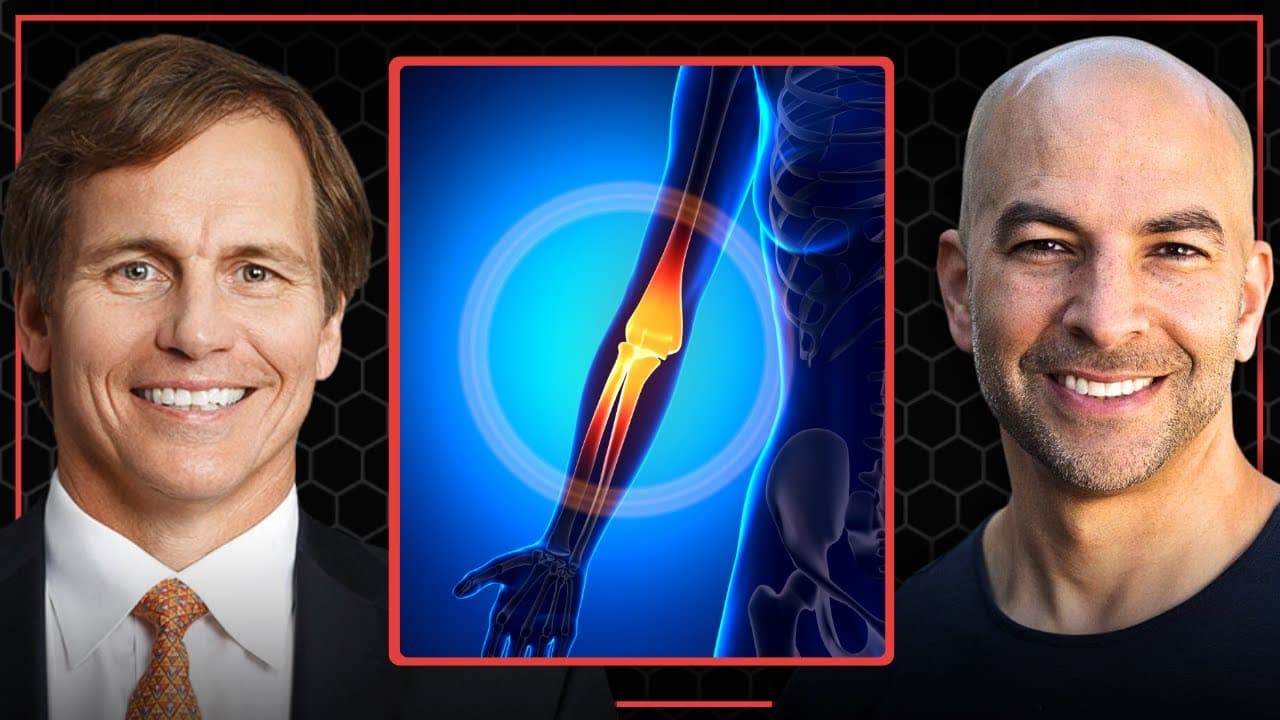
How to Understand and Treat Common Elbow Injuries
TL;DR
Most common elbow tendon problems improve with conservative care, including rest, stretching, strengthening, and oral anti-inflammatory medication when appropriate. Cortisone may help reduce severe or persistent pain, while surgery is generally reserved for cases that fail conservative treatment or acute injuries such as disabling distal biceps ruptures.
Transcript
let's let's pivot now to talk about another piece of anatomy down the arm which is the elbow um so uh let's take a moment and just go back to the anatomy do you want to draw a little sketch of how the humoris lines up with the and the radius very much so all right so the big diagram is looking straight at the anticubital FAA and then obviously the ... Read More
Key Insights
- The elbow is intrinsically stable because the humerus, radius, and ulna fit together through complex, undulating surfaces. That same geometry leaves little room for imperfect alignment, so fractures that are subtle, missed, or inadequately corrected can lead to rapid joint destruction and arthritis.
- The radius is the rotating forearm bone, while the ulna functions as the fixed, straighter forearm bone. The biceps tendon attaches below the elbow to the radius, and the triceps attaches at the tip of the elbow, creating distinct injury patterns around the joint.
- Tennis elbow is lateral epicondylitis, a degenerative or partially torn tendon problem on the outside of the elbow. It was historically associated with the mechanically demanding one-handed tennis backhand, although people who have never played tennis can also develop the condition.
- Golfer's elbow is medial epicondylitis, involving the flexor-pronator tissues on the inside of the elbow. It may follow eccentric loading from overhitting, striking the ground or other objects, and modern tennis strokes that use forceful pronation to generate substantial topspin.
- The typical age range for treating lateral epicondylitis is 40–60, although cases are increasingly seen among active people in their 70s. Activity patterns matter because tendon symptoms may appear after overuse, a return to an old activity, weightlifting, or even handling luggage during travel.
- The first-line treatment for epicondylitis is rest, consistent stretching, and oral anti-inflammatory medication when appropriate. Formal physical therapy is not always used, but strengthening becomes critical when chronic symptoms are accompanied by weak grip strength, poor muscle tone, or deconditioning.
- Cortisone is used selectively when pain is severe enough to prevent elbow extension, arm use, or tolerable strengthening. A smaller dose may cool the inflammation, while needle insertion itself may also stimulate a healing response, although the speakers state that this idea has not been proven by a study.
- A distal biceps rupture may cause a visible Popeye-like muscle deformity without major ongoing pain. The principal functional loss is not elbow flexion, because the biceps is a secondary flexor, but forearm supination, which can impair tasks involving screwdrivers, wrenches, or surgical instruments.
Install to Summarize YouTube Videos and Get Transcripts
Explore YouTube Video Summarizer or Get YouTube Transcript Extractor
Questions & Answers
Q: What are the main bones and soft tissues of the elbow?
The elbow is formed by the humerus in the upper arm and the radius and ulna in the forearm. The radius rotates, while the ulna is described as the fixed, straighter forearm bone. Major soft tissues include the biceps and triceps tendons, the flexor-pronator muscles, the ulnar nerve, the medial collateral ligament, and the olecranon bursa.
Q: What is the difference between tennis elbow and golfer's elbow?
Tennis elbow is lateral epicondylitis, which affects the tendon tissues on the outside of the elbow. Golfer's elbow is medial epicondylitis, which affects the flexor-pronator tissues on the inside. Despite their names, either condition can occur in people who never play those sports, because activity mechanics, repetitive stress, eccentric loading, and deconditioning also contribute.
Q: Why can a tennis backhand cause lateral epicondylitis?
The one-handed backhand places substantial stress on the outside elbow tendons because it is described as less mechanically sound than a forehand. The external rotators also have less strength than the pectoralis and subscapularis muscles used for forehand shots. Repeated loading can contribute to tendon degeneration and partial tearing, especially when mechanics or conditioning are inadequate.
Q: Why are tennis players developing medial epicondylitis?
Competitive tennis players may develop medial epicondylitis because modern strokes emphasize massive topspin. Producing that spin uses the forearm pronator muscles more heavily than older playing styles did. This repeated stimulation loads the flexor-pronator tissues on the inside of the elbow, producing the condition traditionally called golfer's elbow even though the activity causing it is tennis.
Q: What is the first-line treatment for elbow epicondylitis?
First-line care consists of rest, good stretching, and oral anti-inflammatory medication when appropriate. Strengthening is especially important for people with weak grip strength, poor muscle tone, or chronic deconditioning. If squeezing a strengthening device causes only mild pain, gradual grip work may be started. Formal physical therapy is not always considered necessary for these tendon problems.
Q: When can a cortisone injection help elbow pain?
A cortisone injection may help when pain is so severe that a person cannot straighten the elbow, use the arm normally, or begin strengthening without excessive discomfort. It can also calm persistent pain after the underlying movement problem has been corrected. The described approach uses a smaller dose selectively rather than treating every case with an injection.
Q: When is surgery considered for tennis or golfer's elbow?
Surgery is considered when lateral or medial epicondylitis fails conservative treatment, including stretching, strengthening, rest, and selective medication or injection. The surgeon says that no more than about one in five patients, or 20%, undergoes an operation. Most people improve without surgery, particularly when conditioning deficits and harmful movement patterns are corrected.
Q: How does a distal biceps rupture affect elbow function?
A distal biceps rupture can create a visible Popeye-like deformity and unusual muscle movement, but the person may report little pain and feel that the injury is improving. Flexion strength does not decline as much as expected because the biceps is a secondary elbow flexor. The larger deficit is supination strength, affecting forceful forearm rotation used with tools or instruments.
Summary & Key Takeaways
-
The elbow joins the humerus with the radius and ulna through interlocking, undulating surfaces that provide substantial stability but little tolerance for imperfect alignment. Important nearby structures include the biceps and triceps tendons, forearm muscle origins, the ulnar nerve, the medial collateral ligament, and the olecranon bursa.
-
Common tendon disorders include lateral epicondylitis, known as tennis elbow, and medial epicondylitis, known as golfer's elbow. These conditions can affect people who never play either sport. Repetitive loading, poor mechanics, sudden returns to activity, heavy lifting, luggage handling, forceful tennis strokes, and golf swings can provoke symptoms.
-
Initial treatment emphasizes rest, stretching, and progressive strengthening, with oral anti-inflammatory medication when appropriate. Cortisone can calm pain that prevents normal motion or strengthening, particularly after the underlying mechanics have improved. Surgery is generally considered only after conservative treatment fails, while distal biceps rupture may require special consideration because it severely reduces supination strength.
Read in Other Languages (beta)
Share This Summary 📚
Summarize YouTube Videos and Get Video Transcripts with 1-Click
Try YouTube Summary with ChatGPT & Claude or YouTube Transcript Generator
Explore More Summaries from Peter Attia MD 📚


Summarize YouTube Videos and Get Video Transcripts with 1-Click
Try YouTube Summary with ChatGPT & Claude or YouTube Transcript Generator