What Is Collective Intelligence in Developmental Biology?
TL;DR
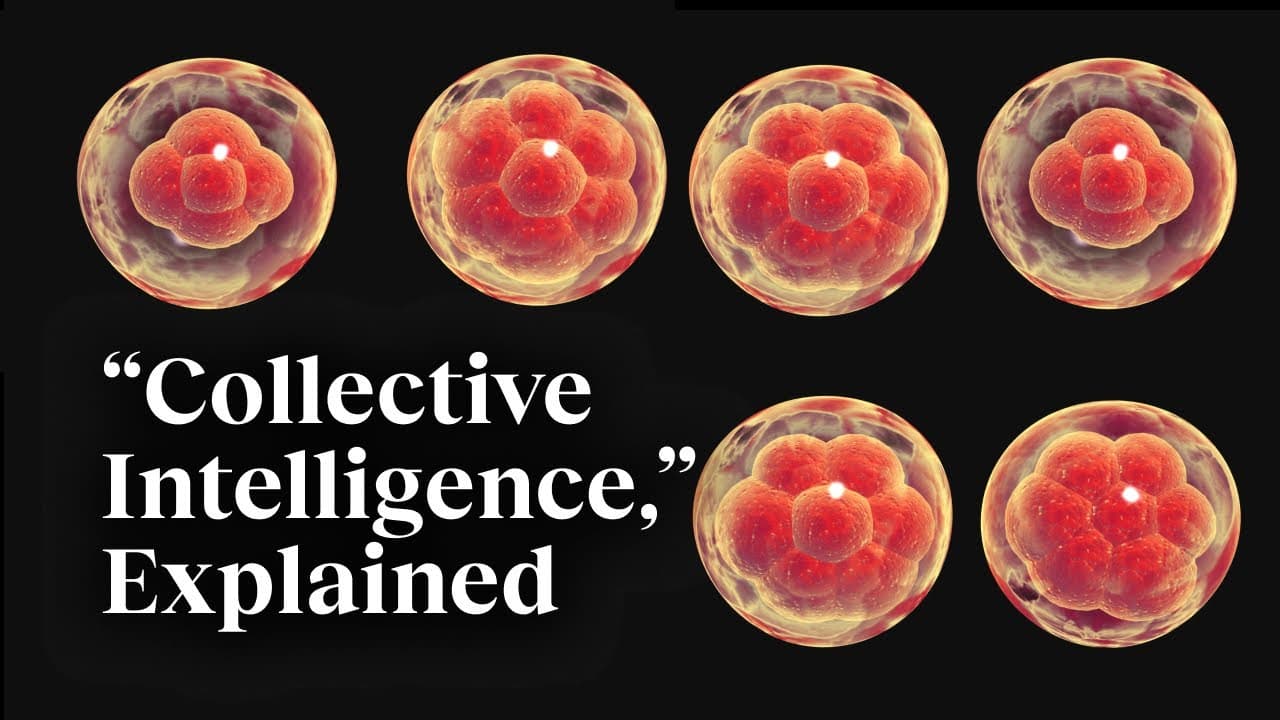
Collective intelligence refers to the idea that all intelligence is inherently collaborative, as biological systems consist of competent agents that work together to solve problems. Developmental biology demonstrates this through the progression from a single cell to a complex organism, revealing how various levels of biological structures solve challenges cooperatively, adapting to their environments.
Transcript
- People tend to think of intelligence as being of two kinds: There's the quote, unquote "real" intelligence, which is what we are supposed to have, and then there's this idea of a 'collective intelligence,' so swarms of bees, colonies of ants, shoals of fish, and so on. And people tend to think of those as radically different things. But the reali... Read More
Key Insights
- ❓ Intelligence is often perceived in two categories: "real" intelligence possessed by humans and collective intelligence observed in swarms, colonies, and shoals.
- 🧑🏭 All intelligence is, in fact, collective intelligence, as biological systems are made up of competent agents with problem-solving capacities.
- 👻 The competency architecture of biological systems allows different levels to shape the behavioral landscape of lower levels, facilitating top-down control.
- 💁 Recognizing diverse forms of intelligence requires overcoming preconceived notions and expanding our perception beyond conventional embodiments.
- 🤯 Developmental biology reveals the remarkable journey from physics to mind, showcasing the gradual construction of bodies and minds from a single cell.
- 🎚️ Evolution has equipped biological systems with the ability to adapt and solve problems at different scales, from metabolic to physiological and transcriptional levels.
- 👨🔬 The ability of cells to navigate complex physiological stressors without exhaustive searches suggests the existence of evolved problem-solving mechanisms.
- 🎙️ More videos with Michael Levin:
Install to Summarize YouTube Videos and Get Transcripts
Explore YouTube Video Summarizer or Get YouTube Transcript Extractor
Questions & Answers
Q: What is the journey that all organisms take according to developmental biology?
Developmental biology explores the progression from a single cell to a fully developed individual with metacognitive capacities and reasoning abilities. It highlights the magic of how our bodies and minds are constructed.
Q: What is the concept of a multi-scale competency architecture?
The multi-scale competency architecture refers to the idea that all parts of an organism, including cells, tissues, organs, and beyond, possess problem-solving competencies. Each level solves problems in different spaces, leading to the cooperative achievement of large-scale goals.
Q: How do biological systems demonstrate intelligence when it comes to anatomical problems?
During processes like embryogenesis and regeneration, cells, tissues, and organs work together to solve anatomical problems. They navigate a path from the shape of an early embryo to the complexity of a mature human body, demonstrating problem-solving capacities at different levels.
Q: Why is it challenging for humans to recognize intelligence in unconventional embodiments?
Humans have a limited capacity to perceive intelligence in unconventional forms, such as extremely small or large organisms. Our ability to recognize intelligence is primarily focused on medium-sized objects moving at medium speeds through three-dimensional space.
Key Insights:
- Intelligence is often perceived in two categories: "real" intelligence possessed by humans and collective intelligence observed in swarms, colonies, and shoals.
- All intelligence is, in fact, collective intelligence, as biological systems are made up of competent agents with problem-solving capacities.
- The competency architecture of biological systems allows different levels to shape the behavioral landscape of lower levels, facilitating top-down control.
- Recognizing diverse forms of intelligence requires overcoming preconceived notions and expanding our perception beyond conventional embodiments.
- Developmental biology reveals the remarkable journey from physics to mind, showcasing the gradual construction of bodies and minds from a single cell.
- Evolution has equipped biological systems with the ability to adapt and solve problems at different scales, from metabolic to physiological and transcriptional levels.
- The ability of cells to navigate complex physiological stressors without exhaustive searches suggests the existence of evolved problem-solving mechanisms.
- The question is not whether something is purely physical or cognitive, but rather what kind of cognition and how much is involved in different systems.
Summary & Key Takeaways
-
Developmental biology is a fascinating science that explores the journey from a single cell to a complex organism with cognitive abilities.
-
Biological systems have a multi-scale competency architecture, where each level solves problems in different spaces and collaborates towards common goals.
-
Recognizing intelligence in unconventional embodiments, such as very small or large organisms, challenges our limited capacity to perceive diverse intelligence.
Read in Other Languages (beta)
Share This Summary 📚
Summarize YouTube Videos and Get Video Transcripts with 1-Click
Try YouTube Summary with ChatGPT & Claude or YouTube Transcript Generator
Explore More Summaries from Big Think 📚


Summarize YouTube Videos and Get Video Transcripts with 1-Click
Try YouTube Summary with ChatGPT & Claude or YouTube Transcript Generator