How to Add Services and Grow Course Revenue

TL;DR
Add a personalized service layer to an existing course when customers need implementation support, not more information. Layla Pomper turned her curriculum into a 90-day operations sprint with an audit, human checkpoints, and tailored lessons, tripling monthly income and putting the business on track for about $1.5 million in annual revenue.
Transcript
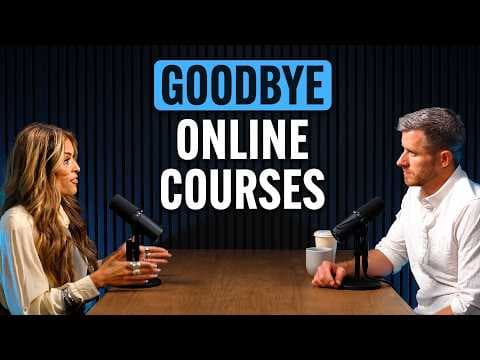
Adding services into the mix, I was able to triple our monthly income. >> Leila built Process Driven into a 150,000 subscriber YouTube channel, teaching systems to small business owners. >> Here is the solution for how to systemize your business. 5 to 50 people making 5 to 50 million. >> This episode is about what she's seeing that many creators ar... Read More
Key Insights
- A self-directed course can reach a revenue ceiling even when its funnel converts well. Layla repeatedly generated about $600,000 to $700,000 annually, but further growth appeared to require profitable advertising or an audience approximately three times larger.
- Customer implementation difficulty is a distinct problem from insufficient course content. One member praised the program after three years but remained on module two of a course containing only 12 hours of material, demonstrating that access does not guarantee progress.
- A hybrid offer can reuse established intellectual property instead of replacing it. Layla kept the same end-to-end curriculum, then added an initial human audit, three checkpoints, and personalized lesson assignments based on each client's situation.
- The 90-day operations sprint is priced as $2,500 each month for three months, totaling $7,500. A higher-touch option involving Layla directly is priced at $7,000 per month, reflecting a separate level of personal involvement.
- Monthly price framing improved sales-call conversion during Layla's testing. After roughly 150 to 200 calls, she found that presenting the fee as a recurring monthly amount worked better than leading with one larger total price.
- Monthly billing aligns the offer with small-business purchasing habits. Prospects may already compare the program with fractional operations support costing around $4,000 per month, while the defined three-month duration gives buyers a visible endpoint.
- Services can expand revenue despite their fulfillment costs. Adding the service layer enabled Layla to triple monthly income, more than double projected revenue, and put the business on track for approximately $1.5 million for the year.
- A small, engaged audience can support substantial revenue when the offer solves a valuable implementation problem. ProcessDriven combined a 20,000-person email list and a YouTube channel with personalized operational support rather than relying only on greater audience volume.
Install to Summarize YouTube Videos and Get Transcripts
Explore YouTube Video Summarizer or Get YouTube Transcript Extractor
Questions & Answers
Q: How can course creators add services to increase revenue?
Course creators can retain their existing curriculum and add structured implementation support around it. Layla converted her course into a 90-day operations sprint that begins with a human audit, includes three checkpoints, and assigns only the lessons relevant to each client. This model addresses requests for guidance without requiring the creator to discard the course or rebuild its core material.
Q: Why did Layla Pomper move beyond a course-only business model?
Layla repeatedly encountered an annual revenue ceiling of about $600,000 to $700,000 despite having funnels that converted well. Her calculations suggested that continuing with the same model would require profitable advertising or tripling her audience, which could take years. Meanwhile, customers repeatedly asked for hands-on guidance, making an added service layer a practical response to both the growth limit and buyer needs.
Q: What does the ProcessDriven 90-day operations sprint include?
The 90-day operations sprint builds on the same end-to-end curriculum already used in the course. It adds a human audit at the beginning, three human checkpoints during the program, and a personalized path through the lessons. Instead of completing every module in sequence, clients receive specific assignments and additional actions suited to their operational situation.
Q: How much does Layla Pomper's service offer cost?
The team-supported service is presented as $2,500 per month for three months, producing a total price of $7,500. Customers work with someone on Layla's team throughout that journey. A separate option for working directly with Layla is priced at $7,000 per month. The prices represent different levels of personal access and support.
Q: Why does quoting a service as a monthly price improve sales calls?
Layla found that quoting the monthly amount produced better conversion than opening with the complete price. A $7,500 total can create substantial sticker shock, while $2,500 each month resembles other recurring operational expenses familiar to small businesses. The three-month term also provides a defined endpoint, so the buyer can evaluate a manageable monthly commitment rather than an indefinite service.
Q: What customer behavior showed that the course needed human support?
Customers repeatedly asked Layla to hold their hands through implementation because they felt scared, faced resistance from team members, or became stuck in the curriculum. One membership customer had participated for three years and still remained on module two, even though the entire course took only 12 hours. That example showed that more access alone was not solving the implementation barrier.
Q: Can adding services increase revenue after fulfillment costs?
Adding services increased Layla's monthly income by approximately three times even after fulfillment costs became part of the model. The shift moved the business from repeated annual revenue around $600,000 to $700,000 toward a projected $1.5 million year. She believed further growth was possible, although that higher target remained an ambition rather than a reported result.
Q: Who is the personalized operations service designed for?
The service is designed for a person responsible for a team of 5 to 50 people in a business making $5 million to $50 million. Its purpose is to help small businesses systemize their operations through tailored guidance, rather than merely giving customers a standard course and expecting them to determine the correct sequence and implementation approach independently.
Summary & Key Takeaways
-
Layla Pomper repeatedly reached an annual revenue ceiling of roughly $600,000 to $700,000 with a primarily self-directed course model. Because her funnels already converted well, meaningful growth appeared to require profitable advertising or tripling her audience, either of which presented a difficult and potentially lengthy path forward.
-
Customer requests revealed that the main problem was not missing educational material. Buyers wanted someone to guide implementation, address fear, secure team participation, and help when progress stalled. Layla responded by preserving her existing curriculum while adding an initial audit, three human checkpoints, and a personalized sequence of relevant lessons.
-
The resulting 90-day operations sprint costs $2,500 each month for three months, while direct work with Layla costs $7,000 monthly. Presenting the offer as a monthly expense improved sales-call conversion, matched how small businesses commonly evaluate operational support, reduced upfront sticker shock, and retained a clear three-month offramp.
Read in Other Languages (beta)
Share This Summary 📚
Summarize YouTube Videos and Get Video Transcripts with 1-Click
Try YouTube Summary with ChatGPT & Claude or YouTube Transcript Generator
Explore More Summaries from The Nathan Barry Show 📚




Summarize YouTube Videos and Get Video Transcripts with 1-Click
Try YouTube Summary with ChatGPT & Claude or YouTube Transcript Generator