How to Extract Caffeine from Coffee Using Methylene Chloride
TL;DR
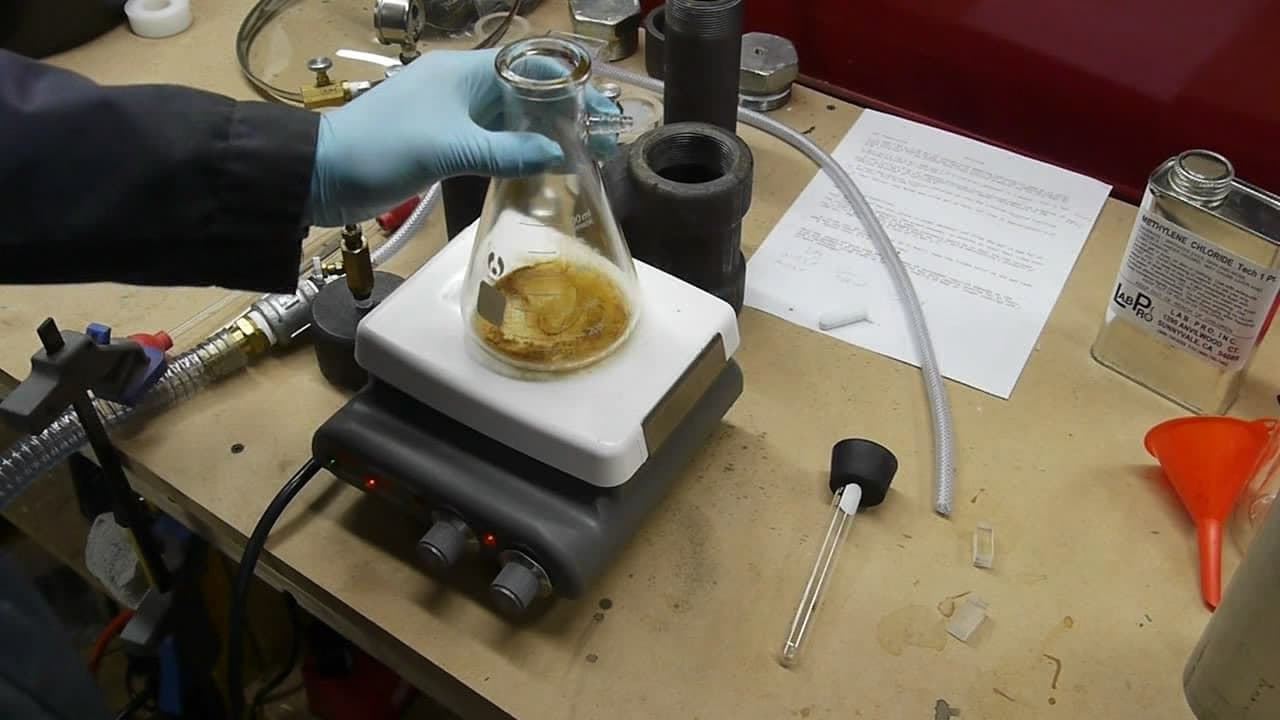
To extract caffeine from coffee, first mix ground coffee with hot water and use vacuum filtration to collect a concentrated coffee solution. Then, add methylene chloride to the solution to dissolve the caffeine, evaporate the solvent, and obtain caffeine crystals, which can be further purified through sublimation.
Transcript
I just love glassware hey everyone in a previous video I showed the first half of this caffeine extraction experiment where I used supercritical carbon dioxide to extract caffeine from green coffee beans and at the end of the video I said that I used methylene chloride to extract the caffeine from that sort of caffeinated water that I pulled out of... Read More
Key Insights
- 🫘 The video demonstrates the extraction of caffeine from coffee beans using a vacuum filtration setup.
- ❓ Methylene chloride is used as a solvent to transfer the caffeine from the aqueous solution.
- 🔮 Sublimation purification is used to obtain purified caffeine crystals.
- 😘 The yield of caffeine obtained in the video is relatively low compared to the expected amount.
- 🫘 The process of caffeine extraction from coffee beans can be further optimized to increase the yield.
- 👨🎨 Methylene chloride, which is commonly used as a paint stripper, can be used as a solvent in the extraction process.
- ☕ The use of hot water helps to extract more caffeine from the coffee grounds.
Install to Summarize YouTube Videos and Get Transcripts
Explore YouTube Video Summarizer or Get YouTube Transcript Extractor
Questions & Answers
Q: What method is used to extract caffeine from coffee beans in the video?
The video demonstrates the use of a vacuum filtration setup and hot water to extract caffeine from ground coffee beans.
Q: Why is methylene chloride used as a solvent in the extraction process?
Methylene chloride has a higher affinity for dissolving caffeine compared to water, making it an effective solvent for transferring caffeine from the aqueous solution.
Q: How is the purified caffeine obtained after the methylene chloride is evaporated?
The methylene chloride is evaporated, leaving behind purified caffeine crystals that can be further purified through a sublimation process.
Q: What is the yield of caffeine obtained from the extraction process?
From 50 grams of coffee beans, the video obtained approximately 260 milligrams of caffeine, which is not a high yield.
Summary & Key Takeaways
-
The video shows the process of extracting caffeine from ground coffee beans using a vacuum filtration setup and hot water.
-
Methylene chloride, a hydrocarbon solvent, is added to the filtrate to transfer the caffeine into the solvent.
-
The methylene chloride is then evaporated, leaving behind purified caffeine crystals that can be further purified through sublimation.
Read in Other Languages (beta)
Share This Summary 📚
Summarize YouTube Videos and Get Video Transcripts with 1-Click
Try YouTube Summary with ChatGPT & Claude or YouTube Transcript Generator
Explore More Summaries from Applied Science 📚

Summarize YouTube Videos and Get Video Transcripts with 1-Click
Try YouTube Summary with ChatGPT & Claude or YouTube Transcript Generator