What Are Prerequisites for Finite State Machines?
TL;DR
The prerequisites for finite state machines are symbols, alphabets, strings, languages, powers of Sigma, cardinality, and Sigma star. For the alphabet {0, 1}, Σ² contains four length-two strings, while Σⁿ contains 2ⁿ strings. Understanding how these concepts define and count possible strings provides the foundation needed before starting finite state machines, so read on for clear definitions and examples.
Transcript
hello everyone welcome to the next lecture in the course theory of computation in the last lecture we have seen an introduction about the course theory of computation and in this lecture we will be studying of about some of the prerequisites that is some of the basic important things that you need to know before starting with our finite State machi... Read More
Key Insights
- Symbols are basic units like 'a', 'b', '0', '1', used to represent information in FSM.
- An alphabet is a collection of symbols, denoted by Sigma, like {a, b} or {0, 1}.
- Strings are sequences of symbols, such as 'aa', '01', or single symbols like 'a'.
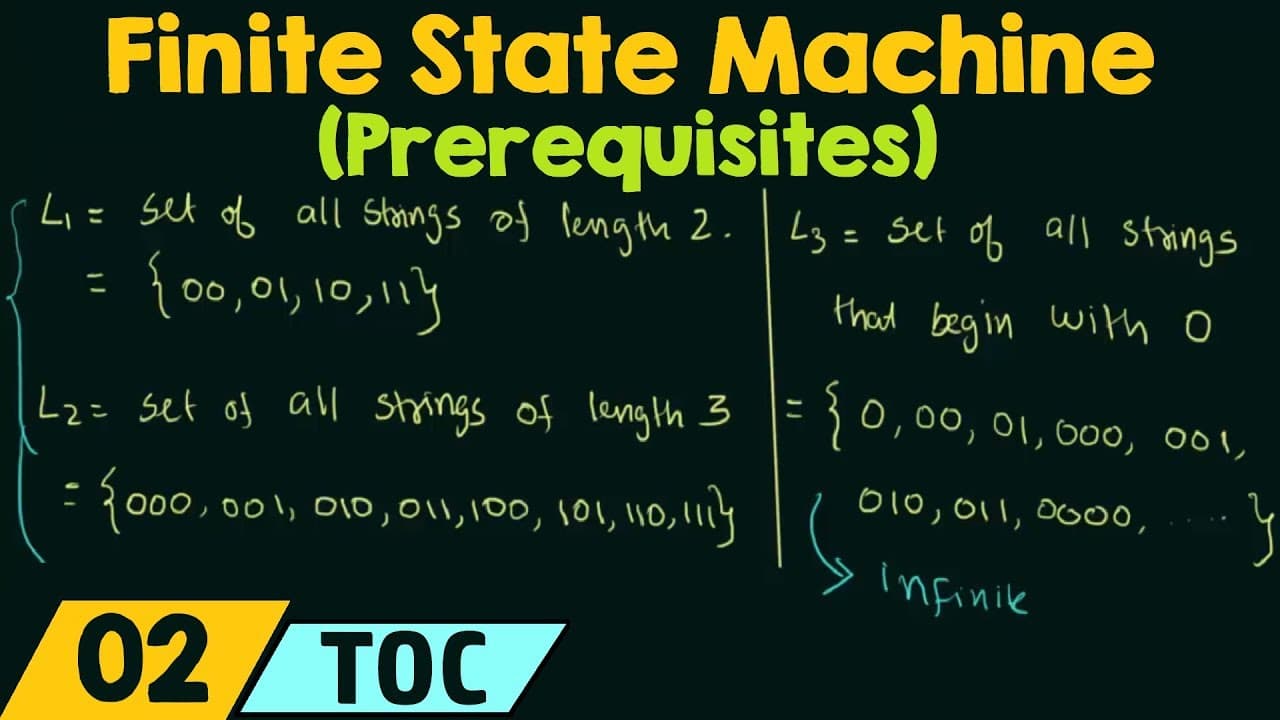
- Languages are sets of strings formed from an alphabet, such as all strings of length two.
- Powers of Sigma (Σ^n) define sets of strings of length 'n' over a given alphabet.
- Cardinality refers to the number of elements in a set, like strings in Σ^n.
- Sigma star (Σ*) represents all possible strings of all lengths from an alphabet.
- Finite languages have a limited number of strings, while infinite languages have unlimited strings.
Install to Summarize YouTube Videos and Get Transcripts
Explore YouTube Video Summarizer or Get YouTube Transcript Extractor
Questions & Answers
Q: What are the prerequisites for learning finite state machines?
The required concepts are symbols, alphabets, strings, languages, powers of Sigma, cardinality, and Sigma star. Together, they describe how symbols form strings, how strings form languages, and how those sets of strings are organized and counted.
Q: What are symbols and alphabets in finite state machines?
A symbol is anything used to represent something, such as a, b, 0, or 1. An alphabet is a collection of symbols, is denoted by Sigma (Σ), and can be a set such as {a, b} or {0, 1}.
Q: What is a string?
A string is a sequence of symbols from an alphabet. A single symbol such as a, 0, or 1 can be a string, as can longer sequences such as aa, bba, or 01.
Q: What is a language in the theory of computation?
A language is a set of strings over an alphabet. For the alphabet {0, 1}, the language of all strings of length two is {00, 01, 10, 11}, while the set of all strings beginning with 0 is an infinite language.
Q: What does Σⁿ mean?
Σⁿ is the set of all strings of length n over an alphabet. For Σ = {0, 1}, Σ¹ is {0, 1}, Σ² is {00, 01, 10, 11}, and Σ³ contains the eight possible strings of length three.
Q: What are Σ⁰ and epsilon?
Σ⁰ is the set containing the string of length zero. That length-zero string is denoted by the special symbol epsilon (ε), and Σ⁰ has a cardinality of one.
Q: How is the cardinality of Σⁿ calculated for the alphabet {0, 1}?
Cardinality means the number of elements in a set. For the two-symbol alphabet {0, 1}, the cardinalities of Σ⁰, Σ¹, Σ², and Σ³ are 1, 2, 4, and 8, so the cardinality of Σⁿ is 2ⁿ.
Q: What is Sigma star (Σ*)?
Sigma star is the union of Σ⁰, Σ¹, Σ², Σ³, and all subsequent powers of Sigma. It therefore contains every possible string of every length over the chosen alphabet and is an infinite set.
Summary & Key Takeaways
-
Understanding finite state machines requires knowledge of several foundational concepts. Symbols are individual characters like 'a' or '1', while alphabets are collections of these symbols, denoted by Sigma. Strings are sequences of symbols, and languages are sets of strings derived from a given alphabet.
-
Powers of Sigma (Σ^n) represent sets of strings of a specific length 'n', and cardinality measures the size of these sets. Sigma star (Σ*) encompasses all possible strings of any length from an alphabet, making it an infinite set.
-
Finite languages contain a limited number of strings, whereas infinite languages, like those represented by Sigma star, have an unlimited number of strings. These concepts form the prerequisites for studying finite state machines in the theory of computation.
Read in Other Languages (beta)
Share This Summary 📚
Summarize YouTube Videos and Get Video Transcripts with 1-Click
Try YouTube Summary with ChatGPT & Claude or YouTube Transcript Generator
Explore More Summaries from Neso Academy 📚
Summarize YouTube Videos and Get Video Transcripts with 1-Click
Try YouTube Summary with ChatGPT & Claude or YouTube Transcript Generator