How to Build Verified Research Reports with Claude
TL;DR
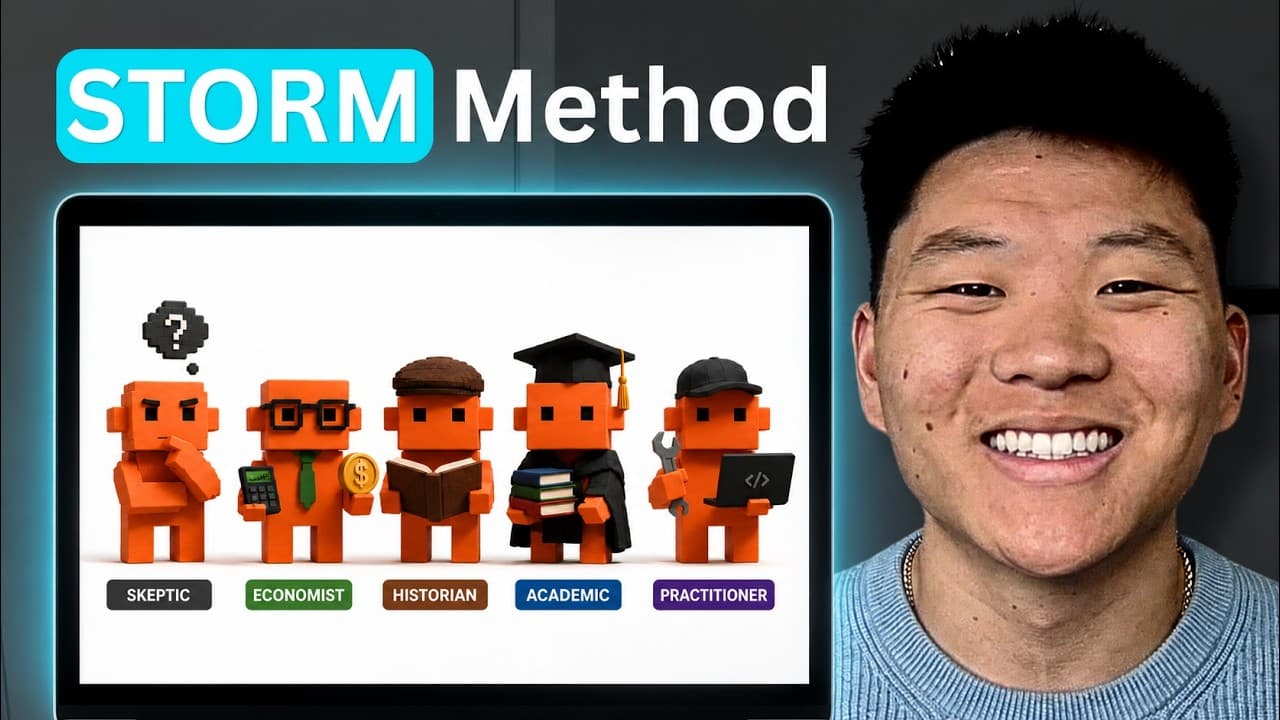
Use five expert lenses, map their contradictions, synthesize their findings, and verify citations before trusting an AI research report. The described STORM skill automates this workflow in Claude, producing a consistent HTML briefing with reliability rankings, assumptions, practical takeaways, and records of sources that were confirmed, corrected, or demoted.
Transcript
So Stanford has a research method called storm, which has actually been shown in peer-reviewed testing to produce articles 25% more organized than the next best method. So I put all of those storm principles into my own Claude skill, which I'm going to give you guys for completely free, and you end up with the result that looks like this. It is an ... Read More
Key Insights
- STORM is a multi-perspective research method that replaces a single research angle with five expert lenses: practitioner, academic, skeptic, economist, and historian. Each lens searches for issues that the others may overlook, reducing blind spots in the initial research plan.
- The workflow is organized into four connected stages: parallel perspective research, contradiction mapping, synthesis, and adversarial peer review. Packaging those stages into a skill allows Claude to execute the complete process from one topic instead of requiring the user to submit each prompt manually.
- Contradiction mapping is the step that makes the expert perspectives evaluate one another. It identifies where their conclusions conflict, which positions have strong evidence, and which rely on weak support before the material is merged into a final briefing.
- Citation verification is built into the final review stage. The resulting report records sources that were confirmed, corrected, or demoted, showing that inaccurate material from an initial pass can be revised before the second version is delivered.
- The HTML briefing uses a repeatable template with a 60-second summary, key findings, reliability scores, assumptions, missing perspectives, and practical takeaways. Consistent formatting makes separate research runs easier to review and adapt for recurring business or content decisions.
- Reliability rankings show both agreement and disagreement behind individual findings. In the demonstration, one finding received a high nine-out-of-ten rating, with support from the academic and skeptic perspectives and challenges from the practitioner and economist perspectives.
- The five default lenses can still share a collective blind spot. One example found that every perspective examined a firm from the owner's position, leaving out customers and frontline employees, so the workflow proposed adding a sixth lens for another report version.
- The demonstrated comparison favored the STORM HTML briefing over Claude Code's Deep Research report in six categories: evidence quality, source diversity, thesis strength, actionability, risk control, and usefulness for video and content. The STORM run also used far fewer agents in that example.
Install to Summarize YouTube Videos and Get Transcripts
Explore YouTube Video Summarizer or Get YouTube Transcript Extractor
Questions & Answers
Q: How does the STORM research workflow work in Claude?
The workflow begins by scoping the topic and may ask questions when the request is too broad. Claude then runs five expert lenses in parallel: practitioner, academic, skeptic, economist, and historian. It maps contradictions among their findings, synthesizes the evidence into one report, performs adversarial peer review, verifies citations against primary sources, and delivers a consistent HTML briefing.
Q: Why does STORM use five different research perspectives?
Five perspectives are used because a single prompt or research angle can leave important blind spots. The practitioner, academic, skeptic, economist, and historian approach the same topic with different priorities and expertise. Their separate findings reveal omissions, disagreements, weak assumptions, and evidence gaps that might remain hidden if Claude generated one undifferentiated research response.
Q: What are the four stages behind the STORM skill?
The skill chains together four main stages. First, five expert lenses research the topic in parallel. Second, a contradiction map identifies disagreements and compares the strength of their evidence. Third, Claude synthesizes the findings into a unified briefing. Fourth, an adversarial peer-review process checks the output and verifies every citation against its primary source before delivery.
Q: How does the STORM workflow verify research claims?
Verification occurs after the multi-perspective findings have been mapped and synthesized. Additional agents conduct adversarial peer review and check citations against their primary sources. The final briefing identifies sources that were confirmed, corrected, or demoted. This process can remove or revise information that appeared credible during the first pass but did not survive closer examination.
Q: What information appears in the final STORM HTML report?
The report follows a consistent HTML template and contains a 60-second summary, key findings, reliability rankings, perspective-level analysis, assumptions, missing lenses, practical takeaways, and source-verification results. It can also show which perspectives supported or challenged a finding, helping the reader distinguish broad agreement from conclusions that remain disputed or depend on uncertain evidence.
Q: How did STORM compare with Claude Code's Deep Research?
In the example, Claude Code's Deep Research launched 103 agents but initially internalized the findings instead of presenting a report. Its later markdown output was described as less thorough and included only a small number of sources, some unconfirmed. Codex judged the STORM HTML briefing stronger in evidence quality, source diversity, thesis, actionability, risk control, and content usefulness.
Q: How can a STORM report be tailored to a business or project?
The skill can include information about the user's work, business, goals, intended reader, and desired decisions. That context directs the report toward practical consequences instead of producing only a collection of statistics. In the demonstration, Claude recognized that the user was an AI educator deciding whether voice AI agents deserved a video or were merely hype.
Q: How do you install and invoke the STORM research skill?
The creator provides a skill markdown file and an HTML report template through the free community linked in the description. For Claude, the files can be placed in the .Claude folder by asking Claude to install the skill there. After installation, a request such as asking Claude to run STORM research can invoke it without requiring a slash command.
Summary & Key Takeaways
-
The STORM workflow approaches one research topic through five perspectives: practitioner, academic, skeptic, economist, and historian. These lenses investigate in parallel, exposing blind spots that a single prompt may miss. Their findings are then compared, synthesized, reviewed, and converted into a structured HTML briefing designed to remain consistent across repeated research runs.
-
The demonstrated skill chains four stages into one automated process: generating perspective-based research, mapping contradictions, synthesizing the evidence, and conducting adversarial peer review with citation verification. Its report includes a 60-second summary, reliability-ranked findings, disagreements among perspectives, underlying assumptions, missing viewpoints, practical takeaways, and a record of corrected or demoted sources.
-
In the presented comparison, the STORM briefing was judged by Codex to outperform Claude Code's Deep Research output across evidence quality, source diversity, thesis strength, actionability, risk control, and usefulness for content. The creator also reports that STORM used roughly 12 agents, while the compared Deep Research run used more than 100 and encountered API rate limits.
Read in Other Languages (beta)
Share This Summary 📚
Summarize YouTube Videos and Get Video Transcripts with 1-Click
Try YouTube Summary with ChatGPT & Claude or YouTube Transcript Generator
Explore More Summaries from Nate Herk | AI Automation 📚





Summarize YouTube Videos and Get Video Transcripts with 1-Click
Try YouTube Summary with ChatGPT & Claude or YouTube Transcript Generator