[Short Answers #2] SZBK07 300 W DC-DC converter quiescent current
TL;DR
This video analyzes input current and voltage relationships in a modified DC-DC converter.
Transcript
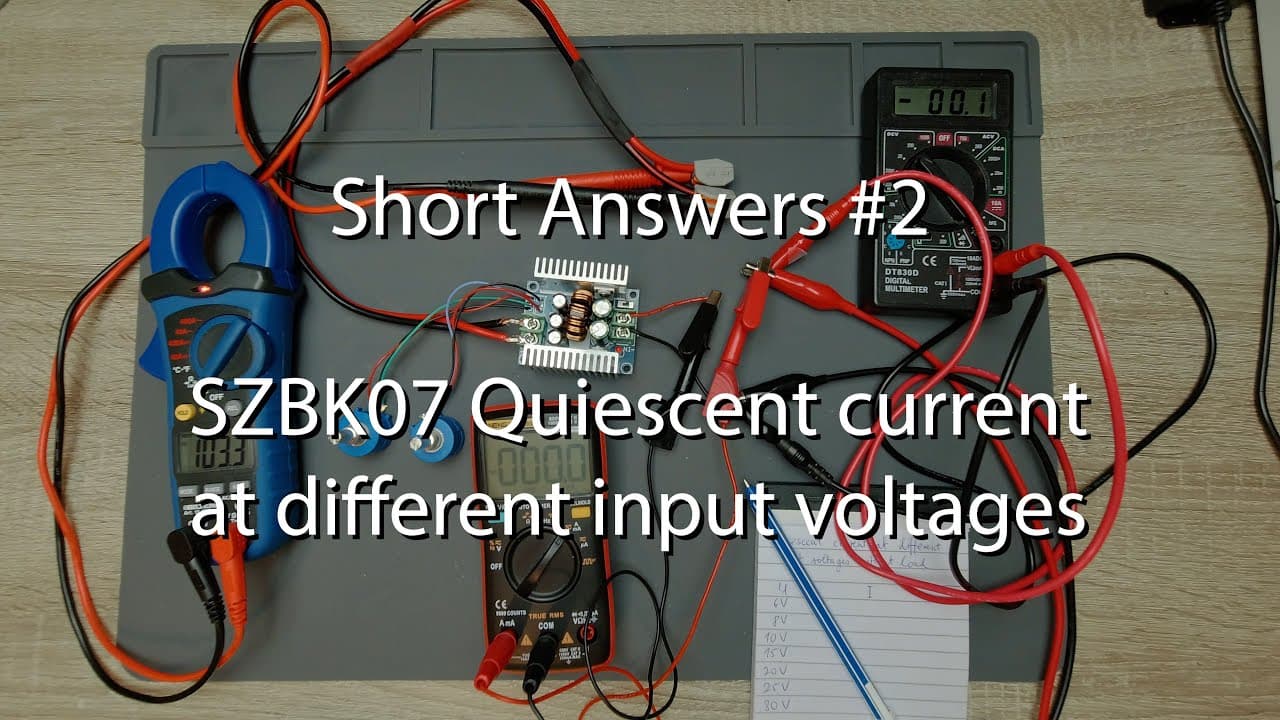
welcome everyone this is another short answers video so i'm going to answer some viewers question very quickly in a short video so the question was regarding this szbk07 dc dc converter and as you can see this is one of my converted converter which means that i have removed the original trimmer potentiometers and i replaced them with these multi-tu... Read More
Key Insights
- ⚡ Replacing standard potentiometers with multi-turn precision potentiometers greatly enhances control over output voltage adjustments in DC-DC converters.
- ⚡ Input and output voltage measurements demonstrate the relationship between supply voltage and converter efficiency, emphasizing the importance of proper configuration.
- 😮 As input voltage increases, the quiescent current also tends to rise, suggesting that even in unloaded scenarios, the converter draws significant current.
- 🧡 The video confirmed that maximum output accompanies optimal input voltage closely, highlighting the converter's performance across its operational range.
- 💁 Testing without a load provides valuable information but also limits conclusions about real-world application performance, which may require resistive or inductive loads.
- 🔡 The converter shows diminished efficiency at lower input voltages, indicating that users should be cautious when operating within its lower thresholds.
- 🫵 Detailed measurement setups involving multiple multimeters for current and voltage offer viewers practical insights into conducting similar tests for various applications.
Install to Summarize YouTube Videos and Get Transcripts
Explore YouTube Video Summarizer or Get YouTube Transcript Extractor
Questions & Answers
Q: What modifications were made to the DC-DC converter in the video?
The original trimmer potentiometers of the DC-DC converter were removed and replaced with multi-turn precision potentiometers. This allows users to adjust the voltage and current more finely and conveniently as compared to the original design, which required turning a small screw with a screwdriver.
Q: What is the purpose of measuring the quiescent current in the context of this video?
Measuring quiescent current provides insights into the DC-DC converter's efficiency and performance at various input voltages without a load. It helps understand how the converter behaves under different conditions, which is crucial for designing and optimizing electronic circuits for specific applications.
Q: How does the input voltage affect the output voltage and current in the DC-DC converter?
The video illustrates that as input voltage increases, the output voltage tends to closely follow the input, albeit with some variations at lower voltages. Concurrently, the input current also rises. For example, the current measurement increased significantly at lower voltages when adjustments were made, demonstrating the converter's dynamics.
Q: What were the maximum input voltage and output voltage measured during the testing?
The testing reached a maximum input voltage of 30 volts, which produced an output voltage of approximately 28.99 volts. This indicates that the converter was able to maintain a stable output voltage relative to the high input voltage, showing good performance at maximum load conditions in this test.
Q: Is the DC-DC converter effective at low input voltages according to the video?
The video indicates that the converter does not perform efficiently at low input voltages. For instance, when testing with an input voltage of 6 volts, the output was significantly lower and showed a notable increase in quiescent current draw. This signifies performance limitations at minimum thresholds.
Q: How is the current measured when testing the input of the DC-DC converter?
The input current is measured in series using a multimeter connected directly in line with the input power supply. This configuration allows for accurate current measurements as the converter operates under different input voltage settings while ensuring that the measurement setup does not interfere with the circuit's functionality.
Summary & Key Takeaways
-
The video demonstrates a modified DC-DC converter with multi-turn precision potentiometers for easier voltage adjustments. This modification enhances the user's ability to fine-tune output settings without needing specialized tools.
-
Input current measurements at various voltage levels are shared, focusing on quiescent current without any load attached, revealing how input voltages influence current draw across the converter's operational range.
-
A systematic increase in input voltage is tested, showcasing various output voltages and their corresponding input currents, alongside a discussion about the performance of the converter at minimum and maximum input conditions.
Read in Other Languages (beta)
Share This Summary 📚
Summarize YouTube Videos and Get Video Transcripts with 1-Click
Try YouTube Summary with ChatGPT & Claude or YouTube Transcript Generator
Explore More Summaries from Curious Scientist 📚
![Building a Peltier cooler-based cooling box - First iteration, improvements [Part 2/6] thumbnail](/_next/image?url=https%3A%2F%2Fi.ytimg.com%2Fvi%2F0YlNw0EGnzI%2Fhqdefault.jpg&w=750&q=75)
Summarize YouTube Videos and Get Video Transcripts with 1-Click
Try YouTube Summary with ChatGPT & Claude or YouTube Transcript Generator