Engineering with Origami
TL;DR
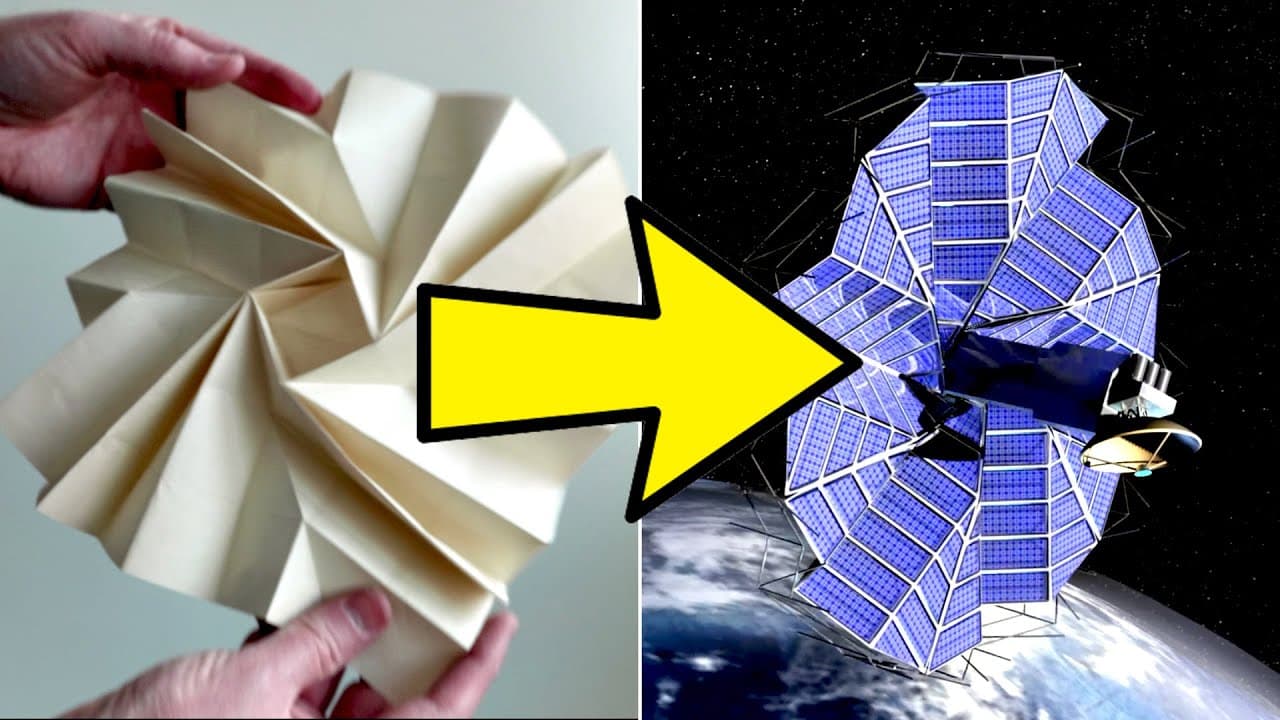
Origami, an ancient art of paper folding, has become highly valuable in modern engineering due to its ability to transform flat sheets into various shapes and structures with minimal processing.
Transcript
engineers are turning to origami for inspiration for all types of applications from medical devices to space applications and even stopping bullets but why is it that this ancient art of paper folding is so useful for modern engineering origami literally folding paper dates back at least 400 years in japan but the number of designs was limited ther... Read More
Key Insights
- 👂 Origami has evolved from a limited number of designs to tens of thousands, thanks to the contributions of origami masters like Akira Yoshizawa.
- 🪭 Origami offers solutions for various engineering challenges, including size reduction, rigidity enhancement, and the folding of thick materials.
- 👻 The principles of origami are scalable, allowing for devices and structures to be both macro-sized and miniaturized.
- 🖐️ The mathematical representation of crease patterns plays a crucial role in the design and construction of origami structures.
- 😷 Origami finds applications in diverse fields, including medical devices, space missions, bulletproof walls, compliant mechanisms, and improved aerodynamics.
- 👻 Origami allows engineers to leverage centuries of creative ideas and adapt them for practical engineering solutions.
- 🫓 The versatility and usefulness of origami in engineering applications stem from its ability to transform flat sheets into complex, functional shapes and structures.
Install to Summarize YouTube Videos and Get Transcripts
Explore YouTube Video Summarizer or Get YouTube Transcript Extractor
Questions & Answers
Q: Why is origami so useful in modern engineering applications?
Origami is useful because it can transform a flat sheet into complex shapes using minimal processing. This makes it ideal for designing structures and mechanisms that require compactness, flexibility, and rigidity.
Q: Can origami be used in medical devices?
Yes, origami-inspired designs are being used in medical devices. For example, flexible catheters with origami bellows provide support during insertion into the body. Origami motions are also used in devices like forceps, which can morph and perform complex tasks inside the body.
Q: How does origami contribute to space applications?
Origami patterns, such as the Miura Ori, have been used in space missions for deploying solar panels. These patterns allow for compactness during launch and reliable deployment in space.
Q: How is origami applied in improving aerodynamics?
Origami-inspired designs have been used to improve the aerodynamics of freight locomotives. Folding patterns can be deployed to reduce drag and save millions of dollars in fuel costs.
Summary & Key Takeaways
-
Origami, originating in Japan, has experienced a renaissance in the 20th century, with tens of thousands of designs now documented.
-
Folding a sheet of paper can create intricate structures like a cactus or even bulletproof walls, demonstrating the versatility of origami in engineering applications.
-
By folding and manipulating materials, origami allows for size reduction, rigidity enhancement, and the folding of thick rigid materials, making it useful in medical devices, space applications, and more.
Read in Other Languages (beta)
Share This Summary 📚
Summarize YouTube Videos and Get Video Transcripts with 1-Click
Try YouTube Summary with ChatGPT & Claude or YouTube Transcript Generator
Explore More Summaries from Veritasium 📚




Summarize YouTube Videos and Get Video Transcripts with 1-Click
Try YouTube Summary with ChatGPT & Claude or YouTube Transcript Generator