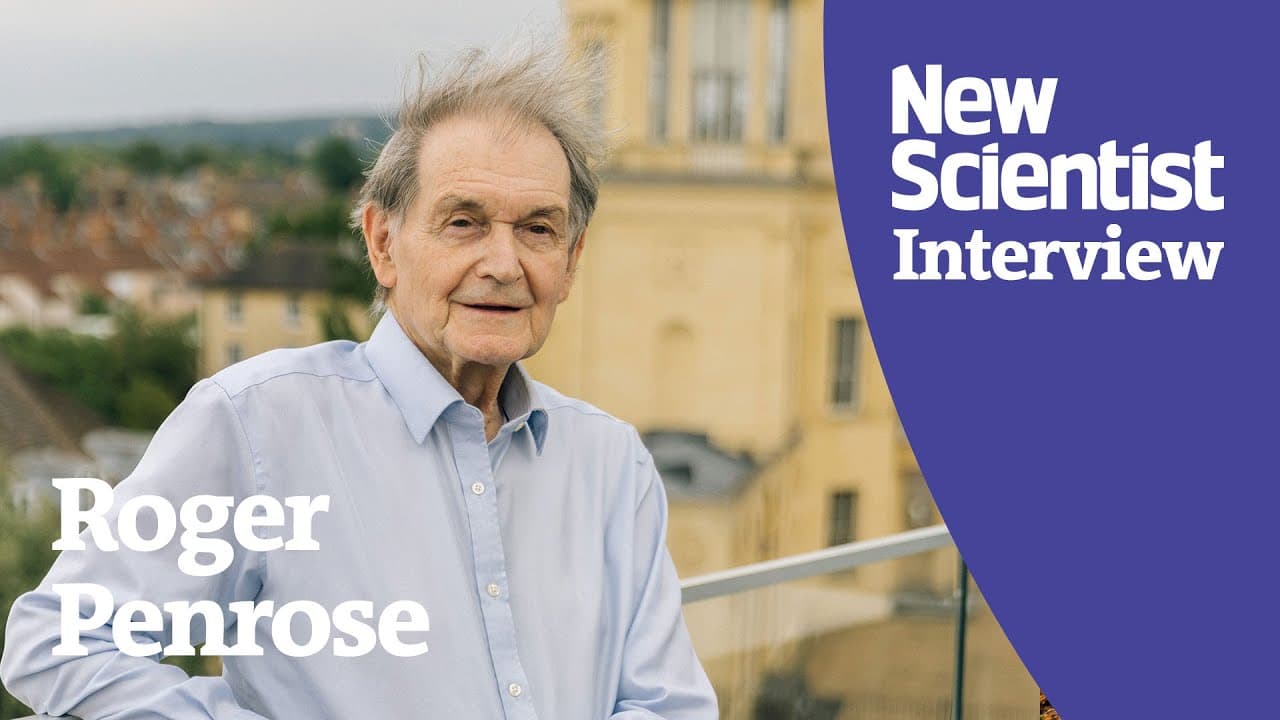
Roger Penrose: How Does Consciousness Relate to Physics?
TL;DR
Roger Penrose asserts that consciousness is fundamentally non-computable and challenges current scientific understanding. He connects consciousness to quantum mechanics and suggests it may reflect deeper truths about the universe. Additionally, he proposes his conformal cyclic cosmology theory, which argues that the Big Bang is merely a continuation of a previous eon.
Transcript
the Big Bang was the conformal continuation of the remote future of a previous Eon and maybe we maybe others produce a very very Advanced civilization which will learn how to send signals into the next eon so Roger thank you for talking to new scientists making time for this one thing I wanted to ask sort of leading off was about black holes becaus... Read More
Key Insights
- 🖤 Penrose's pioneering work on black holes and singularities revolutionized our understanding of these cosmic phenomena.
- ❓ The conformal cyclic cosmology theory proposes a cyclical model of the universe's evolution, challenging traditional linear cosmological frameworks.
- 🤗 Penrose's exploration of consciousness and quantum effects opens up new avenues for understanding the relationship between mind and the physical world.
- 🫷 The Nobel laureate's unorthodox views on physics and consciousness push the boundaries of scientific inquiry, inviting critical examination of established paradigms.
- 🎙️ More videos with Roger Penrose:
Install to Summarize YouTube Videos and Get Transcripts
Explore YouTube Video Summarizer or Get YouTube Transcript Extractor
Questions & Answers
Q: How did Roger Penrose react to the first photograph of a black hole?
Penrose was not surprised by the image as he had already expected the existence of black holes due to his work on singularities in general relativity.
Q: What is the conformal cyclic cosmology theory proposed by Penrose?
The theory suggests that the Big Bang is not the origin of the universe but a continuation from a previous Eon, indicating a cyclic nature to the universe's expansion and contraction.
Q: How does Roger Penrose view the connection between consciousness and quantum effects?
Penrose believes that consciousness involves non-computable processes beyond current scientific understanding, hinting at a deeper level of physics yet to be discovered.
Q: What implications does Penrose's research have for the future of physics and our understanding of the universe?
Penrose's work challenges conventional cosmological views, suggesting that there may be hidden signals from previous Eons and the potential for advanced civilizations to communicate across eons.
Summary & Key Takeaways
-
Roger Penrose talks about black holes and the initial skepticism surrounding their existence due to singularities.
-
He delves into the conformal cyclic cosmology theory, proposing that the Big Bang is a continuation of a previous Eon.
-
Penrose discusses the intersection of quantum effects with consciousness, challenging traditional views on the nature of mind and matter.
Read in Other Languages (beta)
Share This Summary 📚
Summarize YouTube Videos and Get Video Transcripts with 1-Click
Try YouTube Summary with ChatGPT & Claude or YouTube Transcript Generator
Explore More Summaries from New Scientist 📚
Summarize YouTube Videos and Get Video Transcripts with 1-Click
Try YouTube Summary with ChatGPT & Claude or YouTube Transcript Generator