What Is Program Correctness in Compilers?
TL;DR
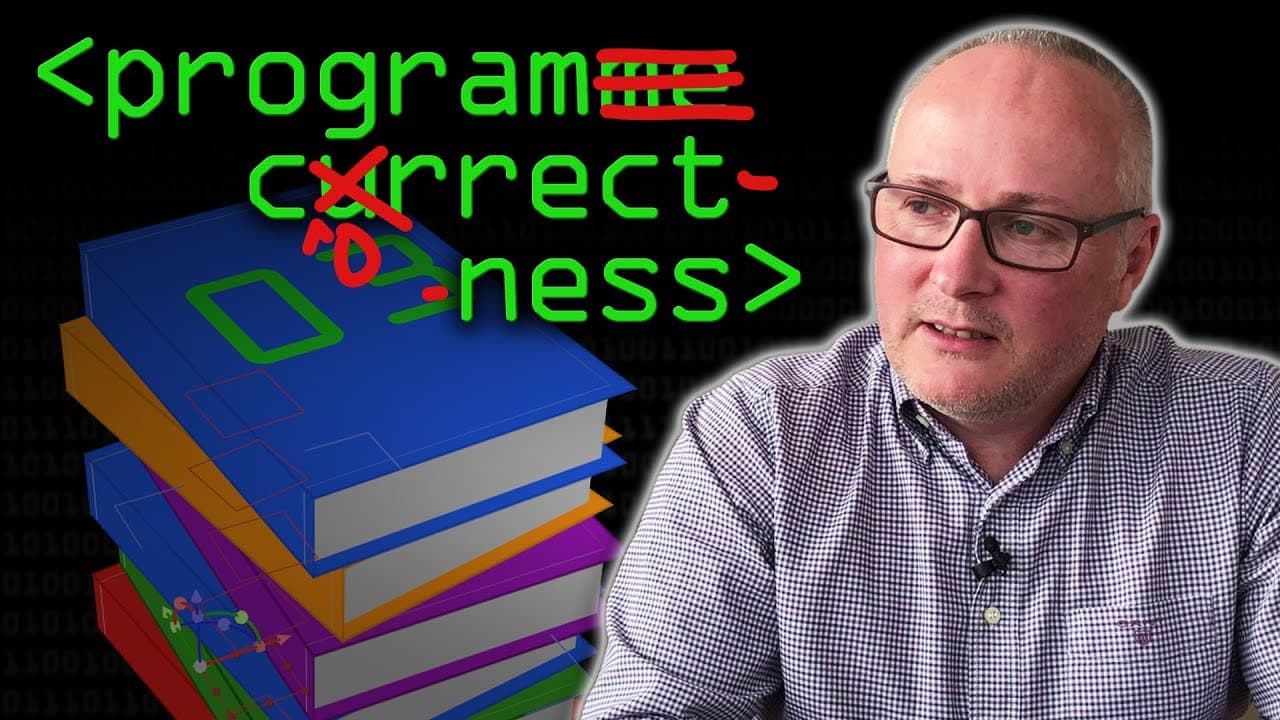
Program correctness ensures that compilers accurately translate high-level languages to low-level code. This video illustrates the verification process through a simple compiler example, demonstrating how to evaluate and compile expressions. It further highlights the use of testing tools like QuickCheck for verifying correctness, providing confidence in program functionality.
Transcript
today we're going to be doing something a little bit different and it's something that brings together many ideas in computer science and it's the idea of program correctness so what we're going to be thinking about is what does it actually mean for a program to be correct and then how can we specify and verify that in some kind of precise way so t... Read More
Key Insights
- 🎭 Program correctness is a critical aspect of software development, ensuring that programs perform as intended.
- 👨💻 Compilers play a crucial role in translating high-level code to machine-readable code for execution.
- ❓ The example of a simple compiler highlights the importance of verifying correctness to ensure accurate translation and execution.
- 👻 Testing tools like QuickCheck can provide high confidence in the correctness of a program, allowing for automated testing of properties.
Install to Summarize YouTube Videos and Get Transcripts
Explore YouTube Video Summarizer or Get YouTube Transcript Extractor
Questions & Answers
Q: How is program correctness defined in the context of a compiler?
Program correctness in a compiler means that the output of executing compiled code is the same as evaluating the original expression. This is verified by translating expressions into stack machine code and executing it with an empty stack.
Q: What are the key components of the example compiler discussed in the content?
The example compiler consists of a source language with arithmetic expressions, a target language with stack machine code, evaluation and compilation functions, and a stack execution mechanism.
Q: How is the correctness of the compiler verified?
The correctness property is defined as the output of executing compiled code being equal to evaluating the original expression. The property is checked using the QuickCheck testing tool, which generates random test cases to verify the property for different expressions.
Q: What are some potential methods for proving program correctness?
Besides testing tools, program correctness can be proven through mathematical induction, formal proofs, or using automated theorem provers or proof assistants. These methods provide higher confidence in the correctness of a program.
Summary & Key Takeaways
-
The content introduces the concept of program correctness and its importance in computer science.
-
It explains the example of a simple compiler that translates high-level language to low-level language.
-
The video discusses the source language for the compiler, the data types involved, and the evaluation and compilation processes.
-
It highlights the significance of verifying the correctness of the compiler and introduces the use of testing tools like QuickCheck.
Read in Other Languages (beta)
Share This Summary 📚
Summarize YouTube Videos and Get Video Transcripts with 1-Click
Try YouTube Summary with ChatGPT & Claude or YouTube Transcript Generator
Explore More Summaries from Computerphile 📚



Summarize YouTube Videos and Get Video Transcripts with 1-Click
Try YouTube Summary with ChatGPT & Claude or YouTube Transcript Generator