What Are Recurrent Neural Networks (RNNs) Used For?
TL;DR
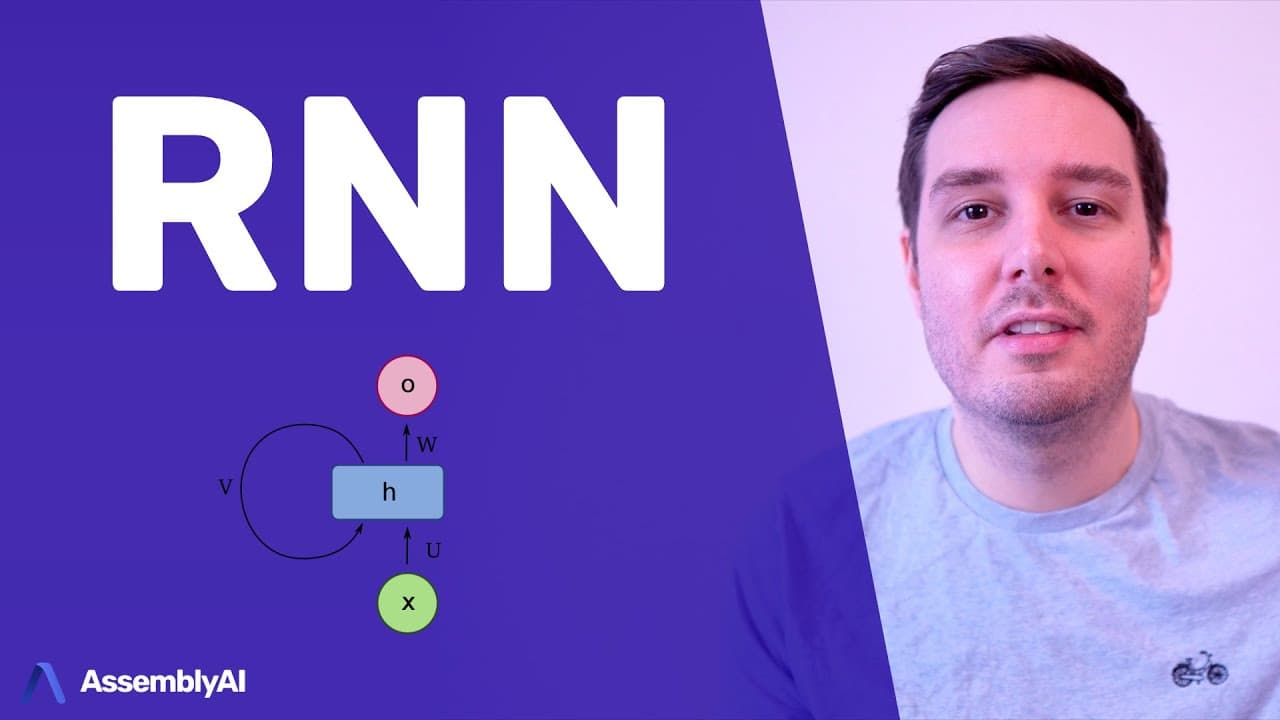
Recurrent Neural Networks (RNNs) are designed for processing sequence data and excel at remembering previous contexts, making them ideal for tasks like text generation and classification. They operate with hidden states that store information over time, allowing flexibility in applications such as sentiment analysis, machine translation, and music generation.
Transcript
recurrent neural networks or short r ends are an essential part in deep learning they are widely used and are incredibly effective in many different kinds of applications especially in the field of natural language processing like for text generation or text classification but they can also be used when working with images or video data so in this ... Read More
Key Insights
- ⏮️ RNNs operate on sequence data and maintain memory of previous outputs.
- 💁 Hidden states in RNNs store information for subsequent time steps.
- ❓ Variants like LSTM and GRU address vanishing gradient issues in RNNs.
- 👨💻 Implementation of RNNs in code is simplified with existing layers in deep learning frameworks.
- 🍵 RNNs offer flexibility in handling various types of sequence data relationships.
- 🈸 RNNs are crucial for applications like text prediction and sentiment analysis.
- ❓ The explanation and motivation behind RNNs highlight their importance in deep learning.
Install to Summarize YouTube Videos and Get Transcripts
Explore YouTube Video Summarizer or Get YouTube Transcript Extractor
Questions & Answers
Q: How do RNNs differ from traditional neural networks?
RNNs differ by operating on sequence data, enabling memory of previous outputs essential for retaining context and predicting subsequent information.
Q: What is the significance of hidden states in RNNs?
Hidden states in RNNs store information from previous time steps, crucial for maintaining long-term dependencies in sequence data processing.
Q: How do RNNs mitigate the vanishing gradient problem?
RNNs mitigate vanishing gradients with specialized variants like LSTM and GRU, equipped with gating mechanisms to preserve long-term dependencies in data processing.
Q: How can RNNs be implemented in code?
RNNs can be easily implemented in deep learning frameworks like PyTorch and TensorFlow using pre-existing layers such as SimpleRNN, LSTM, and GRU for sequence data processing.
Summary & Key Takeaways
-
RNNs are neural networks operating on sequence data, with loops allowing information persistence.
-
They excel in remembering previous context, crucial for text prediction and classification.
-
RNNs are flexible, operating on sequence data, enabling various relationships like one-to-many and many-to-many scenarios.
Read in Other Languages (beta)
Share This Summary 📚
Summarize YouTube Videos and Get Video Transcripts with 1-Click
Try YouTube Summary with ChatGPT & Claude or YouTube Transcript Generator
Explore More Summaries from AssemblyAI 📚






Summarize YouTube Videos and Get Video Transcripts with 1-Click
Try YouTube Summary with ChatGPT & Claude or YouTube Transcript Generator