How to Invest Amid AI and Geopolitical Conflict
TL;DR
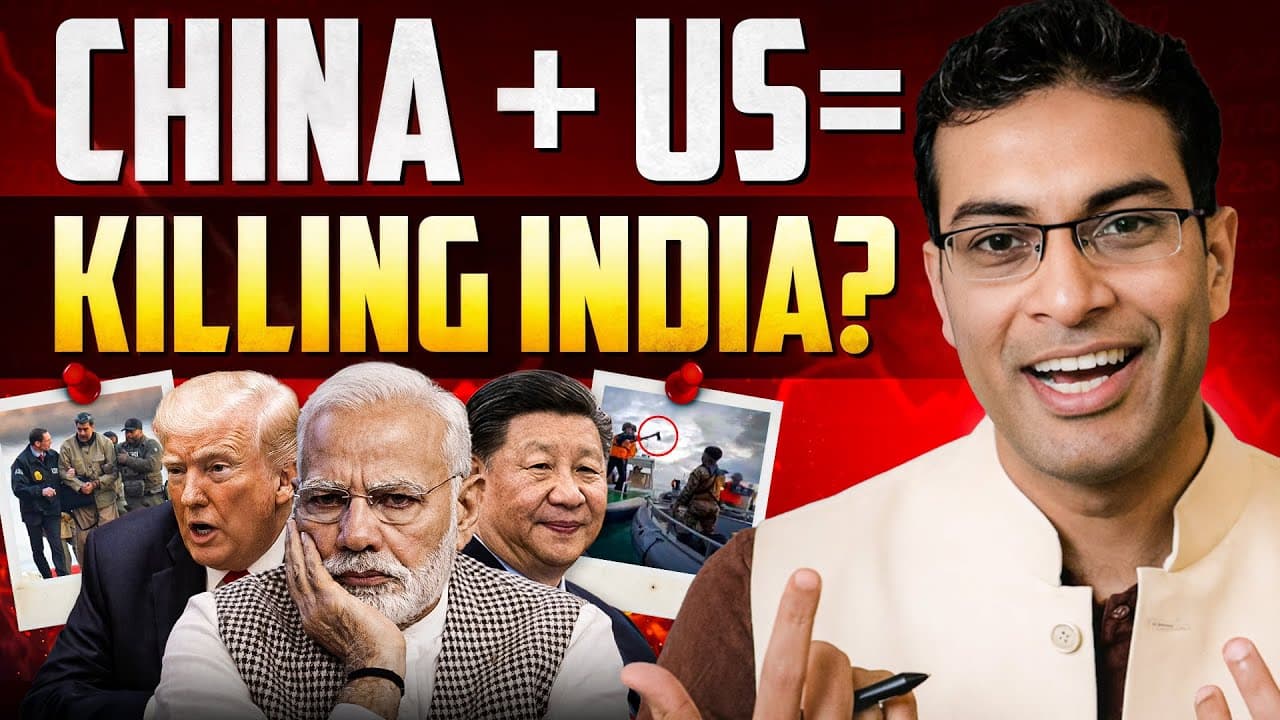
Industrial strength, trade flows, AI, and geopolitical competition can shape currencies, commodities, and equity markets, so investors should examine where countries manufacture, export, and attract foreign money. The central argument is that China’s manufacturing advantage and America’s reindustrialization effort are intensifying their rivalry, while investors must assess where India and diversified global assets fit within that changing system.
Transcript
Hey guys, welcome to today's video. So on today's video, I'm going to talk about the impact of geopolitics on the world of investing. I'm not a geopolitical expert, but my training is in finance. So I'm going to relate whatever little I can understand about geopolitics to the world of investing and finance. This becomes an extremely critical video ... Read More
Key Insights
- Industrialization is the production and export of valuable goods or services that bring foreign money into a country. It supported earlier empires through shipbuilding, factories, railroads, and automation, and it later contributed to China’s emergence as a major manufacturing power.
- A manufacturing advantage depends on value for money, not simply the lowest possible price. China’s competitive position came from combining relatively inexpensive production with acceptable quality, large factories, flexible operating conditions, and an ability to increase output rapidly.
- China became a stronger economic competitor to the United States by expanding its manufacturing base and exporting increasing quantities of goods. The United States received those products and transferred dollars to China, while China accumulated dollars and invested some of them in American assets such as bonds.
- The US-China trade relationship turned the United States into a net importer within the framework presented. China’s exports grew while the United States exported dollars in payment, causing the bilateral trade deficit to expand and reinforcing China’s growing economic influence.
- American reindustrialization is an effort to manufacture more domestically and respond to China’s industrial advantage. The discussion associates this agenda with Donald Trump’s periods of political power beginning in 2016 and again in 2024, while presenting it as an important force in 2026.
- AI is changing the factors of production and therefore affects the new industrial competition. The transcript frames the 2026 AI race as connected to reindustrialization, although the provided portion ends before explaining the four production factors or their detailed investment implications.
- Foreign currency inflows can come from services as well as manufactured products. Thailand is presented as an example because international visitors spend money there, allowing tourism to function like an exported offering that brings foreign funds into the domestic economy.
- Investment diversification requires examining how geopolitical competition could affect equities, commodities, currencies, and different regions. The proposed analysis covers American, Indian, and Middle Eastern exposure, but the available transcript introduces these topics without providing a complete allocation formula or specific investment recommendations.
Install to Summarize YouTube Videos and Get Transcripts
Explore YouTube Video Summarizer or Get YouTube Transcript Extractor
Questions & Answers
Q: How does industrialization strengthen a country’s economy?
Industrialization strengthens an economy by enabling the country to create goods of value, export them, and receive foreign money. A country may also import inputs, add value through manufacturing, and export the finished products. The discussion links this process to the growth of Spanish, Portuguese, British, American, and Chinese economic power across different periods.
Q: Why did China develop a strong manufacturing advantage?
China developed a manufacturing advantage by combining low production costs with acceptable product quality and large-scale output. The argument emphasizes that buyers seek value for money rather than the cheapest item alone. Large factories, the ability to scale quickly, relatively lax labor rules, and easier displacement of villages are cited as contributors to this industrial position.
Q: How did trade with China affect the United States?
Trade transferred large quantities of Chinese-manufactured goods to the United States and dollars in the opposite direction. As Chinese exports increased, China accumulated American currency and invested some of it in US-oriented assets such as bonds. The discussion argues that this pattern widened the trade deficit and helped make the United States a net importer rather than a net exporter.
Q: What is American reindustrialization trying to achieve?
American reindustrialization is intended to increase domestic manufacturing and respond to China’s competitive industrial position. The discussion describes this as a central part of Donald Trump’s agenda when he came to power in 2016 and again in 2024. Its broader objective is to rebuild productive capacity rather than continuing to depend heavily on imported manufactured goods.
Q: Why is value for money important in manufacturing?
Value for money matters because buyers consider both price and quality when choosing where to purchase manufactured goods. A country offering the lowest price does not automatically win demand if its product quality is inadequate. China’s advantage is described as an ability to manufacture cheaply enough while still delivering acceptable value, supported by scale and production capacity.
Q: How is AI connected to geopolitical competition?
AI is presented as a force that will disrupt a factor of production and influence the 2026 race for reindustrialization. This technological shift is placed within the broader economic collision between the United States and China. However, the provided transcript ends before defining the four factors of production or explaining precisely how AI changes each one.
Q: What should global investors examine during geopolitical conflict?
Global investors should examine how industrial capacity, trade flows, AI competition, currencies, commodities, and geopolitical tensions could affect different markets. The proposed framework includes US equities, Indian equities, Middle Eastern exposure, the dollar, gold, China’s role, and diversification. The source does not provide a completed portfolio allocation in the available transcript and explicitly advises personal due diligence.
Q: Where does India fit into the US-China economic rivalry?
India is identified as an important part of the investment discussion because investors may be increasing their exposure to Indian equities while the United States and China compete over industry and technology. The available transcript promises to examine India’s role, but it does not yet provide a detailed conclusion about India’s manufacturing position, market outlook, or preferred investments.
Summary & Key Takeaways
-
Industrialization supports national economic power by enabling countries to produce valuable goods or services, increase exports, and attract foreign money. Historical examples in the discussion include Iberian shipbuilding, British factory production, American railroads and automation, Chinese manufacturing, and Thailand’s tourism sector as another source of foreign currency inflows.
-
China developed a competitive manufacturing advantage by producing goods at low cost while maintaining acceptable quality and achieving enormous scale. Growing exports to the United States produced a widening trade imbalance, accumulated dollars in China, and helped China become a serious economic competitor to the United States after starting from a much poorer position.
-
The United States is pursuing reindustrialization as AI changes the factors of production and geopolitical rivalry intensifies. The investment framework proposed connects manufacturing capacity, trade deficits, reserve currencies, commodities, territorial conflicts, India’s position, and stock markets. Investors are encouraged to understand these relationships and diversify while conducting their own due diligence.
Read in Other Languages (beta)
Share This Summary 📚
Summarize YouTube Videos and Get Video Transcripts with 1-Click
Try YouTube Summary with ChatGPT & Claude or YouTube Transcript Generator
Explore More Summaries from Akshat Shrivastava 📚





Summarize YouTube Videos and Get Video Transcripts with 1-Click
Try YouTube Summary with ChatGPT & Claude or YouTube Transcript Generator