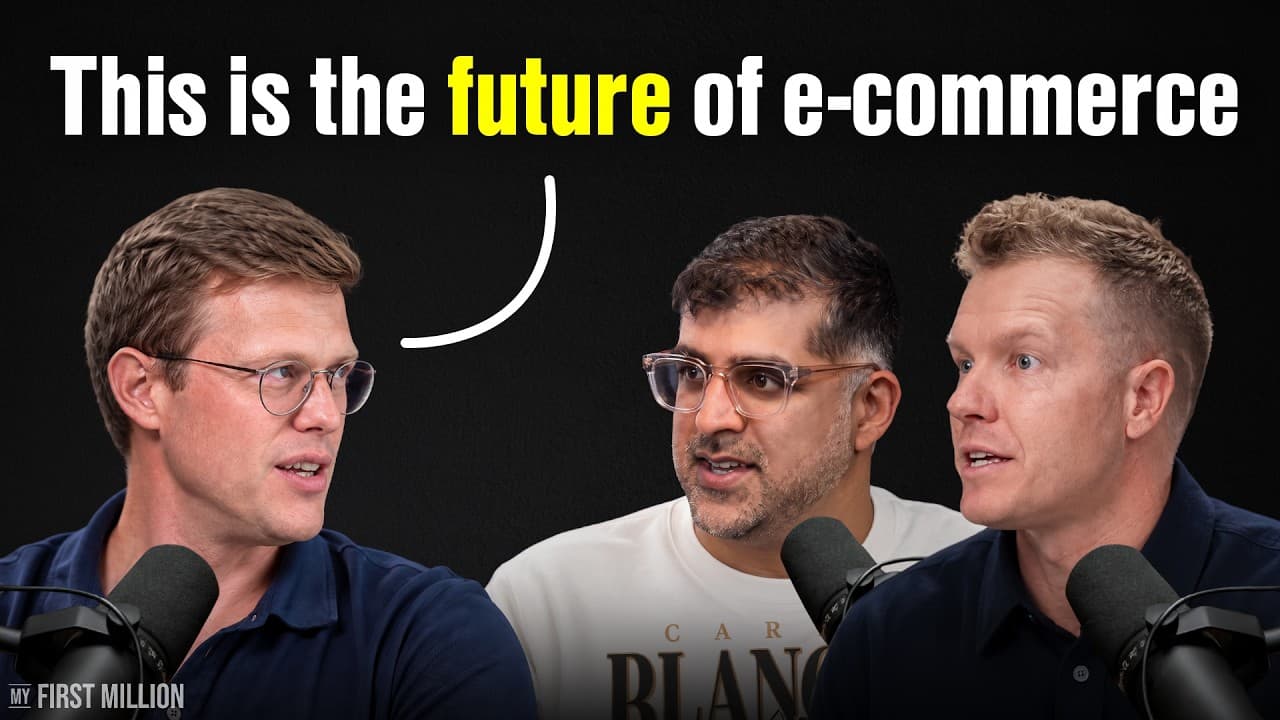
How Grant Lafontaine built Whatnot into a $20B marketplace
TL;DR
Grant Lafontaine built Whatnot from a small two person team to a multi billion dollar valued marketplace by staying focused on the core problem you are solving and iterating through tough early days. Early growth relied on authenticating items and hard work, with growth milestones including 30 sales to 2.3 million in year one, 163 million in year two, and a path toward one billion in year three.
Transcript
You build a company that is worth $20 billion. But just put that in perspective. That is more than if you add up the entire market cap of Wendy's, Under Armour, Herz rental car, Harley-Davidson, American Airlines. Also, isn't that bananas when you hear that? Yeah. I think it's absolutely nuts. What I find interesting about you is that you went from... Read More
Key Insights
- Whatnot’s growth began with a lean, two person team seeking a scalable marketplace model and a strong value proposition for buyers and sellers.
- The founders faced early skepticism and used intense practical experiments to learn what would actually work in live commerce and community building.
- Authenticating every item and focusing on trust were core to early expansion and helped convert first movers into repeat users.
- Initial sales momentum came from niche categories like collectibles, but the platform evolved to accommodate a broader range of products over time.
- The founders iterated on logistics and delivery ideas, realizing that margin and feasibility are critical for a marketplace’s sustainable growth.
- Fundraising dynamics played a role in shaping the company’s timing and strategy, with persistence and follow up proving essential.
- Marketing and growth tactics mattered as much as the product in turning early traction into scalable growth.
- The leadership style emphasized being disagreeable but likable, balancing bold decisions with a culture of credibility and user focus.
Install to Summarize YouTube Videos and Get Transcripts
Explore YouTube Video Summarizer or Get YouTube Transcript Extractor
Questions & Answers
Q: What problem did Whatnot aim to solve when it started
Whatnot began as an attempt to create a better marketplace for used goods by applying live commerce and authentication to build trust between sellers and buyers. The aim was to streamline the buying experience, make it more engaging, and reduce the friction in selling items online. Over time this evolved into a broader marketplace with diverse offerings, but the core focus remained on solving trust and convenience for users.
Q: How did Grant describe the first days of Whatnot
Grant described the early days as lean and creative, with two founders building from a barroom brainstorm and choosing domains to anchor their new venture. They tested ideas by talking to potential users and iterating quickly, which helped determine a viable path forward while avoiding sunk costs in a nonviable concept.
Q: What milestone did Whatnot achieve in year one
In year one Whatnot achieved 30 sales totaling around 2.3 million dollars, demonstrating early product-market fit and proving the viability of a live, authenticated marketplace model. This momentum helped validate continued investment in development and growth strategies that would scale the platform in subsequent years.
Q: What happened as Whatnot scaled to year two
By year two Whatnot scaled to approximately 163 million dollars in revenue, indicating significant acceleration in user adoption, seller participation, and operational efficiency. This growth reflected expanding product categories, improved trust mechanisms, and stronger network effects that powered broader market activity.
Q: What was the trajectory into year three
The trajectory into year three aimed for around one billion dollars in revenue, signaling a major leap in scale and market impact. This path depended on expanding categories, enhancing logistics, and maintaining a focus on authentic, reliable transactions to sustain user trust as the platform grew.
Q: What leadership philosophy did the founders emphasize
The founders emphasized a leadership philosophy of being disagreeable but likable, balancing bold decisions with credibility and user-centric focus. This approach helped them navigate tough choices, defend their vision to investors and teams, and maintain momentum through rapid growth while keeping product quality and user experience in view.
Q: What role did early fundraising play in Whatnot’s development
Early fundraising played a role in accelerating product development and growth strategy, but the founders also stressed the importance of following up and maintaining momentum. They highlighted that perseverance in outreach and choosing the right partners can shape company direction, even when initial rounds are challenging or delayed.
Q: How did live demos and authentication impact user trust
Live demos and authentication built trust by validating items before they change hands on the platform, reducing risk for buyers and increasing confidence for sellers. This trust layer was essential to scaling the marketplace, enabling more ambitious transactions and attracting a broader community of buyers and sellers who valued reliability and transparency.
Summary & Key Takeaways
-
Whatnot started as a small experiment by two founders who swapped risky ideas for hard work and a clear focus on problem solving, then grew into a large marketplace through relentless iteration, user trust, and grit.
-
The founders used domain hopping and live demonstrations to validate ideas early, then shifted from a barroom brainstorm to a scalable platform, proving that creative growth tactics can accompany strong product fundamentals.
-
The path to scale included learning from fundraising attempts and refining the go to market approach, turning initial successes into a durable business that continues to push for bigger market impact.
Read in Other Languages (beta)
Share This Summary 📚
Summarize YouTube Videos and Get Video Transcripts with 1-Click
Try YouTube Summary with ChatGPT & Claude or YouTube Transcript Generator
Explore More Summaries from My First Million 📚

Summarize YouTube Videos and Get Video Transcripts with 1-Click
Try YouTube Summary with ChatGPT & Claude or YouTube Transcript Generator