How to Estimate the Upside of Business Ideas
TL;DR
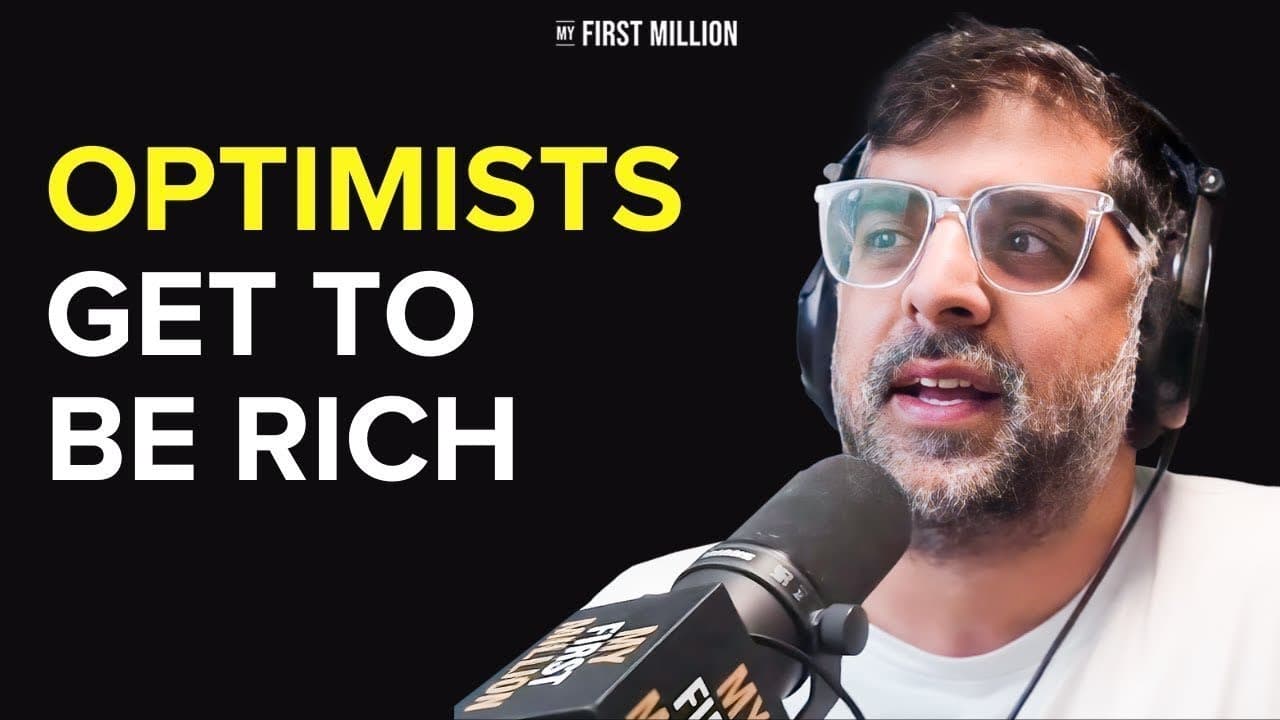
Entrepreneurs should compensate for the human tendency to overestimate risk and underestimate opportunity. Shopify’s investors expected a best-case $400 million exit, yet the company later reached roughly $130 billion to $140 billion in value, showing how even successful professionals can severely misjudge market size and the potential scale of an idea.
Transcript
The the headline here is they made the investment. So it's not like they passed. They made the investment and their best case scenario they wrote was 400 million as an exit value. 400 million and now it's 140 billion. Let me uh tell you about something that I've been thinking about and I thought it was really cool and our friend Sheil just shares t... Read More
Key Insights
- Human judgment tends to overestimate risk and underestimate opportunity, according to the Jeff Bezos quote discussed. Entrepreneurs can compensate by questioning whether perceived dangers are truly as large as they seem and whether the possible upside extends well beyond their initial assumptions.
- Shopify’s investment memo projected a best-case exit value of $400 million within four to six years. The company later reached roughly $130 billion to $140 billion in value, showing that even an investor who correctly backs a winner can underestimate its eventual scale by an enormous margin.
- Shopify had about 10,000 customers, $5 million in company revenue, and $132 million in gross merchandise volume when Bessemer considered the investment. Those modest figures made the opportunity difficult to extrapolate, even for a professional venture capital firm managing tens of billions.
- Market-size errors often arise from comparing a new company with an existing narrow category. Airbnb looked like a version of Couchsurfing, while Uber looked like a black-car service for wealthy San Francisco customers, causing observers to miss the much broader behavior each company could enable.
- Successful products can be underestimated even after early evidence shows that they work. Calm and other meditation apps appeared capable of becoming modest businesses, yet multiple meditation apps became billion-dollar companies, demonstrating the difference between recognizing product viability and appreciating market potential.
- Founders can hold more expansive expectations than their investors or advisers. After people around Shopify suggested the company might be worth only about $50 million, CEO Tobi declined a contractual restriction and offered only a handshake promise not to sell below $75 million.
- An anti-portfolio records major opportunities that an investor considered but ultimately missed. Bessemer publicly highlighted companies such as Airbnb, Apple, eBay, and Google to illustrate that sophisticated investors routinely reject businesses whose eventual success appears obvious only in hindsight.
- New consumer behaviors often look trivial before they become widespread. Snapchat seemed like a goofy, limited messaging product, while musical video creation appeared distracting and unserious, but these reactions reflected an inability to imagine how many people might adopt the underlying behavior.
Install to Summarize YouTube Videos and Get Transcripts
Explore YouTube Video Summarizer or Get YouTube Transcript Extractor
Questions & Answers
Q: Why do entrepreneurs underestimate the upside of business ideas?
Entrepreneurs may underestimate upside because human judgment tends to overestimate risk and underestimate opportunity, as stated in the Jeff Bezos quote discussed. A new market often appears small when evaluated through current behavior or an existing niche category. That framing can conceal how a product might expand participation, change habits, or create demand beyond the customers visible at the beginning.
Q: What did Bessemer predict Shopify could be worth?
Bessemer’s investment memo estimated that, if everything worked, Shopify might sell for $400 million within four to six years, producing a large return on the investment. That was presented as the best-case outcome. Shopify later reached roughly $130 billion to $140 billion in value, making the original optimistic projection dramatically smaller than the result described in the discussion.
Q: What was Shopify’s size when Bessemer invested?
When Shopify was raising $5 million at a $20 million valuation, it had about 10,000 customers and generated approximately $5 million in company revenue. The stores using its platform produced $132 million in gross merchandise volume. These figures already demonstrated traction, but they gave investors little intuitive basis for imagining the multiple millions of customers and far greater scale discussed later.
Q: How can founders evaluate opportunity more accurately?
Founders can evaluate opportunity more accurately by deliberately adjusting for the tendency to focus heavily on risk and treat the current market as a fixed ceiling. They should ask whether a product could serve more users, unlock a broader behavior, or expand its category. The goal is not blind confidence, but a conscious correction for a recurring bias demonstrated by Shopify, Airbnb, Uber, and other examples.
Q: Why did people initially underestimate Airbnb?
Airbnb was initially underestimated because it looked like a more ambitious version of Couchsurfing, a service centered on sleeping in another person’s home or spare space. That comparison anchored expectations to a relatively small category. The discussion says Airbnb later became about a $100 billion company and accounted for one out of every $30 spent on travel in America.
Q: Why was Uber initially viewed as a niche business?
Uber initially looked like a black-car or limousine service for wealthy customers in San Francisco. That framing made the addressable market appear limited because few people seemed likely to hire premium cars regularly. The mistake was treating the company as a service for an existing narrow customer group instead of considering how the underlying transportation behavior and customer base might expand.
Q: What is an anti-portfolio in venture capital?
An anti-portfolio is a public record of companies an investor had an opportunity to back but passed on. Bessemer created one to honor businesses it missed, including Airbnb, Apple, eBay, and Google. The collection demonstrates that even professional investors can reject exceptional opportunities and provides a structured way to examine the assumptions behind major forecasting errors.
Q: What lesson comes from underestimating products that already work?
A working product can still be badly underestimated when observers assume its market will remain small. The examples include Calm and other meditation apps, Snapchat, Airbnb, Uber, and musical video products. In each case, the central error was not always predicting failure. It was recognizing some usefulness while failing to imagine the scale of adoption or the broader category that could develop.
Summary & Key Takeaways
-
Jeff Bezos argued that people generally overestimate risk and underestimate opportunity, so entrepreneurs should deliberately compensate for that bias. Even Bezos initially imagined Amazon might someday become a $100 million revenue company, illustrating how difficult it is for founders and investors to recognize the full potential of rapidly expanding businesses.
-
Bessemer invested in Shopify when it had about 10,000 customers, $5 million in company revenue, and $132 million in gross merchandise volume. Its memo estimated a best-case exit value of $400 million, but Shopify later became worth roughly $130 billion to $140 billion and served multiple millions of customers.
-
The discussion reviews opportunities that initially appeared too small, including meditation apps, Snapchat, Airbnb, Uber, and musical video products. The recurring mistake was not necessarily believing these products would fail. It was assuming their markets were niche, overlooking how new behavior, broader accessibility, and expanding categories could produce vastly larger outcomes.
Read in Other Languages (beta)
Share This Summary 📚
Summarize YouTube Videos and Get Video Transcripts with 1-Click
Try YouTube Summary with ChatGPT & Claude or YouTube Transcript Generator
Explore More Summaries from My First Million 📚

Summarize YouTube Videos and Get Video Transcripts with 1-Click
Try YouTube Summary with ChatGPT & Claude or YouTube Transcript Generator