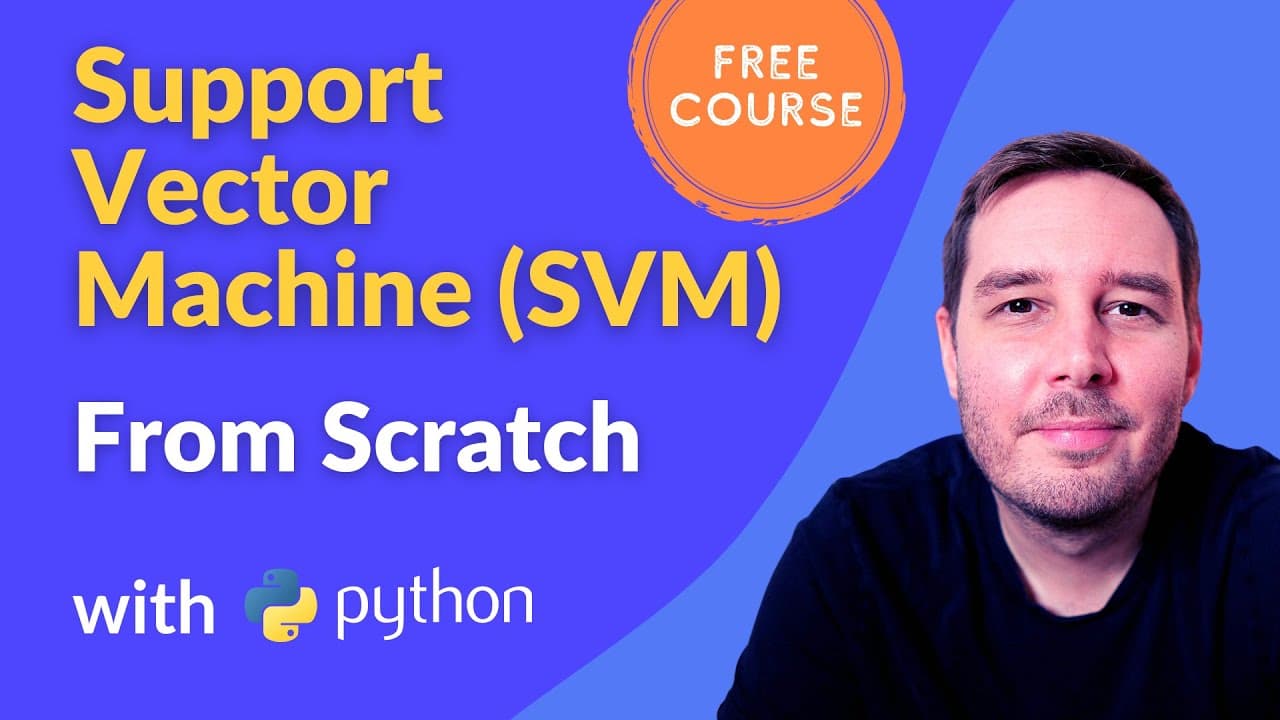
How to Implement Support Vector Machine (SVM) from Scratch in Python
TL;DR
To implement Support Vector Machine (SVM) from scratch in Python, initialize weights and use the hinge loss function during training to find the optimal hyperplane that maximizes the margin between classes. The process involves iterative updates based on gradient descent using training data, followed by class predictions using the learned weights.
Transcript
welcome to another video of the machine learning from scratch course presented by assembly AI in this series we Implement popular machine learning algorithms using only built-in python functions and numpy in this lecture we learn about support Vector machine or short svm so as always we start with a short Theory section and then we jump to the code... Read More
Key Insights
- 🏛️ SVM seeks a hyperplane with maximum margin to separate classes effectively.
- 🦮 Hinge loss in SVM quantifies the misclassification and guides the training process.
- 🌸 Balancing margin maximization and loss minimization is crucial in SVM optimization.
- 🏋️ Training an SVM model involves iterative weight updates over samples for convergence.
- 🏛️ Predictions in SVM are made by applying a linear function to determine class labels.
- 🤩 SVM implementation from scratch requires defining key components like the fit and predict methods.
- 🏋️ Understanding the gradient descent process is essential for updating weights in SVM training.
Install to Summarize YouTube Videos and Get Transcripts
Explore YouTube Video Summarizer or Get YouTube Transcript Extractor
Questions & Answers
Q: What is the main concept behind Support Vector Machine (SVM)?
SVM focuses on finding a hyperplane that maximizes the margin between classes by using a linear model to separate data effectively.
Q: How is the loss function in SVM calculated?
The hinge loss is computed as the maximum of 0 or 1 - (yi * (Wx - B)), reflecting the misclassification error based on the decision boundary.
Q: What are the key steps in training an SVM model?
Training involves initializing weights, iterating over samples to update weights using gradients, and specifying parameters like learning rate, lambda, and iterations for convergence.
Q: How does SVM predict class labels for new data points?
SVM predicts class labels by calculating the dot product of feature vectors and learned weights, determining the sign of the resulting value for classification.
Summary & Key Takeaways
-
SVM aims to find a linear decision boundary with the largest margin between classes, utilizing a linear model.
-
The algorithm involves calculating the hinge loss for training and a cost function that balances margin maximization and loss minimization.
-
Training involves initializing weights, applying update rules iteratively, and predicting class labels based on the learned weights.
Read in Other Languages (beta)
Share This Summary 📚
Summarize YouTube Videos and Get Video Transcripts with 1-Click
Try YouTube Summary with ChatGPT & Claude or YouTube Transcript Generator
Explore More Summaries from AssemblyAI 📚





Summarize YouTube Videos and Get Video Transcripts with 1-Click
Try YouTube Summary with ChatGPT & Claude or YouTube Transcript Generator