How Do FLUX 2 and HunyuanVideo 1.5 Compare?
TL;DR
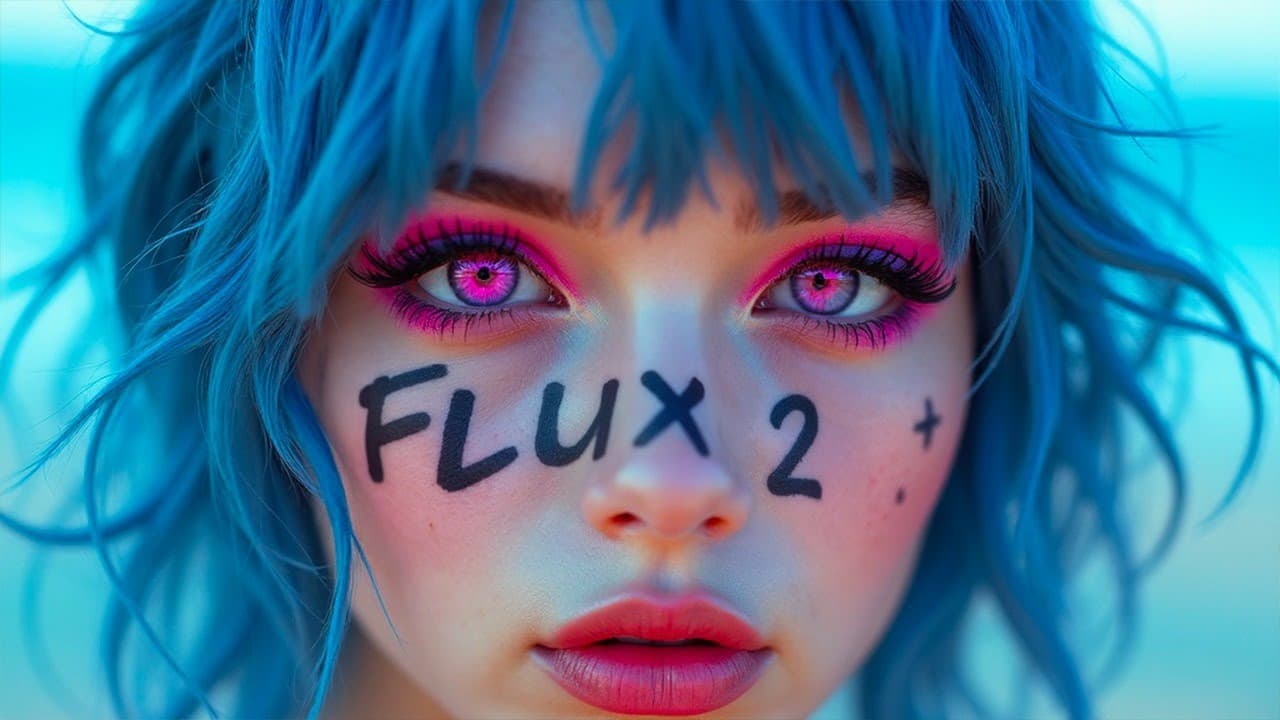
FLUX 2 focuses on high-quality image generation and editing, while HunyuanVideo 1.5 brings stable, controlled video generation to consumer GPUs. FLUX 2 supports up to 10 reference images and four-megapixel output; HunyuanVideo 1.5 uses an 8.3-billion-parameter model and can produce 1080p results through dedicated super resolution. Read on to compare their capabilities, architectures, variants, and practical uses.
Transcript
Black Forest Labs just dropped Flux 2, and the realism on this thing is unreal. Characters stay consistent across 10 reference images. The style doesn't drift. The lighting looks dialed in. And the text rendering finally landed exactly where we always wanted it. And then Tencent rolled in with Hunuan Video 1.5, the new best open- source AI video ge... Read More
Key Insights
- FLUX 2 can use up to 10 reference images simultaneously to preserve characters, products, and visual styles across separate generations. This core capability reduces the need for repeated prompt adjustments or separate LoRA configurations when producing product shots, multi-panel sequences, and other assets requiring consistent identities or aesthetics.
- FLUX 2 supports generation and editing at up to four megapixels, producing photoreal detail, controlled lighting, stable skin textures, defined hands, and clearer material rendering. Its improved typography also makes infographics, interface mockups, structured layouts, logos, and other text-heavy design work more suitable for client-facing production.
- FLUX 2 uses a hybrid architecture in which a Mistral 3 24B vision-language model interprets prompts and reference images, including spatial relationships, lighting, and materials. A rectified flow transformer builds composition and detailed image structure, while a newly designed VAE improves compression, reconstruction quality, and latent-space editing reliability.
- The FLUX 2 lineup includes Pro for direct competition with closed systems, Flex for adjustable steps and guidance, Dev as a fully open-weight 32-billion-parameter checkpoint, and the forthcoming Klein as a smaller Apache 2 release. All variants combine text-to-image generation, text-based editing, and multi-reference capabilities.
- HunyuanVideo 1.5 delivers video generation with only 8.3 billion parameters, allowing it to operate on consumer GPUs. It offers separate 480p and 720p variants, plus a latent-space super-resolution system that raises output to 1080p while avoiding the grid-like shimmer and interpolation artifacts associated with older approaches.
- HunyuanVideo 1.5 interprets long prompts as camera movement, lighting, composition, and multi-step action in both English and Chinese. Demonstrations include physically coherent skating, subtle facial motion, realistic object crushing, cinematic product shots, and controlled pans, tilts, push-ins, pull-outs, orbits, and focus changes.
- HunyuanVideo 1.5 outperforms Open Sora 1.22 in the reported benchmarks for instruction following, visual quality, and motion effects, while Open Sora leads in structural stability and image consistency. Comparative examples show Hunyuan following camera directions more accurately, although both models still struggle with text and demanding action scenes.
- HunyuanVideo 1.5 uses a unified diffusion transformer and a 3D causal VAE that compresses spatial information 16:1 and temporal information 4:1. Its selective and sliding tile attention system removes unnecessary spatiotemporal data, reducing computation for longer sequences while preserving useful motion and visual information.
Install to Summarize YouTube Videos and Get Transcripts
Explore YouTube Video Summarizer or Get YouTube Transcript Extractor
Questions & Answers
Q: How do FLUX 2 and HunyuanVideo 1.5 compare?
FLUX 2 is built for image generation and editing, emphasizing multi-reference consistency, typography, spatial reasoning, and output up to four megapixels. HunyuanVideo 1.5 focuses on video, offering controlled camera movement, prompt following, stable image-to-video conversion, and 1080p output through super resolution. Its 8.3-billion-parameter design can also run on consumer GPUs.
Q: How does FLUX 2 keep characters, products, and styles consistent?
FLUX 2 accepts up to 10 reference images in a single generation. It interprets those images alongside the prompt to preserve characters, products, lighting, and visual styles across outputs. This reduces repeated prompt adjustments and reliance on separate LoRA configurations.
Q: What image-quality and typography improvements does FLUX 2 provide?
FLUX 2 can generate and edit images at up to four megapixels. It produces photoreal detail, controlled lighting, stable skin textures, defined hands, and clearer materials. Its improved text rendering also makes logos, infographics, UI mockups, and structured layouts more practical.
Q: What architecture does FLUX 2 use?
FLUX 2 combines a Mistral 3 24B vision-language model, a rectified flow transformer, and a newly designed VAE. The vision-language model interprets prompts, references, lighting, materials, and spatial relationships, while the transformer constructs the composition and visual details. The VAE supports compression, reconstruction quality, and reliable latent-space editing.
Q: What are the differences between FLUX 2 Pro, Flex, Dev, and Klein?
FLUX 2 Pro is the flagship version offered through the playground and API, while Flex allows adjustments to steps and guidance scale. Dev is a fully open-weight 32-billion-parameter checkpoint that combines generation and editing. Klein is a forthcoming smaller model planned for release under Apache 2.
Q: Can FLUX 2 Dev run locally?
FLUX 2 Dev can run locally with sufficient VRAM or through the FP8-optimized pipeline developed with Nvidia and ComfyUI. It is also available through providers including FAL, Replicate, Runware, Vera, Together AI, Cloudflare, and Deep Infra. The checkpoint integrates with Diffusers, ComfyUI, and other ecosystem tools.
Q: Can HunyuanVideo 1.5 run on consumer GPUs?
Yes. HunyuanVideo 1.5 has 8.3 billion parameters and is designed to run on consumer GPUs. Its unified diffusion transformer, compressed 3D causal VAE representation, and selective attention system reduce computation while preserving useful visual and motion information.
Q: How does HunyuanVideo 1.5 produce 1080p video?
HunyuanVideo 1.5 offers separate variants that generate 480p or 720p video. A dedicated super-resolution system then raises the output to 1080p in latent space. This approach is designed to avoid the grid-like shimmer and interpolation artifacts associated with older upscaling methods.
Summary & Key Takeaways
-
FLUX 2 targets the gap between open-weight image models and polished closed systems. Its multi-reference feature accepts up to 10 images to preserve characters, products, and styles, while four-megapixel generation, improved typography, reliable lighting, stable textures, and stronger spatial reasoning make it practical for product imagery, layouts, interfaces, and sequences.
-
Black Forest Labs offers FLUX 2 Pro, Flex, Dev, and the forthcoming Klein. A hybrid architecture combines a Mistral 3 24B vision-language model, rectified flow transformer, and newly built VAE. Every variant includes text-based editing and multi-reference support, while Dev provides a fully open-weight 32-billion-parameter checkpoint for local or hosted use.
-
HunyuanVideo 1.5 is an 8.3-billion-parameter video model designed for consumer GPUs. It generates 480p or 720p clips and uses latent-space super resolution for 1080p output. Strong prompt interpretation, varied camera movement, stable image-to-video conversion, and efficient compression help it outperform Open Sora 1.22 across several evaluated categories.
Read in Other Languages (beta)
Share This Summary 📚
Summarize YouTube Videos and Get Video Transcripts with 1-Click
Try YouTube Summary with ChatGPT & Claude or YouTube Transcript Generator
Explore More Summaries from AI Revolution 📚




Summarize YouTube Videos and Get Video Transcripts with 1-Click
Try YouTube Summary with ChatGPT & Claude or YouTube Transcript Generator