How to Start a Shopify Dropshipping Store for Beginners
TL;DR
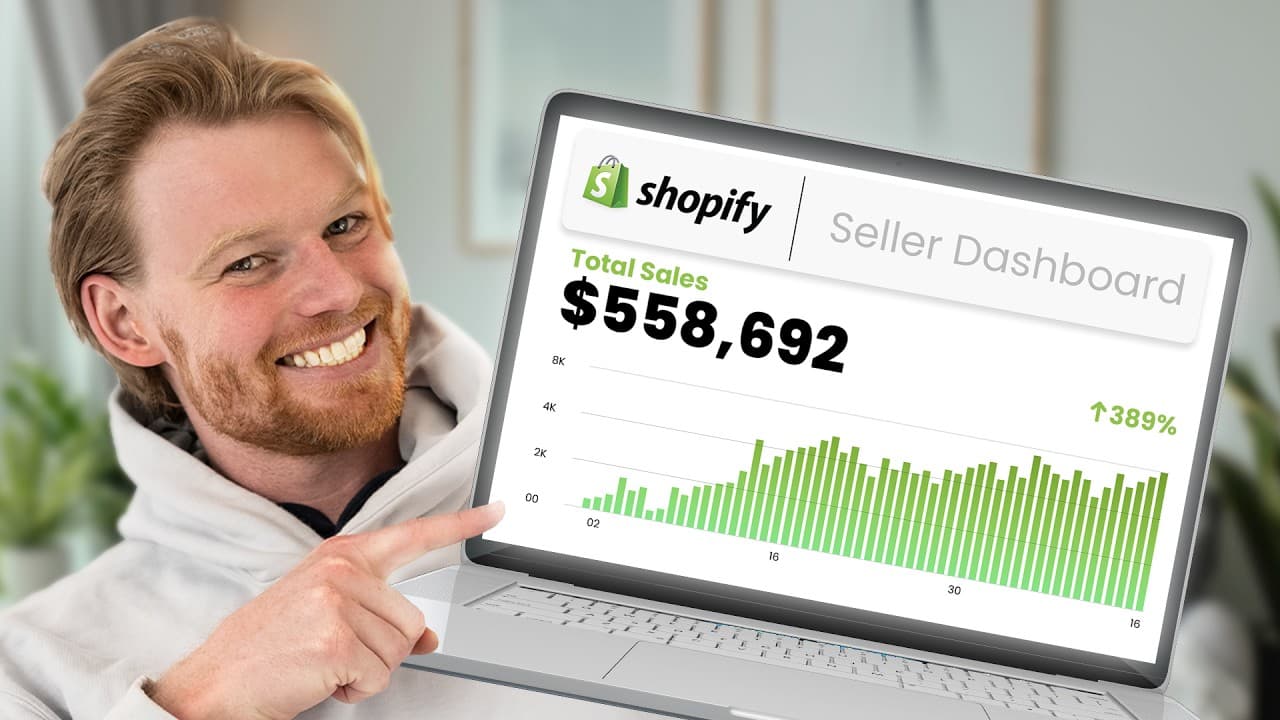
A Shopify store takes about a day to set up, roughly 7 days to coordinate with a supplier, and can be making money within about 8 days. Startup costs are low: around $29 a month for Shopify plus $9 to $20 for a domain, with $500 to $1,000 useful if you plan to run Facebook or TikTok ads. The core skill is picking an unsaturated trending product with high gross margin.
Transcript
in today's video we're going to break down exactly how to create a profitable shop advice store from beginning to end this video is going to be for beginners we're going to cover everything from how to design your store how to set up the settings how to launch Facebook ads and do organic traffic a lot of the other videos out there at the moment are... Read More
Key Insights
- A Shopify dropshipping store takes roughly a day to set up and about 7 days to coordinate with a supplier, meaning a beginner can be making money within about 8 days. This short runway is what makes the model appealing as either a side hustle or a full-time job.
- The main fixed costs are a Shopify store at around $29 a month and a domain at about $9 to $20, so a few hundred dollars is enough to start. Early sales in the first weeks can offset these costs and make the store profitable from the outset.
- Paid marketing needs a separate budget of roughly $500 to $1,000 if you want to run ads on Facebook or TikTok, described as the two most powerful platforms available right now. Free organic marketing is the alternative for anyone without that budget.
- Amazon differs from Shopify because it relies on search engine optimization, where you must rank highly for the product term. Amazon also means you never own customer data, so you can never remarket to buyers or expand your brand off the back of them.
- Amazon carries platform risk that Shopify does not: the marketplace is highly competitive, the logistics are hard to figure out, and Amazon can shut a seller down at any time. That is why the presenter teaches Shopify dropshipping as the first step for beginners.
- A saturated product is one that has been around a long time, where customers have many options and could buy it cheaper at a department store down the street. Searching the product name in Google and seeing how many sellers appear is a quick saturation check.
- Evergreen products such as bed sheets never really go away, while hot trends such as a period pain belt spike and then fade. The target is a hot trend that is not yet saturated, because a beginner cannot out-market established competitors.
- Gross margin is total revenue minus the cost to buy the product from the supplier and ship it to the customer, so a $100 product costing $25 delivered leaves $75. Higher gross margin means more money available to spend acquiring customers on ad platforms.
- Turbo Ad Finder is a free Chrome extension that filters your Facebook feed to show ads only, turning ordinary scrolling into product research. It removes non-ad posts so you see what brands are actively promoting without paying for a research tool.
- A trend can be saturated in the United States, where dropshipping is rampant, while remaining open in markets such as Germany or Australia. Checking regional demand manually is slow, which is the problem Trend Rocket's featured products section was built to solve.
Install to Summarize YouTube Videos and Get Transcripts
Explore YouTube Video Summarizer or Get YouTube Transcript Extractor
Questions & Answers
Q: How much money do you need to start a Shopify dropshipping store?
The only main costs if you stick to free organic marketing are the Shopify store itself, at around $29 a month, and a domain, at roughly $9 to $20. That means a couple of hundred dollars is enough to get started, with no family inheritance required and very low risk. The hope is that initial sales arrive in the first weeks so those costs are offset and the store is profitable from the outset. If you want to run paid marketing on Facebook or TikTok instead, it is good to have about $500 to $1,000 available for ad spend.
Q: How long does it take to set up a Shopify store and start making money?
Setting up the store itself takes about a day. Coordinating with a supplier takes roughly another 7 days, which is the part that depends on someone other than you. Putting those together, a beginner can be making money within about 8 days of starting. This speed is described as one of the main beauties of dropshipping compared with other business models, and it is why the model suits both people who want a side hustle and people aiming to build a full-time job out of it.
Q: What is the difference between selling on Amazon and selling on Shopify?
Amazon relies on search engine optimization, meaning you have to rank highly when someone searches for your product on the marketplace. That is possible but it is a different skill set from building your own store. Amazon also brings several problems: you never own your customers' data, so you can never remarket to them or expand your brand using that audience, the logistics are hard to figure out, competition is intense, and Amazon can shut you down at any time. Those risks are why Shopify dropshipping is taught as the better first step for beginners.
Q: How do you find a winning product for free?
The free method uses your own Facebook feed. Scroll down and you will see plenty of ads from brands. To see only ads, install the free Turbo Ad Finder Chrome extension: click add to Chrome, add extension, pin it to your extensions, then click ads only. That filters your Facebook feed to show ads exclusively, which speeds up the research process considerably. This approach suits people who have more time on their hands and do not want to invest money in research tools yet, though paid tools compile the same kind of data faster.
Q: What does it mean for a product to be saturated?
A saturated product is one where the trend has been around a long time and customers already have lots of options to buy it, including simply walking down the street to a department store and getting it much cheaper. A practical test is to type the product name into Google and see how many results and sellers come up. If many people are selling the exact same product, it is saturated. Beginners should avoid these because winning means out-marketing established competitors, which requires marketing experience you may not have yet.
Q: What is the difference between an evergreen product and a hot trend?
An evergreen product is something that never really goes away, with bed sheets given as the example, since people will always need them. A hot trend is a product that spikes in popularity for a period and then fades, with a period pain belt given as an example of something that has been trending for a while and was likely heading toward saturation. The goal in product research is to find a hot trend that has not yet become saturated, so demand exists but competition has not yet caught up.
Q: What is gross margin and why does it matter in dropshipping?
Gross margin is the total revenue minus what the product costs you to buy from the supplier and ship to the customer. If you sell something for $100 and it costs $25 to buy the product and get it to the customer, you have $75 remaining, which is your gross margin. It matters because the more gross margin you have, the more you can afford to spend on advertising platforms to acquire each customer, and the more profit is likely to be left over for you to take home after those acquisition costs.
Q: Why does the video recommend a 3PL instead of AliExpress dropshipping?
Older videos on the topic focus on using AliExpress for dropshipping. The approach taught here instead uses a 3PL, a third-party logistics provider, to build a branded dropshipping store or a genuine brand. The reason given is that grabbing AliExpress products with no branding and selling them is not the best way to operate, because customers lose faith in the product and the space is very competitive. Building a brand you can be proud of is presented as the more durable path, and good research tools filter out those unbranded listings.
Summary & Key Takeaways
-
The video covers building a branded Shopify dropshipping store end to end, rather than the older AliExpress-style approach. Instead of listing generic AliExpress items, it teaches using a 3PL, a third-party logistics provider, to build a brand you can be proud of. The presenter is the founder of Udi and says he has done $450 million in revenue on Shopify over the past 4 years.
-
Common beginner questions are answered up front. Setup takes about a day, supplier coordination about 7 days, and first money within about 8 days. No prior knowledge is needed beyond being able to log into Facebook and create an email. Costs are around $29 a month for Shopify and $9 to $20 for a domain, plus $500 to $1,000 for paid ads.
-
Product research is presented as the part where most beginners get stuck, and the fix is a repeatable process rather than original ideas. A free method uses the Facebook feed with the Turbo Ad Finder Chrome extension to filter the feed to ads only, which speeds up research. A paid tool, Trend Rocket, compiles trends, brands, and ad data in one place.
Read in Other Languages (beta)
Share This Summary 📚
Summarize YouTube Videos and Get Video Transcripts with 1-Click
Try YouTube Summary with ChatGPT & Claude or YouTube Transcript Generator
Explore More Summaries from Davie Fogarty 📚




Summarize YouTube Videos and Get Video Transcripts with 1-Click
Try YouTube Summary with ChatGPT & Claude or YouTube Transcript Generator