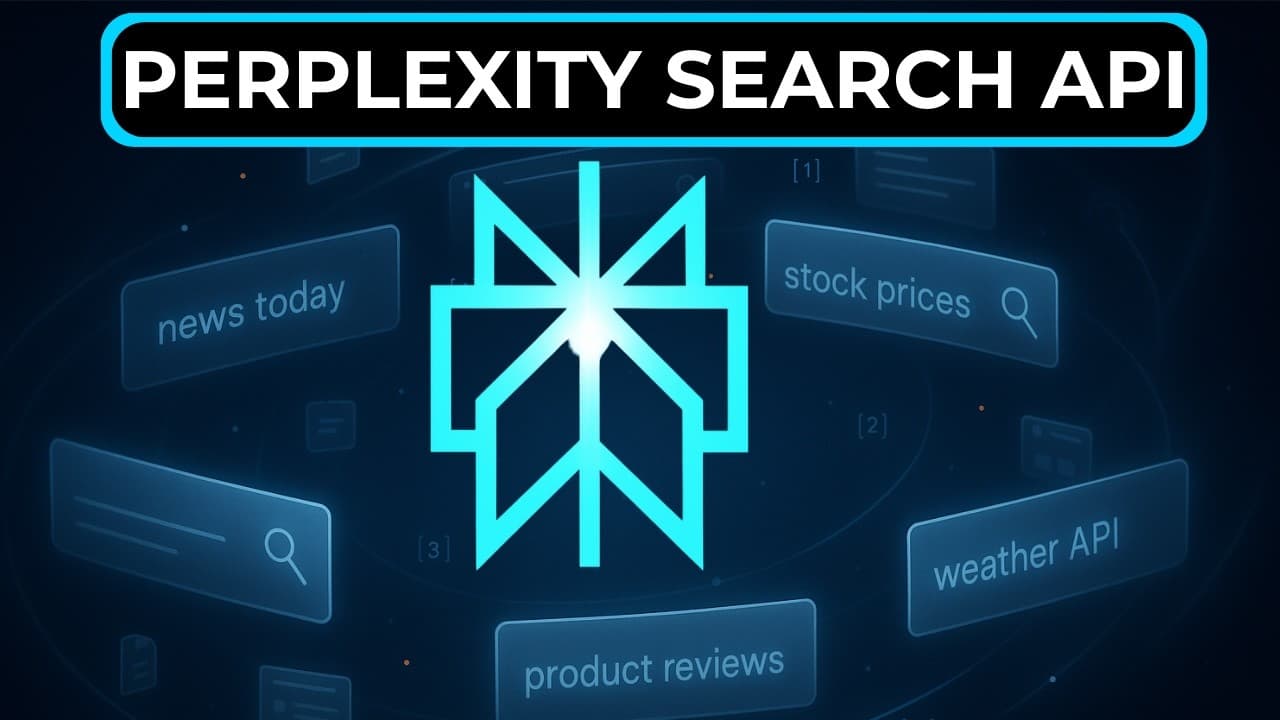
How to Build Apps with Perplexity Search API
TL;DR
Use Perplexity’s Search API to add real-time results, citation-grounded answers, academic source prioritization, and schema-controlled JSON to automations or apps. Import its curl examples into HTTP request nodes, replace the API key, configure queries and filters, then route specialized searches through parallel agents before a main agent consolidates patterns, disagreements, and recommendations.
Transcript
Perplexity just released their new search API. And it doesn't just give you stale links. It gives you clean AI ready answers. And in this video, I'm going to walk you through exactly how to use it to get richer automations and even better vibe coded apps. I'm going to first demo the basics using Niden and then I'm going to step it up and put it int... Read More
Key Insights
- The Search API provides AI-ready results through general search, grounded search, academic search, and structured output. These modes support different priorities, including speed, citation quality, preferred sources, and predictable response organization for automations or applications.
- Instant search is designed for speed and returns result objects containing a title, URL, snippet, date, and last-updated date. A query usually produces 5–10 results, though the presenter cautions that fast retrieval will not deliver perfect results every time.
- Grounded search prioritizes comprehensive responses supported by citations. Its request can specify one of four presented model options: Sonar, Sonar Pro, Sonar Pro Reasoning, or Deep Research, while the query can be supplied dynamically through a chat input or webhook.
- Academic search supports domain and recency filters through web search options. Testing showed that selected domains were prioritized rather than enforced exclusively, since results could still include sources such as YouTube and machinelearningmastery.com alongside the preferred archive-related references.
- Structured output uses a custom schema to control how an answer is organized. Developers can define required and optional fields, such as company name, funding amount, and focus area, allowing an application to receive JSON that already matches its expected data structure.
- The basic setup works by copying curl requests from Perplexity’s documentation into HTTP request steps. Each template uses a similar request structure, and the primary configuration task is replacing the demonstrated API key with the user’s own key.
- A multi-agent research workflow assigns separate academic, practical, and innovation searches to independent sub-agents. These agents work in silos, after which a primary agent consolidates their outputs into patterns, debates, recommendations, and explanations of the reasoning behind important findings.
- The main agent’s prompt determines how research is delegated and synthesized. It can specify which queries each specialist receives, require cross-source pattern identification, request contradictions or debates, and direct the final response to include practical recommendations with supporting reasoning.
Install to Summarize YouTube Videos and Get Transcripts
Explore YouTube Video Summarizer or Get YouTube Transcript Extractor
Questions & Answers
Q: How do you set up the Perplexity Search API in n8n?
Open the Perplexity documentation, choose the relevant endpoint, and copy its curl request into an HTTP request node in n8n. Replace the demonstrated API key with your own, then configure the query content. The query may be hardcoded for testing or supplied dynamically from a chat trigger, webhook, or another workflow variable. Separate request nodes can support instant, grounded, academic, and structured searches.
Q: What does Perplexity instant search return?
Perplexity instant search returns a collection of web results very quickly. Each displayed result includes a title, URL, snippet, date, and last-updated date. The demonstration says a request usually returns 5–10 results depending on the query. Its speed makes it useful for basic retrieval, but the presenter notes that the results will not be perfect every time.
Q: How does grounded search differ from instant search?
Grounded search spends more time producing a comprehensive answer based on citations, while instant search focuses on returning web result objects quickly. The grounded response includes citations as a priority and also provides search results similar to the instant mode. Its request lets users choose among Sonar, Sonar Pro, Sonar Pro Reasoning, and Deep Research, depending on the desired workflow.
Q: How can Perplexity Search API prioritize academic sources?
Academic searches can be configured with web search options that apply a domain filter and a search recency filter. The presenter uses this approach to prioritize archive-related sources and suggests it for peer-reviewed research. Testing indicates that the selected domain is a preference rather than a strict boundary, because other websites may still appear alongside the prioritized sources.
Q: How long does academic search take in the demonstrated workflow?
Academic search takes an average of 7–10 seconds in the demonstrated workflow. That additional time supports a search designed to prioritize selected websites and well-cited sources. The mode is positioned between fast general retrieval and more expensive, higher-latency deep research. Actual results may include preferred academic sources as well as other relevant websites because domain selection is not shown as an exclusive restriction.
Q: How does structured output help an AI application?
Structured output lets an application dictate the exact organization of the returned answer through a custom schema. A developer can name fields, specify their expected structure, and mark individual properties as required or optional. In the example, the schema requests startup details such as company name, funding amount, and focus area, producing JSON that an application can organize without first inferring an unpredictable response format.
Q: How do you build a multi-agent research workflow with the API?
Connect a primary agent to separate academic, practical, and innovation sub-agents, then give each specialist its own HTTP request for the appropriate search type. The main prompt delegates focused queries to those agents, which execute their searches independently. Their results return to the primary agent, which synthesizes common patterns, important findings, contradictions, debates, and recommendations while explaining the reasoning behind major conclusions.
Q: Why use independent search agents for one research question?
Independent search agents can explore the same topic through different source priorities and research perspectives. In the example, academic, practical, and innovation agents work in silos instead of coordinating during retrieval. Because language models are predictive rather than deterministic, these separate branches can produce varied findings. A primary agent can then compare them, trace contributions, identify disagreements, and assemble a richer final synthesis.
Summary & Key Takeaways
-
Perplexity’s Search API supports several workflows: fast general result retrieval, citation-focused grounded answers, source-prioritized academic research, and structured output. Developers can copy curl requests from the documentation into HTTP request nodes, replace the API key, and provide fixed or dynamic queries from chat inputs, webhooks, or other automation variables.
-
Instant search returns roughly 5–10 results with fields such as title, URL, snippet, publication date, and last-updated date. Grounded search takes longer because it builds a comprehensive answer around citations. Academic search averages 7–10 seconds and can apply domain and recency preferences, although preferred domains may not be exclusive.
-
A multi-agent workflow can send one research question to academic, practical, and innovation agents working independently. A primary agent then synthesizes their findings, identifies shared patterns, surfaces contradictions, and produces reasoned recommendations. Structured JSON can also feed vibe-coded applications that require predictable fields, filtering, sorting, and organized research results.
Read in Other Languages (beta)
Share This Summary 📚
Summarize YouTube Videos and Get Video Transcripts with 1-Click
Try YouTube Summary with ChatGPT & Claude or YouTube Transcript Generator
Explore More Summaries from Mark Kashef 📚


Summarize YouTube Videos and Get Video Transcripts with 1-Click
Try YouTube Summary with ChatGPT & Claude or YouTube Transcript Generator