What Is Gemma 4 and Why Is It Free Forever?
TL;DR
Gemma 4 is Google DeepMind's free and open model family whose smallest versions need only a few gigabytes of memory, running offline on a phone or even a first-generation Nintendo Switch. Its 31B dense model ranked #3 among open models and beat some models ten times larger on some measurements. It ships under Apache 2.0, so commercial and derivative use carries almost no restrictions.
Transcript
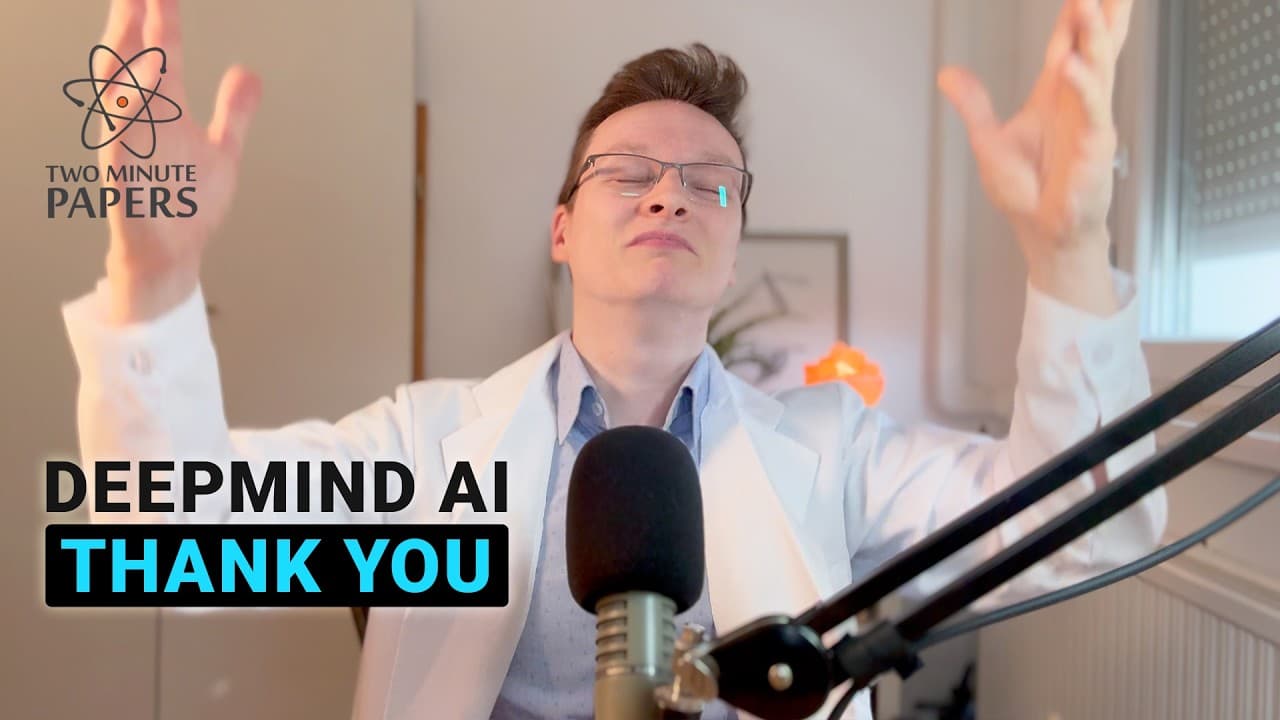
Google DeepMind gave an amazing gift to humanity. And it is full of surprises. Here’s why. Today, we are living in the age of AI where these smart assistants and agents can do things we could only dream of 10 years ago. But. Many of these solutions are proprietary, require a subscription, and run in the cloud. And then this happens. Yup, s... Read More
Key Insights
- Gemma 4 is a free and open family of models from Google DeepMind whose smallest members require only a few gigabytes of memory, so no expensive GPU is needed and the model runs on a phone with no internet connection at all.
- The 2 billion parameter Gemma 4 model runs on an old beat-up first-generation Nintendo Switch, hardware without much memory or processing power, which demonstrates just how far the memory requirements have been pushed down.
- The 31B Gemma 4 was the #3 best open model and beat some models ten times larger while staying competitive with some twenty times larger on some measurements, which is unusual because it is a dense model rather than mixture-of-experts.
- Mixture-of-experts models work by splitting one huge brain into many small ones and routing each question to the top 2 to 8 experts, so only a small part activates at a time, enabling huge models that remain efficient on hardware.
- Curated training data is one reason Gemma 4 punches above its size: Google applied super strict filters instead of dumping half the internet into it, an approach the video suggests applying to your own information diet by ignoring noise.
- Hybrid attention combines a local sliding window, like reading a book line by line for detail, with global attention that zooms out to ask which book and chapter you are in, giving the model both fine detail and broad context simultaneously.
- Gemma 4 understands images as-is, unlike Gemma 3, which squished landscape images back into a square before processing and lost information; the difference shows on any benchmark involving images.
- The Apache 2.0 license replaces the restrictive Gemma license, which passed its handcuffs on to any derivative model trained on its outputs. Under Apache 2.0 you can modify, sell, and deploy commercially with almost zero friction.
Install to Summarize YouTube Videos and Get Transcripts
Explore YouTube Video Summarizer or Get YouTube Transcript Extractor
Questions & Answers
Q: What is Gemma 4 and what hardware does it need?
Gemma 4 is a free and open family of AI models from Google DeepMind. The smallest models require only a few gigabytes of memory, so no expensive GPU is needed. They run on a phone without an internet connection, and the 2 billion parameter version even runs on an old beat-up first-generation Nintendo Switch, hardware that has neither much memory nor much processing power. The family also includes a larger 31B model. This contrasts with NVIDIA's Nemotron 3 Super, which has super capabilities but super hardware requirements too.
Q: Why does running AI models locally matter instead of using cloud subscriptions?
Many AI solutions are proprietary, require a subscription, and run in the cloud, which means you depend on the goodwill of those companies for your workflows. Some OpenClaw users reported losing access to their Claude AI subscription, with heavy workloads cited as the reason. The video's position is that you should always look for options where you own the AI and run it on your own system for free, forever, because then no one can take it away. If a company decides you can no longer use their system, you can plug in Gemma 4 instead.
Q: How does a dense model differ from a mixture-of-experts model?
A mixture-of-experts model is a huge AI with many parameters that splits its big brain into many small ones. When a question arrives, it chops the question into small parts and routes them to the parts of the brain it thinks are best at processing them, typically the top 2 to 8 experts, so only a small portion activates at a time. That keeps huge models efficient. A dense model instead lights up every parameter every time, regardless of whether the question is simple or complex. Gemma 4's 31B model is dense, which makes its performance surprising.
Q: What four techniques make Gemma 4 perform better than its size suggests?
First, super strict filters on highly curated training data rather than dumping half the internet into the model. Second, hybrid attention, which uses a sliding window for local detail and global attention for the broader context at the same time. Third, improved image understanding that processes an image as-is instead of squishing it into a square. Fourth, a shared KV-cache, where layers borrow short-term memory already computed by earlier layers instead of recomputing it from scratch, giving less work for nearly the same result.
Q: How does hybrid attention work in Gemma 4?
Hybrid attention combines two mechanisms simultaneously. The sliding window is local: like reading a book line by line to finish a page, it captures all the fine detail of what is immediately in front of the model. Global attention is the zoomed-out view that answers questions like which book is being read and which chapter this is. Gemma 4 uses both at once, which is why the mechanism is called hybrid attention. Combining them lets the model keep local detail without losing track of the larger structure of the input.
Q: What is a shared KV-cache and why does it help?
The KV-cache is short-term memory for what you are currently working with in a conversation, including documents and questions. Normally the layers of a neural network like to recompute their fresh memory from scratch. Gemma 4 does not do this. Instead, its layers essentially borrow memory that earlier layers already computed. The result is less work for nearly the same output quality. The video describes this as one of those ideas that makes you wonder why it was not always done this way.
Q: Why is the Apache 2.0 license for Gemma 4 significant?
Gemma 3 shipped with the Gemma license, which came with strings attached, described in the video as handcuffs. If you used Gemma 3 to create training data for a derivative model, that derivative inherited the same handcuffs. Gemma 4 changes this by shipping under Apache 2.0, a license true to the open source spirit. You can modify it, sell it, and deploy it commercially with almost zero friction, and you can make derivative models and do a great deal more with far fewer restrictions.
Q: What are the limitations of Gemma 4?
The model does not have a live database, and without an agent harness it cannot browse or look things up, which means it can be confidently incorrect. It is also not great at highly complex, open-ended tasks. On the visual side, it struggles with images containing lots of high-frequency detail, such as thin structures, blades of grass, or a fence seen from far away, where the video jokes it needs even better glasses. Its 256k context window is also expensive to compute, so it suits a few long documents rather than gigabytes of video.
Summary & Key Takeaways
-
Most smart assistants today are proprietary, subscription-based, and cloud-hosted, which means workflows depend on company goodwill. Some OpenClaw users reported losing access to their Claude AI subscription over heavy workloads. Gemma 4 answers this by being free and open, small enough to own and run locally forever, with no expensive GPU required for the smallest models.
-
The 31B Gemma 4 is a dense model that lights up every parameter for every query, unlike mixture-of-experts systems that route questions to only the top 2 to 8 experts. It still performs remarkably well thanks to four choices: strictly curated training data, hybrid attention combining a sliding window with global attention, native non-squished image understanding, and a shared KV-cache that reuses memory computed by earlier layers.
-
Gemma 4 excels at agentic workflows such as tool use and local coding, has a 256k context window twice the size of Gemma 3, and ships under Apache 2.0 instead of the restrictive Gemma license. Limitations remain: no live database, so it can be confidently incorrect without an agent harness, plus weakness on highly complex open-ended tasks and fine visual details.
Read in Other Languages (beta)
Share This Summary 📚
Summarize YouTube Videos and Get Video Transcripts with 1-Click
Try YouTube Summary with ChatGPT & Claude or YouTube Transcript Generator
Explore More Summaries from Two Minute Papers 📚

Summarize YouTube Videos and Get Video Transcripts with 1-Click
Try YouTube Summary with ChatGPT & Claude or YouTube Transcript Generator