How Can Separable Filters Speed Up Image Processing?
TL;DR
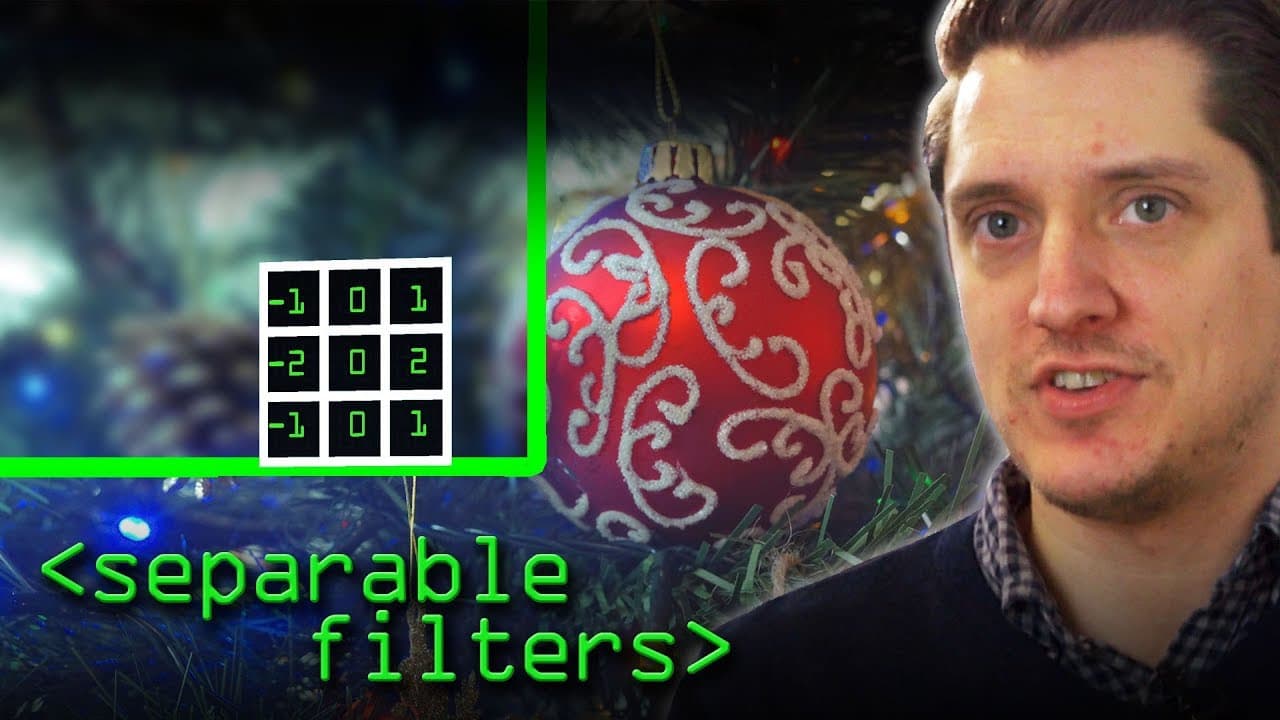
Separable filters optimise image processing by breaking down large convolution operations into two simpler passes: horizontal and vertical. This technique significantly reduces the computational load, allowing for faster processing times compared to using a single large filter directly.
Transcript
I wanted to talk a little bit about About image filtering. We had a video on image filtering a while ago on Gaussian blurs and mean blurs and this kind of thing But remember we talked about convolutions and convolutions are actually used in a lot of places. So Sobel operator for edge detection But also in deep networks, so deep networks have convol... Read More
Key Insights
- 🥺 Convolution is commonly used in image filtering, but large filters can lead to slow processing times.
- 🧭 Decomposing filters into two passes, a horizontal and vertical pass, can optimize convolution operations.
- 🍱 The decomposition technique is beneficial for filters like Sobel, Gaussians, and mean box blurs.
- 💨 The optimization reduces the number of operations per pixel, resulting in faster image filtering.
- 😘 Python code can be compiled with syphon to improve speed in low-level pixel manipulations.
- ⌛ The optimization significantly reduces processing times for large filters.
- 💄 The decomposition technique is not dependent on pixel values, making it efficient for various images.
Install to Summarize YouTube Videos and Get Transcripts
Explore YouTube Video Summarizer or Get YouTube Transcript Extractor
Questions & Answers
Q: Why does a large Gaussian blur using convolutions take a long time to process?
A large Gaussian blur requires a large window and increases the number of operations per pixel, resulting in slower processing times.
Q: How can image filtering with large filters be optimized?
By decomposing the filter into a horizontal pass followed by a vertical pass, the number of operations per pixel can be reduced, resulting in faster processing times.
Q: Is the decomposition into two passes applicable to all filters?
No, the decomposition technique works for filters like Sobel, Gaussians, and mean box blurs, but not for every kernel used in image filtering.
Q: What is the advantage of using the decomposition technique in image filtering?
The advantage is significant speed improvement, as the decomposition reduces the number of operations per pixel, allowing for faster processing.
Summary & Key Takeaways
-
Image filtering using convolutions can be slow for large filters, resulting in minutes to hours of processing time.
-
To optimize the process, the filter can be decomposed into two passes, a horizontal pass followed by a vertical pass.
-
This optimization reduces the number of operations per pixel and significantly speeds up the image filtering process.
Read in Other Languages (beta)
Share This Summary 📚
Summarize YouTube Videos and Get Video Transcripts with 1-Click
Try YouTube Summary with ChatGPT & Claude or YouTube Transcript Generator
Explore More Summaries from Computerphile 📚




Summarize YouTube Videos and Get Video Transcripts with 1-Click
Try YouTube Summary with ChatGPT & Claude or YouTube Transcript Generator