What Are Atoms and How Do They Form Matter?
TL;DR
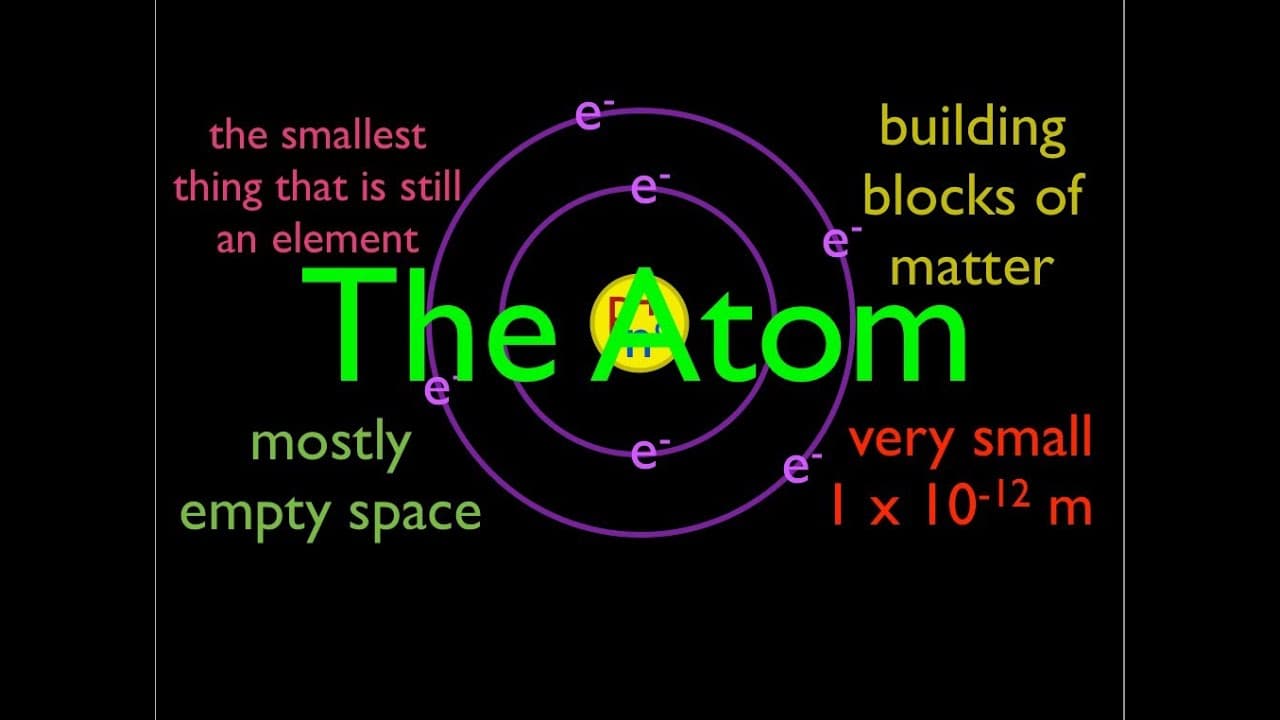
Atoms are the fundamental building blocks of matter, consisting of a nucleus made of positively charged protons and neutral neutrons, with negatively charged electrons orbiting around. Protons determine the type of atom, while neutrons help stabilize the nucleus, and electrons enable chemical bonding. Despite being mostly empty space, atoms form the foundation of all elements and substances in the universe.
Transcript
okay in today's video I'm going to go every over everything you ever wanted to know well maybe not everything but most of the things you ever wanted to know or should know about an atom what are atoms alright everything is surrounding you as you sit there watching this incredible video is made of atoms your computer the table the chair you might be... Read More
Key Insights
- 🫀 Atoms consist of a nucleus with protons and neutrons, surrounded by electrons in energy levels.
- 😶🌫️ Protons and neutrons are in the nucleus, while electrons occupy the electron cloud.
- 🖐️ Atoms are the basic units of elements, playing a vital role in chemical bonding and the formation of matter.
- 💆 The mass of protons and neutrons is approximately the same, while electrons have negligible mass.
- 💪 Neutrons mediate the strong nuclear force to prevent protons from repelling each other.
- 🫀 The charge of protons, neutrons, and electrons determines their interactions and functionality within an atom.
- 🫀 Electrons are responsible for chemical bonding through their interactions with other atoms' nuclei.
Install to Summarize YouTube Videos and Get Transcripts
Explore YouTube Video Summarizer or Get YouTube Transcript Extractor
Questions & Answers
Q: What is the key role of protons, neutrons, and electrons in an atom?
Protons provide the positive charge, neutrons maintain neutrality and mediate nuclear forces, while electrons form the electron cloud and participate in chemical bonding.
Q: Why are atoms considered the building blocks of matter?
Atoms combine to form molecules by bonding through interactions between electrons and nuclei, creating the diverse substances in the world.
Q: How do protons, neutrons, and electrons differ in terms of charge and location?
Protons have a positive charge and are in the nucleus, neutrons are neutral and also in the nucleus, while electrons are negatively charged and orbit outside the nucleus.
Q: Why are atoms mostly empty space despite being the fundamental units of matter?
The vast majority of an atom's volume is empty space, with the nucleus being extremely small compared to the electron cloud, making atoms mostly void.
Summary & Key Takeaways
-
Atoms are the smallest units of elements, comprising positively charged protons and neutral neutrons in the nucleus, with negatively charged electrons orbiting.
-
Protons have a positive charge, neutrons are neutral, and electrons have a negative charge, which are crucial for chemical bonding.
-
Atoms are mostly empty space, with the nucleus being significantly smaller than the electron cloud, emphasizing the tiny size of atoms.
Read in Other Languages (beta)
Share This Summary 📚
Summarize YouTube Videos and Get Video Transcripts with 1-Click
Try YouTube Summary with ChatGPT & Claude or YouTube Transcript Generator
Explore More Summaries from Step by Step Science 📚
Summarize YouTube Videos and Get Video Transcripts with 1-Click
Try YouTube Summary with ChatGPT & Claude or YouTube Transcript Generator