How to understand policy gradients in reinforcement learning
TL;DR
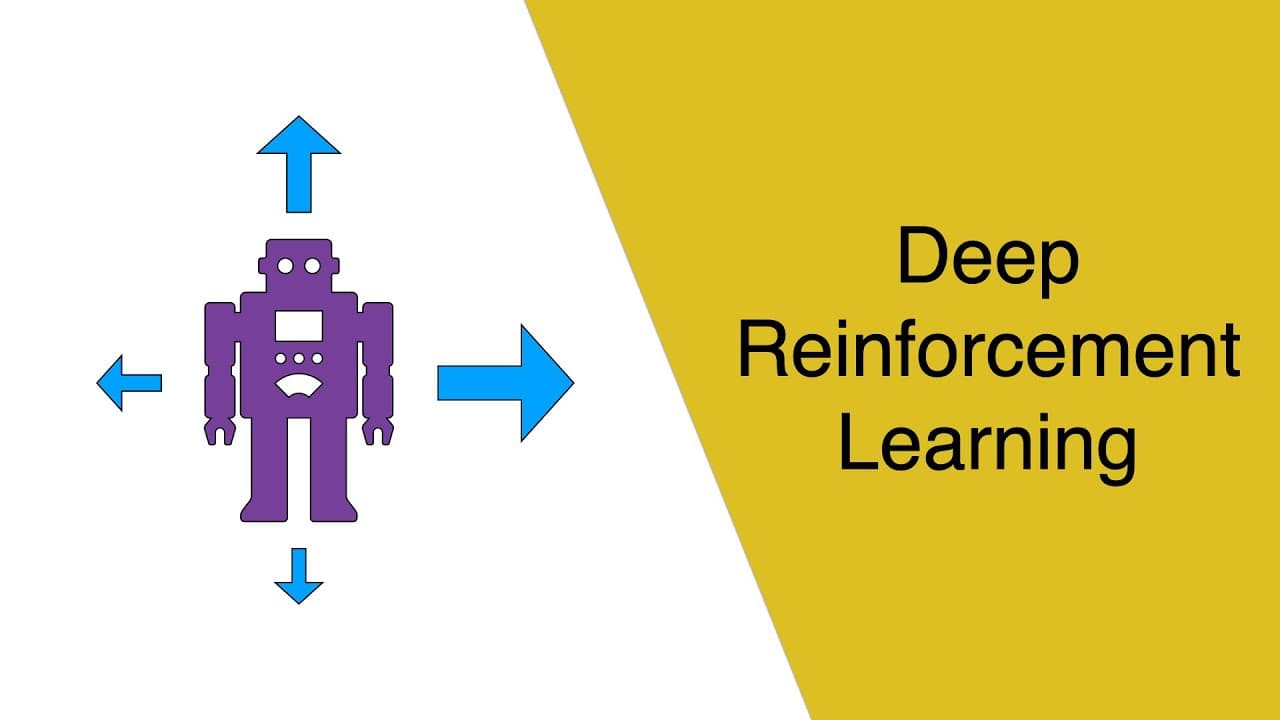
Policy gradients optimize how a neural policy acts by maximizing expected rewards. The video introduces the basics of reinforcement learning, including Markov decision processes, the Bellman equation, rewards, and the discount factor, then shows how neural networks fit into value and policy estimation through Q networks and policy gradients.
Transcript
hello i'm luis serrano and this is a friendly introduction to deep reinforcement learning and policy gradients reinforcement learning has great applications in many cutting-edge fields such as self-driving cars robotics and even winning a complicated games like go chess and atari games the difference between reinforcement learning and the more comm... Read More
Key Insights
- MDP is introduced as the framework for modeling decision making in reinforcement learning.
- The Bellman equation is the central tool for computing the value of states by considering the best next move.
- Rewards can be positive or negative and influence both the immediate value and the policy choice.
- The discount factor gamma represents the idea that immediate rewards are more valuable than future rewards.
- Policy is a set of instructions or arrows that guide the agent to the best moves.
- The value of a state can be propagated from terminal states back to earlier states using the Bellman update.
- Neural networks enable scaling when the state space is large, enabling value and policy estimation.
- Training the policy neural network involves using the estimated values to improve decision making over time.
Install to Summarize YouTube Videos and Get Transcripts
Explore YouTube Video Summarizer or Get YouTube Transcript Extractor
Questions & Answers
Q: How is an MDP used in reinforcement learning
An MDP provides the environment, states, actions, and rewards that define the decision making problem for an agent. In reinforcement learning, the agent interacts with this environment, receiving rewards and updating its policy to maximize the cumulative reward. The MDP structure helps formalize which actions lead to better long term outcomes and guides the learning process.
Q: What is the Bellman equation used for in this context
The Bellman equation expresses the value of a state as the best expected return achievable from that state, considering possible actions and subsequent state values. It provides a recursive relationship that allows the agent to propagate value information from terminal states back through the state space, guiding policy improvement.
Q: What role do rewards play in the learning process
Rewards quantify the immediate outcome of taking actions in the environment. They can be positive or negative, shaping how the agent evaluates states and actions. Over many steps, rewards combine with the discount factor to determine the overall goal, encouraging efficient paths to high value states.
Q: Why is a discount factor used in reinforcement learning
The discount factor reflects the idea that immediate rewards are more valuable than distant rewards. By multiplying future values by gamma, the agent prioritizes quicker gains and reduces the influence of far future outcomes, which stabilizes learning and helps with convergence in value estimation.
Q: How do policy and value networks relate in this video
The video explains that value networks estimate how good it is to be in a given state, while policy networks decide which action to take in each state. Neural networks can be used to approximate both, enabling scalable learning in large or continuous state spaces and enabling more sophisticated control policies.
Q: What is the intuition behind cutting steps with a negative reward
Assigning a negative reward for each step creates an incentive to reach terminal states faster and avoid unnecessary wandering. This shapes the policy toward efficient routes, accelerating convergence to high value states by penalizing long or inefficient trajectories.
Q: How do arrows in the grid world help visualize policy
Arrows on the grid indicate the preferred move from each state, pointing toward neighboring states with the highest value. When multiple moves share the highest value, multiple arrows are shown. This visualizes the policy as a map of optimal actions across the state space.
Q: What is the connection between Q networks and policy gradients
Q networks estimate the value of state-action pairs, guiding decision making by selecting actions that maximize predicted value. Policy gradients directly optimize the policy parameters to maximize expected rewards. Both approaches use neural networks to scale learning and can be complementary in deep reinforcement learning.
Summary & Key Takeaways
-
In this video a friendly introduction to deep reinforcement learning concepts is presented, focusing on how agents interact with an environment to maximize cumulative rewards and how the Bellman equation guides value estimation.
-
The discussion covers MDPs, rewards, the discount factor and their roles in shaping policies, with visual explanations of grids and arrows representing optimal moves.
-
The talk connects neural networks to reinforcement learning by describing value networks and policy networks and explains basic training ideas for policies in practical terms.
Read in Other Languages (beta)
Share This Summary 📚
Summarize YouTube Videos and Get Video Transcripts with 1-Click
Try YouTube Summary with ChatGPT & Claude or YouTube Transcript Generator
Explore More Summaries from Luis Serrano Academy 📚

Summarize YouTube Videos and Get Video Transcripts with 1-Click
Try YouTube Summary with ChatGPT & Claude or YouTube Transcript Generator