What Is Machine Learning: Key Concepts Explained
TL;DR
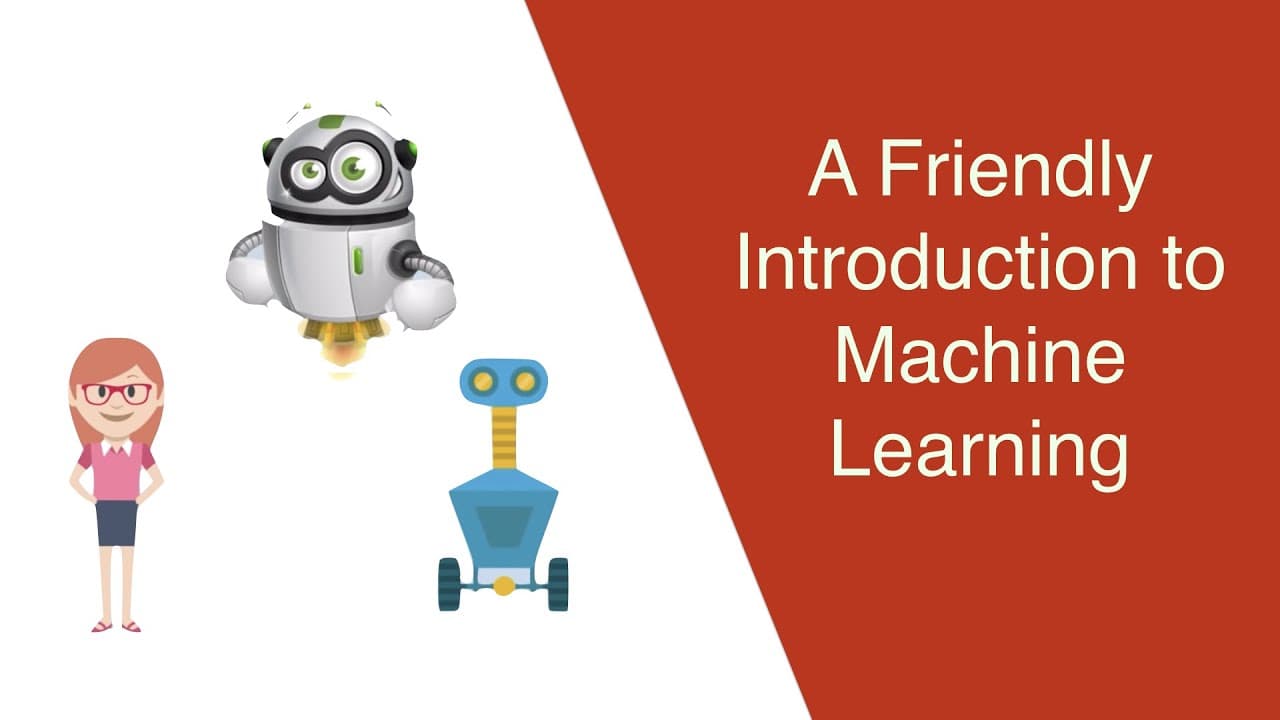
Machine learning allows computers to learn from data, mimicking human learning from experience. Key algorithms include linear regression for predictions, naive Bayes for classification, decision trees for decision-making, logistic regression for binary outcomes, and clustering for grouping data. This introduction demystifies these concepts with practical examples, making machine learning accessible to beginners.
Transcript
hi and welcome to the machine learning P degree from udasi so we're going to talk about today is what is machine learning well this is the world and in the world we got humans and we got computers and one of the main differences between humans and computers is that humans learn from past experience whereas computers need to be told what to do they ... Read More
Key Insights
- Machine learning enables computers to learn from data, similar to how humans learn from experience.
- Linear regression predicts outcomes by finding the best-fitting line through data points.
- Gradient descent is used to minimize errors in linear regression by iteratively adjusting the line.
- Naive Bayes classifies data by calculating probabilities based on features like keywords in emails.
- Decision trees make predictions by splitting data into branches based on feature values.
- Logistic regression models binary outcomes by finding a line that separates data into two classes.
- Neural networks use layers of nodes to capture complex patterns and relationships in data.
- Support vector machines find a hyperplane that best separates data points into different classes.
Install to Summarize YouTube Videos and Get Transcripts
Explore YouTube Video Summarizer or Get YouTube Transcript Extractor
Questions & Answers
Q: How does linear regression work in machine learning?
Linear regression predicts outcomes by finding the best-fitting line through data points. This line is determined by minimizing the sum of squared distances (errors) between the line and the data points. The method uses gradient descent to iteratively adjust the line, reducing the error to find the optimal fit.
Q: What is the purpose of gradient descent in machine learning?
Gradient descent is used to minimize errors in models like linear regression. It works by iteratively adjusting the model parameters to reduce the difference between predicted and actual values. This optimization technique helps find the optimal solution by gradually descending the error landscape.
Q: How does naive Bayes classify data?
Naive Bayes classifies data by calculating the probability of each class based on the presence of certain features. It assumes independence between features, making it efficient for text classification tasks like spam detection. The algorithm uses prior probabilities and likelihoods to determine the most probable class for a given input.
Q: What is a decision tree in machine learning?
A decision tree is a model that makes predictions by splitting data into branches based on feature values. Each node in the tree represents a decision point, and each branch represents an outcome. The tree is built by recursively partitioning the data, aiming to maximize the separation of classes at each split.
Q: How does logistic regression differ from linear regression?
Logistic regression models binary outcomes, predicting probabilities of class membership rather than continuous values. It finds a line (or hyperplane) that separates data into two classes. Unlike linear regression, which predicts exact values, logistic regression estimates the likelihood of a data point belonging to a particular class.
Q: What are neural networks used for in machine learning?
Neural networks are used to capture complex patterns and relationships in data. They consist of layers of interconnected nodes (neurons) that process input data and learn features through training. Neural networks are particularly effective for tasks like image recognition, natural language processing, and other applications requiring deep learning.
Q: How do support vector machines classify data?
Support vector machines classify data by finding a hyperplane that best separates data points into different classes. The algorithm optimizes the margin between the hyperplane and the nearest data points from each class, known as support vectors. This approach is effective for high-dimensional data and non-linear classification using kernel tricks.
Q: What is the purpose of clustering algorithms in machine learning?
Clustering algorithms group data into clusters based on similarity, optimizing placement or categorization. K-means clustering iteratively assigns data points to clusters, refining cluster centers until convergence. Hierarchical clustering builds a tree-like structure of nested clusters, allowing for flexible grouping without specifying the number of clusters upfront.
Summary & Key Takeaways
-
Machine learning allows computers to learn from data, mimicking human learning from experience. Algorithms like linear regression predict outcomes by finding the best-fitting line through data points. Gradient descent is used to minimize errors in linear regression by iteratively adjusting the line.
-
Naive Bayes classifies data by calculating probabilities based on features like keywords in emails. Decision trees make predictions by splitting data into branches based on feature values. Logistic regression models binary outcomes by finding a line that separates data into two classes.
-
Neural networks use layers of nodes to capture complex patterns and relationships in data. Support vector machines find a hyperplane that best separates data points into different classes. Clustering algorithms group data into clusters based on similarity, optimizing placement or categorization.
Read in Other Languages (beta)
Share This Summary 📚
Summarize YouTube Videos and Get Video Transcripts with 1-Click
Try YouTube Summary with ChatGPT & Claude or YouTube Transcript Generator
Explore More Summaries from Serrano.Academy 📚
Summarize YouTube Videos and Get Video Transcripts with 1-Click
Try YouTube Summary with ChatGPT & Claude or YouTube Transcript Generator