How to engineer design skills with sub agents
TL;DR
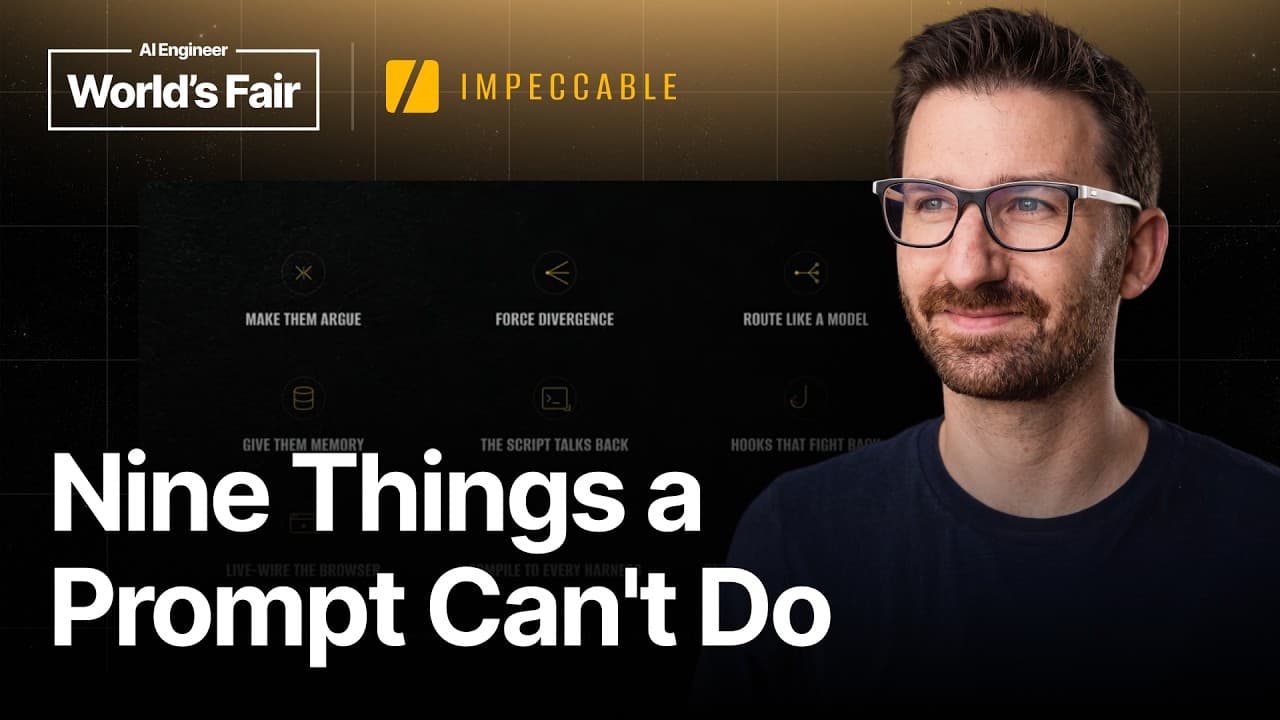
Prompting is just the starter level, but true skill engineering treats skills as extensions of the harness. The talk shows how to use adversarial prompting, memory, and structured hooks to improve design outcomes and enforce balanced critique. It covers forcing divergence, memory handling, and deploying multiple sub agents to critique and guide design decisions.
Transcript
Hello everybody. How's it going? Okay, I think we still have some people trickling in, but I'm super excited to be here. Okay, first off, let me reload these slides because my claw code was still building something on it. Um, okay. So, the contrast is a little bit low. Um, so please bear with me. I'm going to try to cover uh what you cannot read as... Read More
Key Insights
- The median is the model's gravity, meaning even many lines of crafted prose cannot overcome the model defaults and tendencies. This underscores why prompting alone often fails to produce durable results.
- Prompting is only the starter level; harness engineering is needed to extend the capabilities of the used harness, making skills act as integrated tools rather than standalone prompts.
- Two blind sub agents beat a single confident guess by providing diverse independent critiques, reducing the risk of a biased self-assessment and producing more balanced outcomes.
- Adversarial prompting introduces a critique loop where one agent challenges another, encouraging the system to surface issues that a single thread would overlook.
- Memory and state management are essential components of advanced skills, enabling the system to retain context and apply past learnings to current tasks.
- Structured outputs and explicit hooks, such as reports and browser evidence, improve reliability and traceability of the model’s reasoning and recommendations.
- Routing and forcing divergence instead of convergence helps avoid stagnation in a single line of thought, leading to more robust design decisions.
- The talk presents a practical workflow to turn prompts into a reusable design harness, including a starter kit and sample repos to try along the way.
Install to Summarize YouTube Videos and Get Transcripts
Explore YouTube Video Summarizer or Get YouTube Transcript Extractor
Questions & Answers
Q: What is meant by adversarial prompting in skill engineering
Adversarial prompting involves creating two sub agents that critique each other without seeing each other’s work. One acts as a design director examining hierarchy and heuristics, while the other runs a deterministic detector and collects browser evidence. The main thread then synthesizes the results, producing a more balanced critique than a single agent could provide. This avoids biased self-assessment and surfaces issues that might be overlooked in a single thread. By separating critique and evaluation, the system achieves more reliable design feedback and better-informed decisions.
Q: Why is prompting alone not enough for reliable design work
Prompting alone tends to be a starter level approach because the model’s gravity pulls toward familiar patterns and safe predictions. Even extensive prompts cannot overcome the model’s intrinsic tendencies, and a purely prompt-based workflow can produce slop or rely on target-shifting ideas. By contrast, harness engineering treats prompts as components of a larger system with memory, sub agents, and structured outputs, enabling more consistent, testable, and adaptable results across iterations.
Q: How does memory factor into skill engineering
Memory in skill engineering stores context and past interactions so that the system can apply prior learnings to new tasks. This helps avoid repeating the same mistakes or regressing to earlier, less effective patterns. With memory, skills can adapt over time, maintain coherence across steps, and support more complex workflows, such as iterative design reviews or long-running design projects, by recalling previous evidence, criteria, and decisions.
Q: What is the role of two blind sub agents in the workflow
Two blind sub agents perform independent analyses to avoid shared biases. One acts as a design director, evaluating hierarchy and slop, while the other runs a deterministic detector and gathers browser evidence. The main thread then merges these independent perspectives into a single, balanced critique. This separation helps surface issues that a single agent might miss and provides a more nuanced assessment of the design.
Q: What does forcing divergence achieve in the model’s reasoning
Forcing divergence prevents premature convergence on a single solution. By encouraging different lines of thought and disjoint evaluations, the model explores alternative design paths, uncovers edge cases, and reveals potential weaknesses. This leads to more robust decisions and reduces the risk that the final outcome relies on a narrow or biased viewpoint.
Q: How are hooks and outputs used to improve reliability
Hooks and explicit outputs such as browser evidence and structured reports are used to guide the model’s behavior and make its reasoning more traceable. This improves reliability by providing clear criteria, checkpoints, and external references that can be reviewed or tested. By emitting outputs to a standard channel rather than hiding them in prose, models can be cached, reused, and audited more easily.
Q: What is meant by treating a skill as an extension of the harness
Treating a skill as an extension of the harness means designing it to operate as a tool within the broader system rather than as a standalone prompt. Such skills integrate with other components, memory, and sub agents to extend capabilities, enabling the user to perform more complex tasks with greater consistency and reusability. The approach shifts focus from crafting perfect prompts to building a cohesive, end-to-end workflow.
Q: What practical resources does the talk offer for practitioners
The talk provides a starter kit and a sample repository with a starter folder and demos to help practitioners experiment with the dark arts of skill engineering. It also shows how to replicate the concepts in real projects, such as a mini impeccable or design review workflows, guiding users step by step from prompting to harness-based tooling.
Summary & Key Takeaways
-
The talk argues that prompting alone is insufficient and that skills should extend the harness to be more capable than single prompts. It outlines a shift from static prompts to dynamic, multi-agent systems that can remember, critique, and steer design work.
-
It demonstrates a design critique workflow that uses two blind sub agents plus a main thread to avoid biased self-assessment, yielding more balanced feedback and higher quality outputs.
-
It emphasizes practical techniques and a starter kit with demos to help practitioners implement the dark arts of skill engineering in real projects.
Read in Other Languages (beta)
Share This Summary 📚
Summarize YouTube Videos and Get Video Transcripts with 1-Click
Try YouTube Summary with ChatGPT & Claude or YouTube Transcript Generator
Explore More Summaries from AI Engineer 📚


Summarize YouTube Videos and Get Video Transcripts with 1-Click
Try YouTube Summary with ChatGPT & Claude or YouTube Transcript Generator