How to Master Storytelling with Story Loops
TL;DR
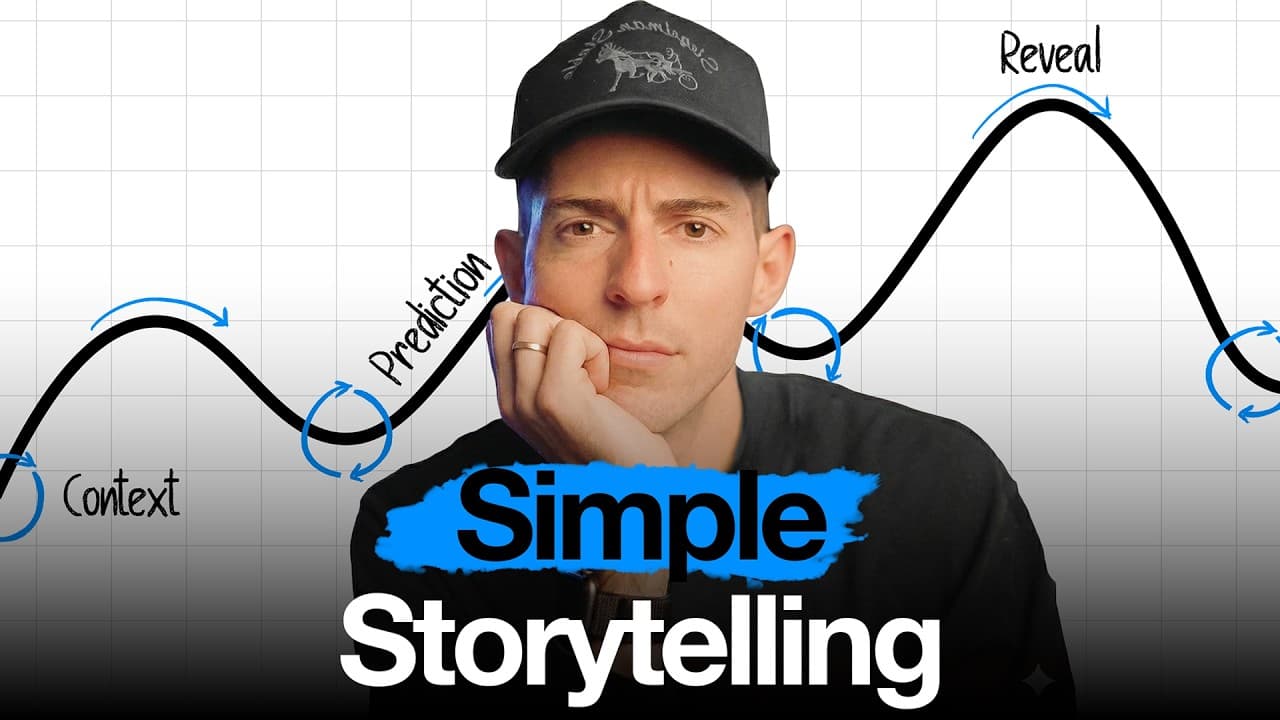
Master storytelling by building a narrative from story loops, each with two parts: clear context that creates curiosity and a reveal that delivers the payoff. Stringing multiple loops together creates the smaller rises and falls that sustain attention within a traditional story arc. The framework works across movies, speeches, YouTube videos, sales presentations, emails, and campfire stories. Read on for the reveal types and practical steps.
Transcript
Today we're talking about storytelling. If you want your content to perform better, you have to learn how to tell better stories. And here's the truth that may surprise you. Every great story uses the exact same storytelling framework. Whether you're Christopher Nolan making movies or Nolan Christopher around the fire, this one super simple framewo... Read More
Key Insights
- Story loops are a storytelling framework that enhances audience engagement by creating a series of context and reveal moments.
- Each story loop consists of two parts: the context, which sets the stage, and the reveal, which delivers the payoff.
- Effective storytelling involves creating curiosity in the audience's mind, prompting them to predict what will happen next.
- There are five types of reveals: worse than expected, neutral, better than expected, unexpected but confusing, and unexpected but intriguing.
- The most engaging reveals are those that are better than expected or unexpected but intriguing, as they release dopamine in the viewer's brain.
- A successful story uses multiple story loops stitched together to create a cohesive narrative arc.
- The context must be clear and relatable to ensure the reveal is impactful and exceeds audience expectations.
- Story loops can be applied to various storytelling formats, including movies, speeches, videos, and written content.
Install to Summarize YouTube Videos and Get Transcripts
Explore YouTube Video Summarizer or Get YouTube Transcript Extractor
Questions & Answers
Q: How can you master storytelling with story loops?
Build your story from multiple loops, with each loop opening through clear context and closing with a reveal. Identify interesting reveal points, work backward to establish the necessary context, and connect enough loops to form a compelling broader narrative.
Q: What are the two parts of a story loop?
A story loop has two parts: context and reveal. The context opens the loop by establishing a fact, question, or detail, while the reveal closes it with a payoff.
Q: How do story loops keep an audience engaged?
Clear context helps viewers understand the situation and begin predicting what will happen next. The reveal then resolves that curiosity, and another loop opens to continue the story’s sequence of smaller rises and falls.
Q: Why must the context in a story loop be clear?
Viewers need to understand the context before they can become curious about what happens next. If the details seem disconnected, viewers may become confused, bored, and leave rather than continue watching or listening.
Q: What can be used to establish context in a story loop?
Context can begin with an establishing fact, an opening question, or a declarative detail. Whatever form it takes, it must communicate a situation clearly enough for the audience to understand its meaning.
Q: What are the five types of reveals in story loops?
The five reveal types are worse than expected, neutral, better than expected, unexpected but confusing, and unexpected but intriguing. Better-than-expected and unexpected-but-intriguing reveals are presented as the most engaging because they stimulate curiosity and dopamine release.
Q: How are story loops different from the traditional story arc?
The traditional arc describes the broad path of introduction, rising action, climax, falling action, and resolution, but it offers limited tactical guidance about what to say. Story loops operate inside that arc as smaller context-and-reveal cycles that create repeated rises and falls.
Q: Where can the story-loop framework be used?
Story loops can improve many formats, including movies, nursery rhymes, public speeches, YouTube videos, sales presentations, emails, and campfire stories. The same context-and-reveal structure can be repeated throughout each format to sustain audience interest.
Summary & Key Takeaways
-
Story loops are essential for engaging storytelling, consisting of context and reveal moments that keep the audience intrigued. By setting clear context and delivering compelling reveals, storytellers can create curiosity and surprise, enhancing the overall narrative experience.
-
The effectiveness of a story loop depends on the type of reveal: better than expected or unexpected but intriguing reveals are most engaging. These reveals stimulate curiosity and dopamine release, motivating the audience to continue engaging with the story.
-
To apply story loops effectively, storytellers should identify interesting reveal points and work backward to establish the necessary context. This ensures a cohesive narrative that captivates the audience and maintains their attention throughout the story.
Read in Other Languages (beta)
Share This Summary 📚
Summarize YouTube Videos and Get Video Transcripts with 1-Click
Try YouTube Summary with ChatGPT & Claude or YouTube Transcript Generator
Explore More Summaries from Kallaway 📚





Summarize YouTube Videos and Get Video Transcripts with 1-Click
Try YouTube Summary with ChatGPT & Claude or YouTube Transcript Generator