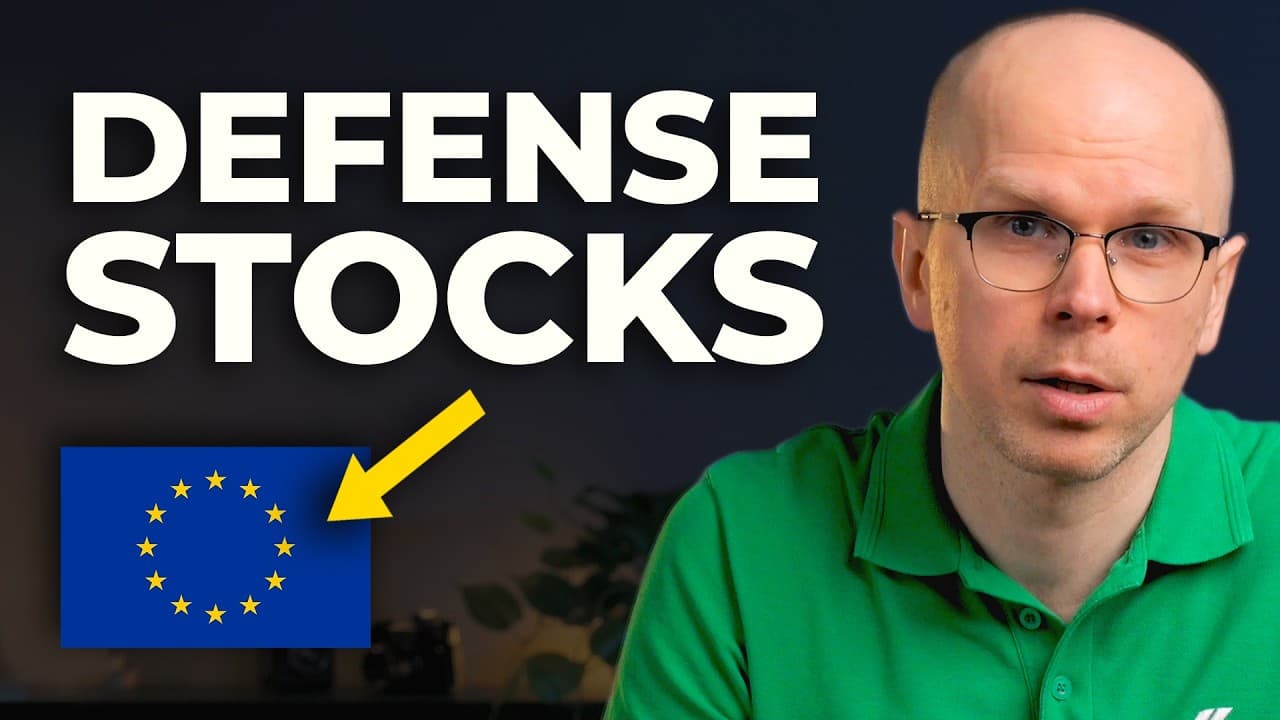
Are European Defense Stocks Worth Buying Now?
TL;DR
European defense companies may benefit from rising military spending, reduced confidence in United States security guarantees, and demand for strategically reliable European equipment. However, their share prices already reflect substantial optimism. Pricing risk, poor sector timing, and the uneven distribution of stock market returns support using diversified global index funds instead of concentrating heavily in defense stocks.
Transcript
now that Donald Trump is pulling support from Ukraine questioning the future of NATO and hinting at invading Greenland European countries are waking up and getting ready to spend big on defense the European Union has announced an 800 billion Euro defense spending plan other European countries are doing the same and because so much money is getting ... Read More
Key Insights
- European defense spending is expected to rise because Russia's invasion of Ukraine ended confidence that lasting peace could be assumed, while Russia's military spending reached $146 billion last year and reportedly matched combined European spending after adjusting for purchasing power.
- The United States security subsidy is viewed as ending because European countries can no longer confidently depend on American military protection. Donald Trump's remarks about Europe and Greenland, along with the sudden stoppage of support for Ukraine, increased pressure for Europe to finance its own defense.
- Strategic reliability is becoming a purchasing priority because the United States can potentially disable essential functionality in American missile systems and fighter jets. This dependence encourages European governments to direct more of their expanding defense budgets toward European manufacturers.
- Pricing risk is substantial because widely anticipated improvements can already be reflected in stock prices. Rheinmetall rose from under €100 before the 2022 war to around €1,300, while Thales, Leonardo, and Saab also experienced large increases from their earlier prices.
- A good company is not automatically a good investment because the purchase price determines the potential return. Defense stocks can perform poorly if current valuations already assume exceptional growth or if investor enthusiasm has pushed prices above the companies' underlying value.
- Investor timing is a persistent performance problem because people tend to add money after prices rise and withdraw it during difficult periods. Morningstar's 2024 report found a 2.6 percentage point annual gap between sector fund returns of 9.6% and investor returns of 7%.
- A European defense ETF illustrates industry timing risk because WisdomTree launched the first such ETF listed on justETF.com in March 2025, after defense shares had already become much more expensive and public interest in the sector had grown.
- Broad global diversification reduces skewness risk because market profits are unevenly distributed among companies and industries that are difficult to identify beforehand. Owning the whole market ensures exposure to successful stocks and sectors without depending on a narrow defense allocation.
Install to Summarize YouTube Videos and Get Transcripts
Explore YouTube Video Summarizer or Get YouTube Transcript Extractor
Questions & Answers
Q: Why could European defense companies earn more money?
European defense companies could benefit from three forces identified in the analysis: Russia's growing military threat, declining confidence in United States security guarantees, and demand for strategically reliable European weapons. Europe is preparing to spend more on defense, including an announced European Union plan of €800 billion, and much of that spending is expected to go to European manufacturers rather than American suppliers.
Q: How does Russia affect European defense spending?
Russia's invasion of Ukraine in 2022 ended the assumption that war in Europe was effectively a solved problem. European countries became concerned that Russia might eventually threaten other Eastern European states. Russia also increased its military spending to $146 billion last year, an amount described as matching all European spending combined when adjusted for lower Russian purchasing costs.
Q: Why is Europe becoming less dependent on United States security guarantees?
European countries historically spent less on their own defense because they could rely on the United States military for protection. Donald Trump's unpredictable decisions, hostile remarks about Europe, comments about Greenland, and sudden stoppage of support for Ukraine made that reliance appear unsafe. The resulting conclusion is that Europe must spend substantially more to provide for its own security.
Q: Why might Europe buy more weapons from European manufacturers?
Reliance on American military technology creates strategic risk because the United States can potentially disable important functionality in missile systems and fighter jets. A country could spend billions on equipment and later lose essential capabilities if a future American president disagrees with its policies. European governments may therefore favor domestic suppliers as defense budgets rise, keeping more spending within Europe.
Q: Why can rising defense profits still produce poor stock returns?
Higher corporate profits do not guarantee attractive investment returns because stock prices incorporate widely known expectations. European defense shares have already risen sharply, with Rheinmetall moving from under €100 before the 2022 war to around €1,300. A buyer now needs future company value to exceed the optimism already reflected in the price, and excessive enthusiasm could leave some shares overpriced.
Q: What is sector timing risk in defense investing?
Sector timing risk is the danger of buying an industry after enthusiasm and prices have already surged, then selling when conditions weaken. Morningstar's 2024 research reported that sector funds returned an average of 9.6% annually, while their investors earned only 7%. The 2.6 percentage point gap was linked to unsuccessful attempts to rotate between industries at favorable times.
Q: What does skewness mean for a defense stock portfolio?
Skewness means that stock market gains are distributed unevenly rather than shared equally among every company and industry. The cited research found that the average American stock lost money over time and that the average industry underperformed the market. A portfolio concentrated in defense could therefore miss the small group of other industries and companies responsible for much of the market's wealth creation.
Q: What investment strategy can reduce the risks of defense stocks?
A diversified global index fund or ETF can reduce the risks created by concentrating on one industry. Buying the broad market provides exposure to many companies and sectors, ensuring that the portfolio includes successful stocks and industries even when they cannot be predicted beforehand. The tradeoff is giving up the possibility of an exceptional gain from correctly selecting one winning industry.
Summary & Key Takeaways
-
European defense companies have three major potential growth drivers. Russia has increased military spending, Europe can no longer assume that the United States will always guarantee its security, and European governments increasingly recognize the strategic risks of relying on American weapons that could lose essential support or functionality after a political dispute.
-
The investment opportunity is less straightforward because defense share prices have already risen dramatically. Rheinmetall, Thales, Leonardo, and Saab were all many times more expensive than around the beginning of the Ukraine war. Investors therefore need to determine whether future profits exceed the optimistic expectations already embedded in current market prices.
-
Concentrating on defense stocks introduces pricing, timing, and skewness risks. Investors frequently enter popular sectors after prices rise, while market wealth creation tends to come from a small number of unpredictable winners. The preferred strategy presented is broad global diversification, which ensures exposure to successful companies and industries without requiring accurate sector forecasts.
Read in Other Languages (beta)
Share This Summary 📚
Summarize YouTube Videos and Get Video Transcripts with 1-Click
Try YouTube Summary with ChatGPT & Claude or YouTube Transcript Generator
Explore More Summaries from Tom Crosshill 📚


Summarize YouTube Videos and Get Video Transcripts with 1-Click
Try YouTube Summary with ChatGPT & Claude or YouTube Transcript Generator