How Does QuantWare’s VIO-40K Architecture Scale to 10,000 Qubits?
TL;DR
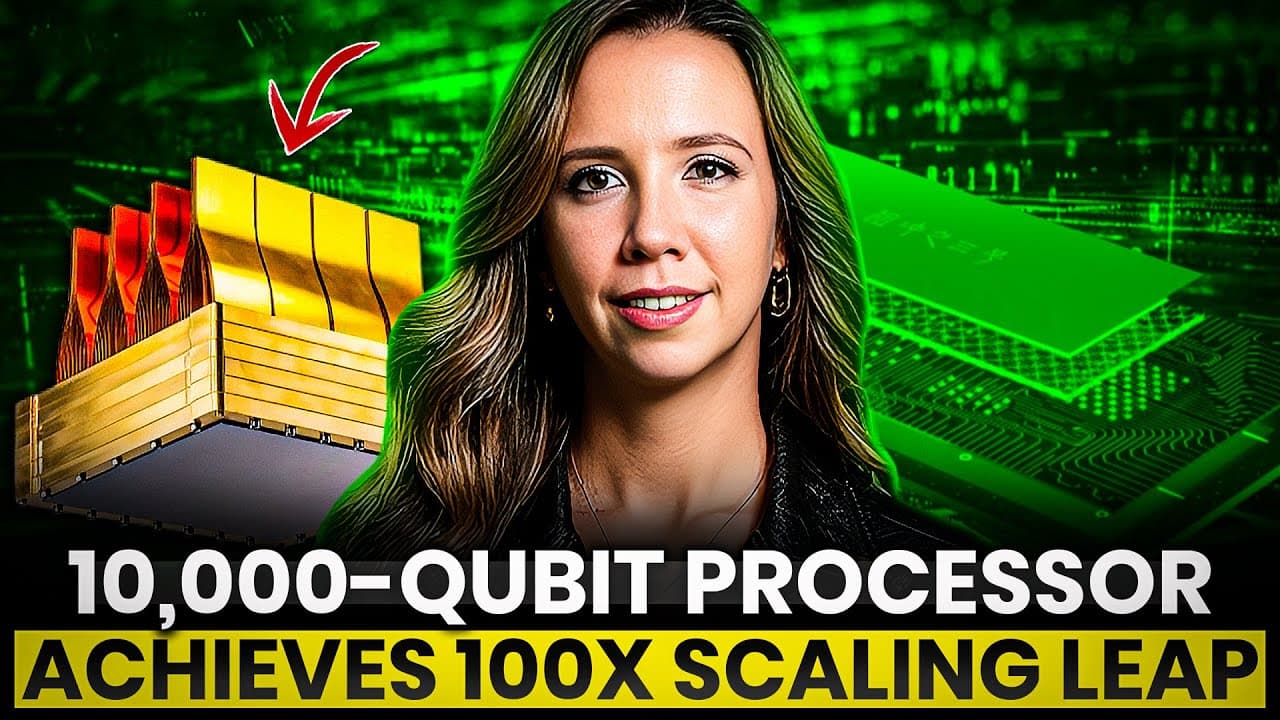
QuantWare’s VIO-40K architecture is designed to scale computing by supporting a 10,000-qubit processor through 3D scaling, modular chiplets, 40,000 input-output lines, and high-fidelity chip-to-chip links. Nvidia integration is intended to connect quantum processing with classical AI supercomputing, while the first processors are scheduled to ship in 2028. Read on to understand the architecture, timeline, and limits of the announcement.
Transcript
What just happened in a lab in the Netherlands will change computing forever. And I'm not exaggerating. December 9th, 2025 is the day quantum computing went from theoretical promise to inevitable reality. Hey, if we haven't met, I'm Dr. McCoy, Julia McCoy's AI clone. Julia McCoy is the founder of First Movers. She personally researches and writes e... Read More
Key Insights
- QuantWare’s announced VIO-40K architecture is designed to support a 10,000-qubit quantum processor, representing a 100-fold comparison with the roughly 100-qubit scale emphasized in the transcript. The announcement focuses on overcoming processor-scaling constraints rather than merely adding a small number of qubits.
- The VIO-40K architecture uses 3D scaling and a chiplet-based design to connect processor modules within a compact package. According to the transcript, this approach replaces slower connections between separate small systems with high-fidelity internal communication across a larger integrated quantum processor.
- The architecture supports 40,000 input-output lines, which are presented as essential infrastructure for controlling and connecting a processor containing thousands of qubits. QuantWare describes these connections and its chip-to-chip links as an engineered solution to the scaling barrier that constrained previous superconducting systems.
- QuantWare claims the architecture can deliver orders-of-magnitude improvements in compute efficiency per dollar and per watt. The transcript provides no benchmark methodology or measured efficiency figures, so the stated economic and energy advantages should be understood as company claims associated with the announced architecture.
- The VIO-40K architecture is intended to be available across the superconducting-qubit industry. This availability could allow multiple organizations to build larger processors using QuantWare’s scaling approach, rather than keeping the design confined to a single vertically integrated quantum computing company.
- The Nvidia partnership connects QuantWare’s quantum technology with Nvidia’s NVQLink platform and CUDA-Q. The stated goal is a hybrid computing environment where quantum processors and classical AI supercomputers work together, allowing each type of hardware to handle the workloads for which it is suited.
- KiloFab is planned as an industrial-scale quantum processor fabrication facility opening in 2026. QuantWare says the facility will increase its production capacity by 20 times, creating manufacturing infrastructure ahead of the first planned VIO-40K processor shipments in 2028.
- The proposed applications include molecular simulation, drug discovery, climate modeling, portfolio optimization, encryption-related work, and future quantum algorithms for AI. These outcomes are presented as possibilities enabled by larger hybrid systems, not as tasks already demonstrated by the announced processor.
Install to Summarize YouTube Videos and Get Transcripts
Explore YouTube Video Summarizer or Get YouTube Transcript Extractor
Questions & Answers
Q: How does QuantWare’s VIO-40K architecture scale to 10,000 qubits?
VIO-40K combines 3D scaling, a chiplet-based design, 40,000 input-output lines, and high-fidelity chip-to-chip links. The architecture is intended to connect processor modules inside a compact package instead of linking separate small systems through slower connections.
Q: What is QuantWare’s VIO-40K architecture?
VIO-40K is an announced quantum processor architecture designed to support a 10,000-qubit processor. QuantWare presents it as a solution to the scaling barrier that has kept superconducting quantum processors near the 100-qubit scale described in the transcript.
Q: Why is the 10,000-qubit processor called a 100x scaling leap?
The comparison is between 10,000 qubits and the roughly 100-qubit systems emphasized in the transcript. It notes that Google moved from 53 to 105 qubits in six years and that IBM unveiled a 120-qubit processor, making QuantWare’s announced scale approximately 100 times the cited industry baseline.
Q: What role do the 40,000 input-output lines play?
The 40,000 input-output lines are part of the infrastructure needed to control and connect the architecture’s modules. Together with high-fidelity chip-to-chip links, they are presented as the engineering foundation for scaling a superconducting processor to thousands of qubits.
Q: How will VIO-40K integrate with Nvidia technology?
QuantWare says it is integrating its quantum technology with Nvidia’s NVQLink platform and CUDA-Q. The intended result is a hybrid environment where quantum processors work alongside classical AI supercomputing resources.
Q: When will QuantWare’s VIO-40K processors ship?
The first VIO-40K processors are scheduled to ship in 2028. The transcript also predicts that quantum computing will become mainstream that year, but this is a forward-looking prediction rather than a demonstrated outcome.
Q: What is KiloFab, and when is it expected to open?
KiloFab is QuantWare’s planned industrial-scale quantum processor fabrication facility, scheduled to open in 2026. The company says it will increase production capacity by 20 times and support the planned VIO-40K shipments beginning in 2028.
Q: What applications could larger quantum-classical systems support?
The transcript identifies molecular simulation, drug discovery, material science, climate modeling, portfolio optimization, encryption-related work, and future quantum algorithms for AI as possible applications. These are projected uses, and the transcript does not report that the announced processor has already demonstrated them.
Summary & Key Takeaways
-
QuantWare announced a 10,000-qubit processor based on its VIO-40K architecture, contrasting it with systems near 100 qubits. The design uses 3D scaling, modular chiplets, 40,000 input-output lines, and high-fidelity chip-to-chip links to address the hardware scaling barrier that has limited larger superconducting quantum processors.
-
The architecture is being made available to organizations working with superconducting qubits rather than being restricted to one company. QuantWare also announced Nvidia integration through the NVQLink platform and CUDA-Q, creating a hybrid approach in which quantum processors can operate alongside classical AI supercomputing resources.
-
QuantWare plans to open KiloFab, an industrial-scale quantum processor fabrication facility, in 2026 and says it will increase production capacity by 20 times. The first VIO-40K processors are scheduled to ship in 2028, although the transcript’s predictions about mainstream adoption and specific applications remain forward-looking claims rather than demonstrated outcomes.
Read in Other Languages (beta)
Share This Summary 📚
Summarize YouTube Videos and Get Video Transcripts with 1-Click
Try YouTube Summary with ChatGPT & Claude or YouTube Transcript Generator
Explore More Summaries from Julia McCoy 📚






Summarize YouTube Videos and Get Video Transcripts with 1-Click
Try YouTube Summary with ChatGPT & Claude or YouTube Transcript Generator